

What You Should Know
Clinical AI pioneer Ambience Healthcare has announced a major expansion of its inpatient intelligence platform with the launch of Nursing Summary and Ambient Flowsheet Documentation.Combined with its previously released Chart Chat for Nursing, the new applications establish a single, comprehensive system of intelligence supporting bedside nurses from pre-shift preparation through post-intervention charting.The expanded platform targets the severe cognitive load and
Read More
HHS and Secretary Robert F. Kennedy, Jr. Launch Operation Trialblazer to Modernize Clinical Trials

What You Should Know
The U.S. Department of Health and Human Services (HHS), under Secretary Robert F. Kennedy, Jr., has unveiled "Operation Trialblazer," a sweeping, department-wide initiative designed to bring clinical research and investment back to the United States.The strategic pivot addresses an alarming competitive gap: China's global share of Phase 1 trials surpassed the U.S. for the first time in 2021, and in 2024, China exceeded the U.S. in total clinical trial registrations with
Read More
ChartSpan Acquires Personal Health Data Platform Validic to Scale Remote Patient Monitoring

What You Should Know
Care management pioneer ChartSpan has finalized the strategic acquisition of Validic, a provider of personal health data and Internet of Things (IoT) platform.The combined entity, operating under the ChartSpan banner, creates a unified delivery layer that merges full-service clinical care teams with a scaled device-logistics and data-normalization ecosystem.The transaction bridges a severe healthcare data gap, combining traditional Chronic Care Management (CCM) and
Read More
Adonis Launches AI-Powered Revenue Cycle Orchestration in Epic Connection Hub
What You Should Know
AI-driven revenue cycle management (RCM) pioneer Adonis has officially launched its platform in the Epic Connection Hub, enabling health systems to deploy its intelligence layer directly over their native Epic environments.The strategic deployment addresses severe operational strain inside health system billing offices, where teams are frequently left to reactively mine thousands of disjointed, legacy administrative work queues.Instead of replacing foundational systems of
Read More
Thoreau Enters Definitive Agreement for Strategic Growth Investment in Ensemble Health Partners

What You Should Know
Revenue cycle managed services leader Ensemble Health Partners has announced a definitive agreement for a strategic growth investment from Thoreau, the healthcare investment platform founded by veteran private equity executive Matt Holt.The transaction values Ensemble at an estimated $12 billion, positioning the newly launched, Apollo Global Management-backed Thoreau platform at the epicenter of scaled healthcare administrative outsourcing.Legacy institutional
Read More
Kinomatic Secures $4M to Expand AI-Enabled Surgical Planning Platform

What You Should Know
Orthopedic technology innovator Kinomatic has successfully finalized a $4M seed funding round led by healthcare-focused venture firm Waterline Ventures.The company has demonstrated significant commercial scale, documenting 7x revenue growth over four years, a 5x expansion in regional provider networks, and a world-class Net Promoter Score (NPS) of 85.Renowned orthopedic specialist and opioid-reduction advocate Dr. Andrew B. Wickline, MD, FAAOS, joins the executive
Read More
Opmed and Mayo Clinic Unveil Multimodal AI Platform at ACC.26 to Optimize Surgical Capacity

What You Should Know
Healthcare operations AI pioneer Opmed has announced the results of a multi-year collaborative study with the Mayo Clinic aimed at optimizing operating room (OR) efficiency.Presented at the ACC.26 (American College of Cardiology Expo), the study proves that Opmed's multimodal deep learning platform reduces cardiovascular (CV) procedure scheduling errors by approximately 50%.Traditional scheduling methods rely on historic human averages, generating an inaccurate status quo
Read More
Vali Health Emerges from Stealth with $6M to Scale Responsible AI Across Home Care EHRs

What You Should Know
San Francisco-based health technology innovator Vali Health has emerged from stealth with a $6M funding round led by Bonfire Ventures, Supernode, and Comma Capital.The financing features prominent backing from Jacquelyn Kung, co-founder of ClearCare (now WellSky), aligning the startup with deep clinical and operations software lineage.The platform tackles the acute, multi-layered "no-show crisis" impacting home care, where sudden caregiver call-outs leave vulnerable aging
Read More
Model N Acquires Kalderos to Expand 340B Capabilities and Gross-to-Net Analytics
What You Should Know
End-to-end life sciences revenue management pioneer Model N has announced its strategic acquisition of drug discount analytics platform Kalderos.The transaction consolidates Kalderos’ proprietary Truzo platform into Model N’s commercial infrastructure to provide real-time, claims-level visibility into complex 340B discount networks.Life sciences manufacturers face intensifying gross-to-net (GTN) pressures, driven by ongoing Medicare drug price negotiations,
Read More
Abridge Unveils AI-Native Clinician Intelligence Platform with Enterprise-Wide Northwestern Medicine Rollout
What You Should Know
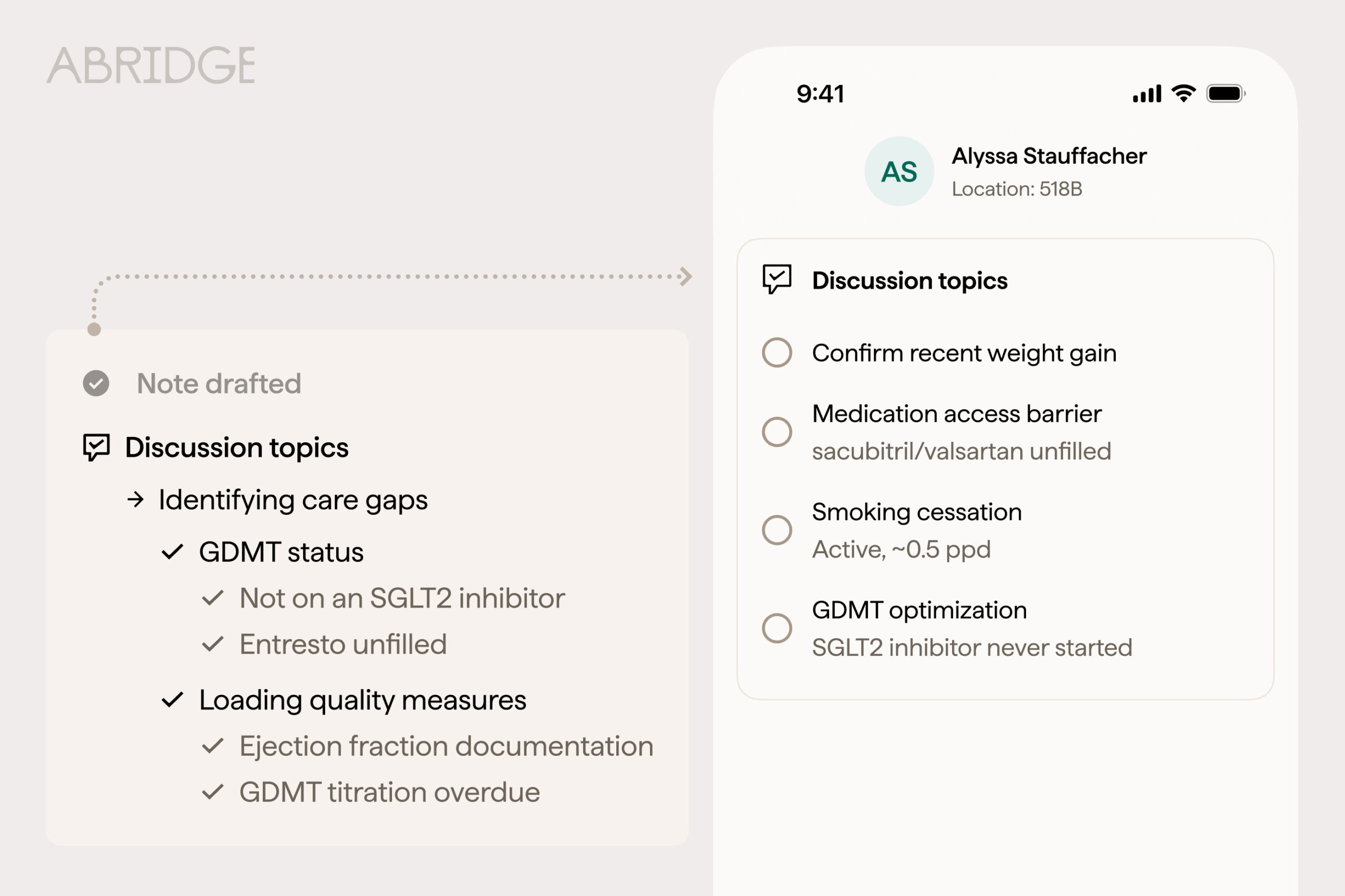
At its keynote in New York City, generative AI pioneer Abridge unveiled the first AI-native clinician intelligence platform built to orchestrate clinical, financial, and evidence-based decisions.The expansion shifts Abridge from a passive, post-visit ambient documentation tool to an active, end-to-end intelligence layer spanning pre-visit chart synthesis, intra-visit clinical decision support, and real-time billing codes.Expanding its inpatient care footprint, Abridge
Read More
