
What You Should Know
- At its keynote in New York City, generative AI pioneer Abridge unveiled the first AI-native clinician intelligence platform built to orchestrate clinical, financial, and evidence-based decisions.
- The expansion shifts Abridge from a passive, post-visit ambient documentation tool to an active, end-to-end intelligence layer spanning pre-visit chart synthesis, intra-visit clinical decision support, and real-time billing codes.
- Expanding its inpatient care footprint, Abridge announced a system-wide enterprise implementation at Northwestern Medicine, alongside clinical nursing integrations validated to slash vacancy rates and reduce overtime by 70%.
- The platform targets administrative waste by collaborating with commercial payers like Aetna and Cigna to anchor documentation, medical coding, and real-time claims directly within natural bedside conversations.
- Partnering with NVIDIA, Abridge is training a custom, clinically reasoning foundation model built on the NVIDIA Nemotron open frontier family and powered by NVIDIA Blackwell AI infrastructure.
The market for generative AI applications inside American health systems is navigating an aggressive structural shakeout. For the past two years, hospital boards and healthcare IT procurement committees have deployed lightweight ambient audio tools to mitigate an escalating clinician burnout crisis. While these point solutions successfully automated basic clinical documentation, they frequently hit a performance ceiling. Most ambient “scribes” operate as isolated software layers over the Electronic Health Record (EHR)—capturing dictation but remaining completely detached from real-time revenue cycles, point-of-care clinical decision support, and cross-functional team workflows.
When digital health tools act merely as passive administrative recorders rather than active care orchestrators, data fragmentation persists. Clinical documentation, billing codes, and downstream commercial insurance claims continue to be processed and audited over separate, multi-week cycles. This lag forces providers and insurance payors into an expensive, adversarial loop of retroactive denials, claim re-work, and uncaptured legitimate revenue. To insulate operating margins and protect care continuity, the health technology market must transition away from lightweight, single-user apps toward a centralized, native intelligence platform that can ground every financial, operational, and clinical decision in the trusted conversation between a clinician and a patient.
To establish this unified platform architecture, generative AI market leader Abridge has unveiled its AI-native clinician intelligence platform at its keynote event in New York City. Now live across more than 300 health systems and supporting over 100 million annual clinical conversations, the company has detailed a sweeping structural expansion. Backed by an enterprise-wide rollout at Chicago’s premier academic health system, Northwestern Medicine, Abridge is re-engineering healthcare delivery by connecting point-of-care clinical workflows directly to real-time claims reconciliation and custom foundation models.
Moving Beyond Documentation: Preserving Care Continuity Before, During, and After the Visit
The updated Abridge platform architecture systematically expands the capabilities of generative AI to support the entire, continuous care loop rather than just the post-visit summary. The platform is engineered to function as an automated intelligence layer that moves natively with the care team across three distinct operational zones:
Before the Visit
Abridge actively reviews the patient’s longitudinal chart journey to draft specialty-tailored pre-charted notes, histories of present illness (HPI), and precise pre-round summaries that ingest information from emergency department data logs, laboratory metrics, and prior clinical interactions. By surfacing critical chronic conditions and documenting gaps before a clinician walks into the exam room, it eliminates the need for exhausting retrospective chart mining.
During the Visit
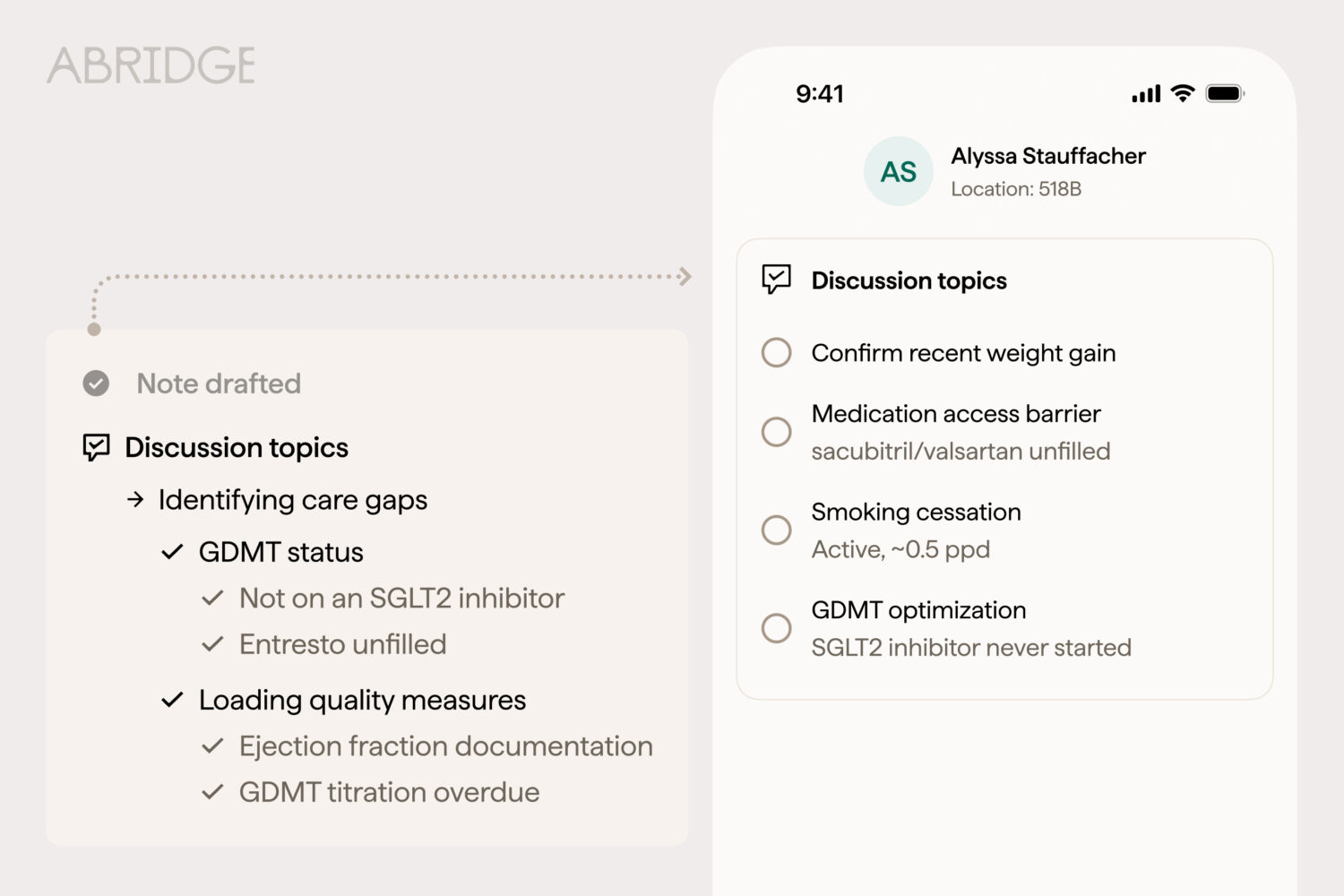
The application transitions from a passive recorder to an active assistant. By dynamically evaluating the ongoing patient dialogue against a built-in library of medical evidence—enriched by direct collaborations with the American Diabetes Association, the American Academy of Family Physicians, and Wolters Kluwer’s UpToDate—Abridge surfaces context-aware discussion topics and evidence-based queries in real time. It enables doctors to safely deliver highly informed care without shifting browser tabs or losing direct eye contact with the patient.
After the Visit
The platform translates natural speech recognition—validated in over 28 languages—into structured clinical outputs, billing codes, discrete flowsheets, and pharmacy orders. Clinicians can utilize a natural-language AI agent to instantly refine the drafted outputs before routing the documentation seamlessly into core EHR systems like Epic, Oracle Health, and athenahealth for final electronic signature.
Stabilizing the Inpatient Floor: Nursing Automations and Smart Room Integrations
A major structural milestone for the platform is its formal expansion into inpatient nursing workflows. Nurses bear the brunt of repetitive EHR charting burdens, a factor that drives severe workforce attrition and forces hospitals onto expensive temporary travel-agency contracts. By securely analyzing natural nurse-patient interactions at the bedside, Abridge automatically synthesizes structured draft charts tracking verbalized findings, educational touchpoints, and nursing interventions. This context carries forward across shift handoffs, providing the next clinician with an immediate, shared clinical picture.
The immediate financial return on investment (ROI) for this infrastructure layer is highly documented. Misti Foust-Cofield, Vice President and Chief Nursing Officer at Reid Health, revealed that rolling out Abridge helped bring their nursing vacancy rate down from an 18% crisis baseline to 8.6% with zero reliance on contract travel staff, while simultaneously cutting incidental clinical overtime by 70%. Given that retraining a single nurse costs approximately $100,000, the platform delivers millions in immediate operating capital protections to the balance sheet.
To further power the inpatient stay, Abridge has announced deep “smart room” hardware integrations with automation pioneers hellocare.ai and Artisight, alongside system-wide deployments via UCHealth’s Virtual Health Center to completely automate routine monitoring and cognitive testing steps.
Dismantling the Claims Battlefield via Real-Time Adjudication
On a macroeconomic scale, Abridge’s platform expansion sets its sights on real-time claims and payment alignment. Historically, health systems and payors have weaponized advanced technology tools against one another—using separate AI engines to automatically generate denials and counter-appeals weeks after a medical procedure has occurred. Abridge disrupts this adversarial cycle by grounding documentation, diagnostic specificities, and billing codes in the actual audio truth of the encounter at the moment care is delivered.
To advance this vision, executive leaders from Johns Hopkins Health System, Emory Healthcare, Aetna, and Cigna Healthcare joined Abridge on stage to demonstrate a future of real-time adjudication. By establishing a shared, automated, and auditable data foundation, providers and insurers can collapse the distance between care delivery and claims settlement. This framework cuts administrative re-work, eliminates back-end denials, and ensures that premium dollars are routed directly to patient care rather than administrative overhead. To enforce strict data integrity across this network, Abridge has partnered with AHIMA (American Health Information Management Association) to rigorously audit and validate its automated coding and Clinical Documentation Improvement (CDI) models.
Custom Nemotron Models on NVIDIA Blackwell Infrastructure
To sustain this extensive operational layer across millions of active medical sessions, Abridge has partnered with computing leader NVIDIA to train a first-of-its-kind, domain-adapted foundation model for clinical conversations. Moving away from a reliance on opaque, general-purpose third-party LLMs, Abridge is building on the NVIDIA Nemotron open model family. This architecture grants complete visibility into model weights and training datasets, ensuring absolute data provenance, auditability, and security for strict HIPAA and GxP compliance.
The new foundation model is trained on NVIDIA’s Blackwell AI infrastructure, utilizing de-identified clinical data through advanced pre-, mid-, and post-training runs. By adapting the domain early in the training lifecycle, Abridge embeds native clinical reasoning directly into the foundation weights. This open architecture allows the platform to optimize for quality, processing speed, and compute costs at every layer—deploying specialized, highly efficient models calibrated for specific clinical tasks and workflows at scale. Kimberly Powell, Vice President of Healthcare at NVIDIA, noted that Nemotron provides the perfect open frontier architecture for this moment, giving Abridge the foundation to break new ground across the entire global healthcare ecosystem.
