
• Skip to main content
  • Skip to secondary menu
  • Skip to primary sidebar
  • Skip to secondary sidebar
  • Skip to footer

  • Opinion
  • Health IT
    • Behavioral Health
    • Care Coordination
    • EMR/EHR
    • Interoperability
    • Patient Engagement
    • Population Health Management
    • Revenue Cycle Management
    • Social Determinants of Health
  • Digital Health
    • AI
    • Blockchain
    • Precision Medicine
    • Telehealth
    • Wearables
  • Life Sciences
  • Investments
  • M&A
  • Value-based Care
    • Accountable Care (ACOs)
    • Medicare Advantage

KLAS 2026 EHR Market Share Report: Epic Gains as Oracle Health Faces Third Year of Losses

by Jasmine Pennic 05/14/2026 Leave a Comment

  • LinkedIn
  • Twitter
  • Facebook
  • Email
  • Print
KLAS 2026 EHR Market Share Report: Epic Gains as Oracle Health Faces Third Year of Losses
Source: KLAS Acute Market Share Report

What You Should Know

  • The number of hospitals impacted by EHR purchase decisions dropped 40% compared to 2024 and nearly 50% compared to 2023, according to a new KLAS 2026 EMR Market Share report.
  • Shift to AI: Health systems redirected capital toward technologies with immediate financial returns, specifically AI and operational efficiency solutions, rather than core EHR upgrades.
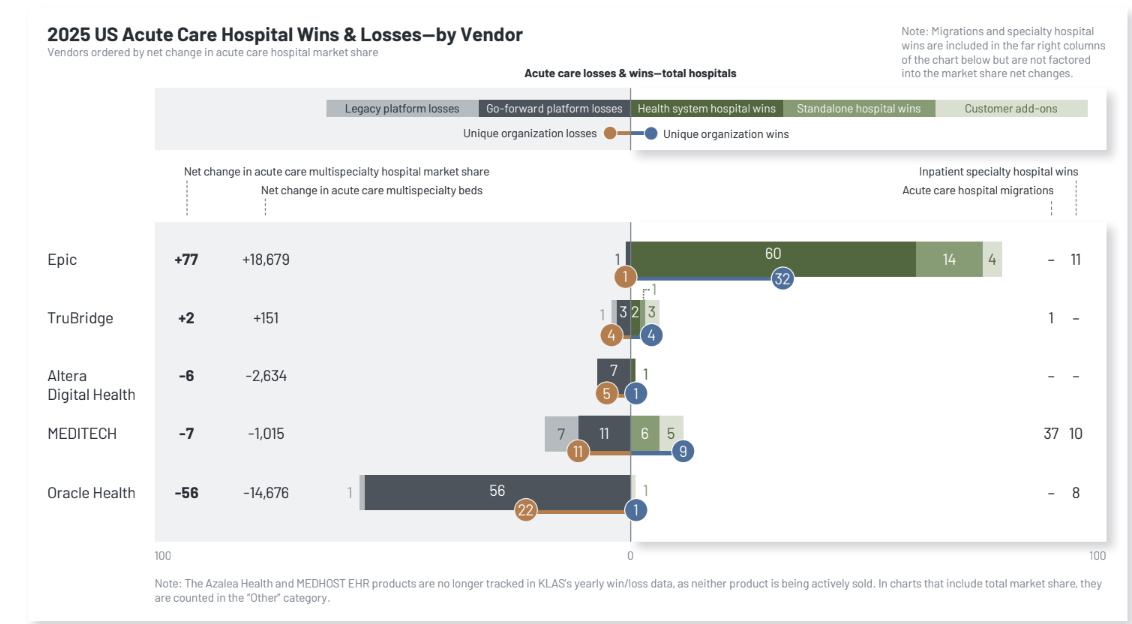
  • Epic Dominance: Epic was the only vendor selected by large health systems (>10 hospitals) in 2025 and added 77 hospitals and 18,679 beds to its multispecialty market share.
  • Oracle Health Volatility: Oracle Health saw its third consecutive year of major net losses, losing 56 hospitals and 14,676 beds.
  • MEDITECH Retention: MEDITECH achieved its strongest legacy customer retention to date, with 84% of customers choosing to migrate to the Expanse platform.

The U.S. acute care EHR market hit a significant “purchase freeze” in 2025. Driven by ongoing questions around government policy and a strategic pivot toward Artificial Intelligence, health systems largely deferred major EHR transitions. This market exhaustion resulted in a 40% year-over-year decline in decision-making energy, leaving many vendors struggling to maintain momentum.

For health systems that did move forward, the primary motivation was standardization. Epic emerged as the clear winner of this trend, broadening its footprint among smaller health systems and midsize standalone hospitals that were largely fleeing Oracle Health.

The Oracle Health Proofpoint: A Critical 2026

Oracle Health continues to face a period of intense volatility. Since the acquisition of Cerner, repeated layoffs and restructuring have contributed to a steady decline in customer satisfaction with the Millennium platform.

  • Market Erosion: Oracle Health saw the largest net loss in market share for the third year in a row.
  • Customer Fragility: Nearly one-third of sampled customers report that Oracle Health is not part of their long-term plans.
  • The AI Hope: 2026 is viewed as a pivotal year for the vendor as it launches its new AI-enabled EHR; its success is considered imperative for restoring market confidence.

Epic’s Strategic Expansion

As the overall market trended down, Epic successfully pivoted its strategy to capture smaller segments of the market.

  • Large System Lock: Only two large health systems made enterprise-wide decisions in 2025; both chose Epic.
  • Community Connect: Epic added seven standalone hospitals through its Community Connect offering, which allows smaller facilities to “tether” to a larger neighbor’s Epic instance.
  • Data Exchange: A key driver for hospitals switching to Epic was the desire for easier regional data exchange with existing partners.

The MEDITECH “Expanse” Migration

Despite the general decline in small standalone hospital purchasing, MEDITECH reported its strongest retention numbers to date.

  • Legacy Loyalty: 84% of MEDITECH customers making a decision chose to migrate to the Expanse platform, up from 63% in 2024 and 30% in 2023.
  • Workflow Improvements: These migrations were largely credited to continued software improvements, including updated nurse workflows.
  • Future Needs: However, customers noted a continuing need for better interoperability and broader capabilities to eliminate the need for third-party solutions like capacity management.

  • LinkedIn
  • Twitter
  • Facebook
  • Email
  • Print

Tap Native

Get in-depth healthcare technology analysis and commentary delivered straight to your email weekly

Reader Interactions

Primary Sidebar

Subscribe to HIT Consultant

Latest insightful articles delivered straight to your inbox weekly.

Submit a Tip or Pitch

Featured Insights

Aligning IT & Clinical Teams: How to Reduce Friction and Improve Communication

Most-Read

KLAS 2026 EHR Market Share Report: Epic Gains as Oracle Health Faces Third Year of Losses

KLAS 2026 EHR Market Share Report: Epic Gains as Oracle Health Faces Third Year of Losses

Aidoc Secures $150M to Accelerate Enterprise-Scale Clinical AI Across 2,000 Hospitals

OpenAI Launches ChatGPT for Clinicians: Free AI Documentation and Research Tool for Verified Physicians

OpenAI Launches ChatGPT for Clinicians: Free AI Documentation and Research Tool for Verified Physicians

IKS Health Acquires TruBridge for Rural EHR and RCM Solutions Expansion

IKS Health Acquires TruBridge for Rural EHR and RCM Solutions Expansion

UT Austin is Building the Nation's First 'AI-Native' Hospital, Backed by $750M

Why UT Austin is Building an ‘AI-Native’ Hospital from Scratch

The Medtech Pitch Deck Casino: Why Hype Still Wins, and How Scrutiny Could Improve Everyone’s Odds

The Casino Model: Why Medtech VCs Are Betting Billions on Unproven AI

Oracle Lays Off 539 Kansas City Employees as Focus Shifts to AI Data Centers

Oracle Lays Off 539 Kansas City Employees as Focus Shifts to AI Data Centers

SAMHSA and ONC Invest $20M in Behavioral Health IT Initiative

HHS Reverses 2024 Tech Reorganization: Why HHS Just Stripped AI and Cyber Operations Out of the ONC

How Small Medical Practices Can Build HIPAA-Aligned DevSecOps Without Enterprise Budgets

How Small Medical Practices Can Build HIPAA-Aligned DevSecOps Without Enterprise Budgets

Insilico Medicine and Eli Lilly Form $2.75B AI Drug Discovery Collaboration

Insilico Medicine and Eli Lilly Form $2.75B AI Drug Discovery Collaboration

Secondary Sidebar

Footer

Company

  • About Us
  • 2026 Editorial Calendar
  • Advertise with Us
  • Reprints and Permissions
  • Op-Ed Submission Guidelines
  • Contact
  • Subscribe

Editorial Coverage

  • Opinion
  • Health IT
    • Care Coordination
    • EMR/EHR
    • Interoperability
    • Population Health Management
    • Revenue Cycle Management
  • Digital Health
    • Artificial Intelligence
    • Blockchain Tech
    • Precision Medicine
    • Telehealth
    • Wearables
  • Startups
  • Value-Based Care
    • Accountable Care
    • Medicare Advantage

Connect

Subscribe to HIT Consultant Media

Latest insightful articles delivered straight to your inbox weekly

Copyright © 2026. HIT Consultant Media. All Rights Reserved. Privacy Policy |