
• Skip to main content
  • Skip to secondary menu
  • Skip to primary sidebar
  • Skip to secondary sidebar
  • Skip to footer

  • Opinion
  • Health IT
    • Behavioral Health
    • Care Coordination
    • EMR/EHR
    • Interoperability
    • Patient Engagement
    • Population Health Management
    • Revenue Cycle Management
    • Social Determinants of Health
  • Digital Health
    • AI
    • Blockchain
    • Precision Medicine
    • Telehealth
    • Wearables
  • Life Sciences
  • Investments
  • M&A
  • Value-based Care
    • Accountable Care (ACOs)
    • Medicare Advantage

Report: Deep Learning in Medical Imaging Market to Reach $300M by 2021

by HITC Staff 02/16/2017 Leave a Comment

  • LinkedIn
  • Twitter
  • Facebook
  • Email
  • Print

Report: Deep Learning in Medical Imaging Market to Reach $300M by 2021

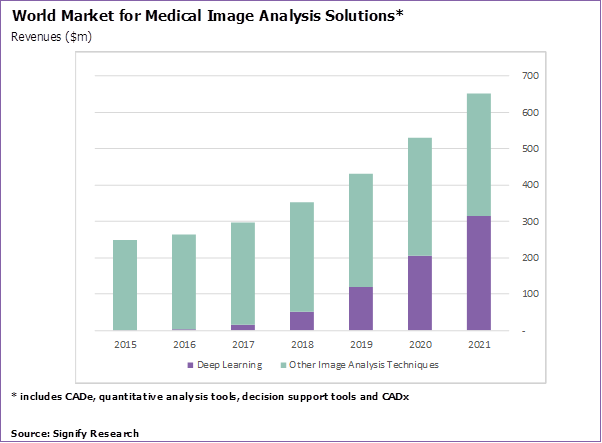
Deep learning will increasingly be used in the interpretation of medical images to address many long-standing industry challenges. This will lead to a $300 million market by 2021, according to a new report by Signify Research, an independent supplier of market intelligence and consultancy to the global healthcare technology industry.

Market Drivers

In most countries, there are not enough radiologists to meet the ever-increasing demand for medical imaging. Consequently, many radiologists are working at full capacity. The situation will likely get worse, as imaging volumes are increasing at a faster rate than new radiologists entering the field. Even when radiology departments are well-resourced, radiologists are under increasing pressure due to declining reimbursement rates and the transition from volume-based to value-based care delivery. Moreover, the manual interpretation of medical images by radiologists is subjective, often based on a combination of experience and intuition, which can lead to clinical errors.

A new breed of image analysis software that uses advanced machine learning methods, e.g. deep learning, is tackling these problems by taking on many of the repetitive and time-consuming tasks performed by radiologists. There is a growing array of “intelligent” image analysis products that automate various stages of the imaging diagnosis workflow.

In cancer screening, computer-aided detection can alert radiologists to suspicious lesions. In the follow-up diagnosis, quantitative imaging tools provide automated measurements of anatomical features. At the top-end of the scale of diagnostic support, computer-aided diagnosis provides probability-driven, differential diagnosis options for physicians to consider as they formulate their diagnostic and treatment decisions.

“Radiology is evolving from a largely descriptive field to a more quantitative discipline. Intelligent software tools that combine quantitative imaging and clinical workflow features will not only enhance radiologist productivity, but also improve diagnostic accuracy,” said Simon Harris, Principal Analyst at Signify Research and author of the report in a statement.

Still in the Infant Stages of Deep Learning in Medical Imaging

However, it is early days for deep learning in medical imaging. There are only a handful of commercial products and it is uncertain how well deep learning will cope with variations in patient demographics, imaging protocols, image artifacts, etc. Many radiologists were left underwhelmed by early-generation computer-aided detection, which used traditional machine learning and relied heavily on feature engineering. They remain sceptical of machine learning’s abilities, despite the leap in performance of today’s deep learning solutions, which automatically learn about image features from radiologist-annotated images and a “ground-truth”.

Furthermore, the “black box” nature of deep learning and the lack of traceability as to how results are obtained could lead to legal implications. Whilst none of these problems are insurmountable, healthcare providers are likely to take a ‘wait and see’ approach before investing in deep learning-based solutions.

“Deep learning is a truly transformative technology and the longer-term impact on the radiology market should not be under-estimated. It’s more a question ofwhen, not if, machine learning will be routinely used in imaging diagnosis”, Harris concluded.

  • LinkedIn
  • Twitter
  • Facebook
  • Email
  • Print

Tap Native

Get in-depth healthcare technology analysis and commentary delivered straight to your email weekly

Reader Interactions

Primary Sidebar

Subscribe to HIT Consultant

Latest insightful articles delivered straight to your inbox weekly.

Submit a Tip or Pitch

Featured Research Report

2026 Best in KLAS Awards: The Full List of Software & Services Winners

Most-Read

Health Recovery Solutions (HRS) Acquires Rimidi for Chronic Care Management and RPM Integration

Health Recovery Solutions (HRS) Acquires Rimidi for Chronic Care Management and RPM Integration

RadNet Subsidiary DeepHealth Acquires French Radiology AI Leader Gleamer

RadNet’s $269M AI Play: DeepHealth Acquires French AI Gleamer

Walgreens Launches Virtual Weight Management Platform for Self-Pay GLP-1 Patients

Walgreens Launches Virtual Weight Management Platform for Self-Pay GLP-1 Patients

KLAS Digital Pathology 2026 Report: Top IMS, Scanner, and AI Vendors Evaluated

KLAS Digital Pathology 2026 Report: Top IMS, Scanner, and AI Vendors Evaluated

The "Platform" Squeeze: Epic Releases Native AI Charting, Putting Venture-Backed Scribes on Notice

The “Platform” Squeeze: Epic Releases Native AI Charting, Putting Venture-Backed Scribes on Notice

Analysis: Oracle Cerner’s Plans for a National EHR

Oracle May Cut 30k Jobs and Sell Cerner to Fund $156B OpenAI Deal

The $1.9B Exit: Why CommonSpirit is Insourcing Revenue Cycle and Tenet is Betting Big on Conifer AI

The $1.9B Exit: Why CommonSpirit is Insourcing Revenue Cycle and Tenet is Betting Big on Conifer AI

KLAS 2026 Rankings: Aledade and Guidehealth Named Top VBC Enablement Firms

KLAS 2026 Rankings: Aledade and Guidehealth Named Top VBC Enablement Firms

Beyond the Hype: New KLAS Data Validates the Financial and Clinical ROI of Ambient AI

Beyond the Hype: New KLAS Data Validates the Financial and Clinical ROI of Ambient AI

Anthropic Debuts ‘Claude for Healthcare’ and Opus 4.5 to Engineer the Future of Life Sciences

Anthropic Debuts ‘Claude for Healthcare’ and Opus 4.5 to Engineer the Future of Life Sciences

Secondary Sidebar

Footer

Company

  • About Us
  • 2026 Editorial Calendar
  • Advertise with Us
  • Reprints and Permissions
  • Op-Ed Submission Guidelines
  • Contact
  • Subscribe

Editorial Coverage

  • Opinion
  • Health IT
    • Care Coordination
    • EMR/EHR
    • Interoperability
    • Population Health Management
    • Revenue Cycle Management
  • Digital Health
    • Artificial Intelligence
    • Blockchain Tech
    • Precision Medicine
    • Telehealth
    • Wearables
  • Startups
  • Value-Based Care
    • Accountable Care
    • Medicare Advantage

Connect

Subscribe to HIT Consultant Media

Latest insightful articles delivered straight to your inbox weekly

Copyright © 2026. HIT Consultant Media. All Rights Reserved. Privacy Policy |