
• Skip to main content
  • Skip to secondary menu
  • Skip to primary sidebar
  • Skip to secondary sidebar
  • Skip to footer

  • Opinion
  • Health IT
    • Behavioral Health
    • Care Coordination
    • EMR/EHR
    • Interoperability
    • Patient Engagement
    • Population Health Management
    • Revenue Cycle Management
    • Social Determinants of Health
  • Digital Health
    • AI
    • Blockchain
    • Precision Medicine
    • Telehealth
    • Wearables
  • Life Sciences
  • Investments
  • M&A
  • Value-based Care
    • Accountable Care (ACOs)
    • Medicare Advantage

The Kabuki Dance Of “Blocking Data” In Healthcare

by Our Thought Leaders 04/13/2015 4 Comments

  • LinkedIn
  • Twitter
  • Facebook
  • Email
  • Print

Who Stole U.S. Healthcare Interop?

Long forgotten is a similar dilemma in a vastly different industry ‒ motor vehicle manufacturing. For decades, car companies issued their own vehicle identification number. The resulting mess made it virtually impossible for consumers (let alone law enforcement) to tell if a car they were about to buy had been stolen, was a lemon, part of a manufacturer recall or if it had serious damage (manmade or otherwise) somewhere in its history.

A vehicle identification number, commonly abbreviated to VIN, is a unique code including a serial number, used by the automotive industry to identify individual motor vehicles, towed vehicles, motorcycles, scooters and mopeds as defined in ISO 3833. VINs were first used in 1954. From 1954 to 1981, there was no accepted standard for these numbers, so different manufacturers used different formats

In 1981, the National Highway Traffic Safety Administration of the United States standardized the format.It required all over-the-road-vehicles sold to contain a 17-character VIN.  VIN [Wikipedia]

Today, that VIN is stamped on every major part of every vehicle manufactured in a way that makes it easy for consumers and law enforcement to check on the status of any car (or car part) easily and quickly ‒ nationally.

So why this is effectively a Kabuki dance between ONC, ISV’s and Congress is no mystery. ONC is firmly stuck between enormous commercial interests and a clearly recalcitrant Congress to simply authorize the development of any National  Standard for healthcare IT (either NPI or more broadly for data interoperability). ISV’s are, of course, competing aggressively for revenue and market share in any way they can. Patients are the collateral damage in these warring interests.
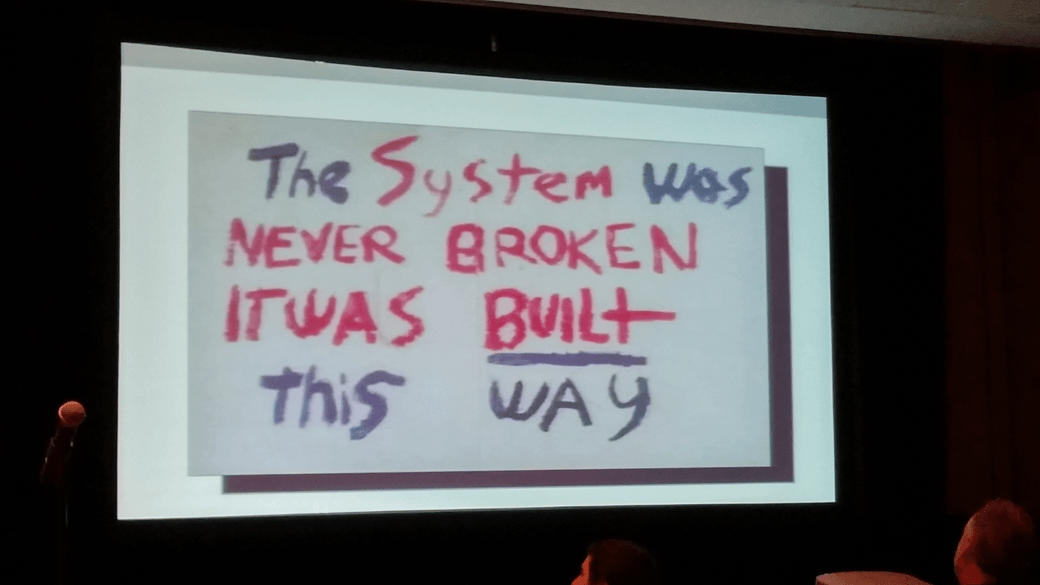
The Kabuki Dance Of "Blocking Data" In Healthcare

It’s painful to watch and it’s painful to realize the complete and utter disregard by all for basic patient safety ‒ but that is the healthcare system we have built. No, it’s not broken ‒ it’s just been optimized for revenue and profits ‒ not safety and quality. Congress simply refuses to reign in the commercial interests of the ISV’s and ONC is simply an effective buffer to hide their clear ‒ financially motivated ‒ reluctance.  

Everyone’s well meaning, of course. Everyone’s doing “the best they can”, but it’s very much like the quote from the recent Ken Burns biography of cancer. With a little substitution we can easily apply the title of the second installment of that epic series directly to the healthcare interoperability dilemma.

The important thing is that the viral National Patient ID theory was not wrong. The environmental Meaningful Use theory was not wrong. The hereditary Vendor API theory was not wrong – they were just insufficient. It was like the blind man and the elephant. They were catching parts of the whole and then all of sudden – if you stepped back – you saw the whole elephant. Siddhartha Mukherjee, MD ‒ Top 10 Quotes From the Ken Burns Documentary: ‘Emperor of All Maladies’

Unlike the war on cancer ‒ we haven’t seen ‒ nor do we appear to be looking for ‒ the whole elephant. 

Dan Munro has spent the last 15 years in the tech startup community including several early stage ventures with successful exits in the healthcare space. Follow him on Twitter at: @danmunro

Opinions expressed by HIT Consultant Contributors are their own.

Pages: Page 1 Page 2 Page 3
  • LinkedIn
  • Twitter
  • Facebook
  • Email
  • Print

Tagged With: Anthem, API, apple, cancer, digital health, Electronic Health Record, Epic Systems, health information exchange, Health IT, Health IT Interoperability, Healthcare Interoperability, healthcare it, HIM, HIMSS 2015, HIPAA, HIT, HIT Consultant, Information Blocking, interoperability, MD, Meaningful Use, Microsoft, National Patient ID, NPI, Office of the National Coordinator, ONC, patient safety

Tap Native

Get in-depth healthcare technology analysis and commentary delivered straight to your email weekly

Reader Interactions

Primary Sidebar

Subscribe to HIT Consultant

Latest insightful articles delivered straight to your inbox weekly.

Submit a Tip or Pitch

2026 Predictions & Trends

Healthcare 2026 Forecast: Executives on AI Survival, Financial Reckoning, and the End of Point Solutions

2026 Healthcare Executive Predictions: Why the AI “Pilot Era” Is Officially Over

Most-Read

NYC Health + Hospitals to Acquire Maimonides in $2.2B Safety Net Overhaul

NYC Health + Hospitals to Acquire Maimonides in $2.2B Safety Net Overhaul

KLAS Report: Why Hospitals Are Choosing Efficiency Over 'Agentic' AI Hype in 2025

KLAS Report: Why Hospitals Are Choosing Efficiency Over ‘Agentic’ AI Hype in 2025

Advanced Primary Care 2026: Top 6 Investments for Health Systems According to Harvard Medical School

Advanced Primary Care 2026: Top 6 Investments for Health Systems According to Harvard Medical School

AI Nutrition Labels: The Key to Provider Adoption and Patient Trust?

AI Nutrition Labels: The Key to Provider Adoption and Patient Trust?

Kristen Hartsell, VP of Clinical Services, RedSail Technologies

The Pharmacy Closures Crisis: How Independent Pharmacies Are Fixing Pharmacy Deserts

HHS Launches 'OneHHS' AI Strategy to Integrate AI Across CDC, CMS, and FDA for Efficiency and Public Trust

HHS Launches ‘OneHHS’ AI Strategy to Integrate AI Across CDC, CMS, and FDA for Efficiency and Public Trust

From Overwhelmed to Optimized: How AI Agents Address Staffing Challenges and Burnout in Healthcare

From Overwhelmed to Optimized: How AI Agents Address Staffing Challenges and Burnout in Healthcare

The VBC Paradox: Why Hospitals Are Doubling Down on Value-Based Care While Revenue at Risk Lags

The VBC Paradox: Why Hospitals Are Doubling Down on Value-Based Care While Revenue at Risk Lags

Tebra Secures $250M to Challenge Legacy EHRs with AI-Powered Automation

Tebra Secures $250M to Challenge Legacy EHRs with AI-Powered Automation

AstraZeneca Selects Salesforce Agentforce Life Sciences to Deploy AI-Powered Global Customer Engagement

AstraZeneca Selects Salesforce Agentforce Life Sciences to Deploy AI-Powered Global Customer Engagement

Secondary Sidebar

Footer

Company

  • About Us
  • Advertise with Us
  • Reprints and Permissions
  • Op-Ed Submission Guidelines
  • Contact
  • Subscribe

Editorial Coverage

  • Opinion
  • Health IT
    • Care Coordination
    • EMR/EHR
    • Interoperability
    • Population Health Management
    • Revenue Cycle Management
  • Digital Health
    • Artificial Intelligence
    • Blockchain Tech
    • Precision Medicine
    • Telehealth
    • Wearables
  • Startups
  • Value-Based Care
    • Accountable Care
    • Medicare Advantage

Connect

Subscribe to HIT Consultant Media

Latest insightful articles delivered straight to your inbox weekly

Copyright © 2025. HIT Consultant Media. All Rights Reserved. Privacy Policy |