

What You Should Know
ATA Action, the advocacy affiliate of the American Telemedicine Association (ATA), formally submitted comments to Dr. Michelle Tarver, M.D., Ph.D., Director of the FDA’s Center for Devices and Radiological Health (CDRH), addressing Docket No. FDA-2026-N-7874 (Considerations for the Regulation of Generative AI-Enabled Medical Devices: Discussion Paper and Request for Feedback).Endorses the FDA's proposed two-axis risk framework—evaluating systems based on the clinical
Read More
Technology
What US Telehealth Companies Can Learn From Telemedicine in Africa
Most US telehealth products are built on an assumption that rarely gets tested: the patient has a smartphone, a data plan and a connection steady enough for a video visit. In much of Africa, that assumption breaks at the first step.
The International Telecommunication Union's Facts and Figures 2025 found that 36% of Africa's population was online in 2025, the lowest rate of any ITU region, against 74% worldwide, as reported by The Guardian Nigeria. Telemedicine companies on the continent have
Read More
Keeping Exudate Away From Periwound Skin: A Practical Dressing Consideration

When managing a draining wound, attention naturally focuses on the wound itself. But the skin surrounding the wound—the periwound skin—also plays an important role in everyday wound care.
When wound exudate repeatedly reaches or remains in contact with surrounding skin, excess moisture can contribute to skin maceration, leaving the area overly soft, fragile, or uncomfortable. For this reason, effective exudate control is not only about how much fluid a dressing can absorb. It is also about
Read More
Telehealth Was Built for Two. Interpreted Care Requires Three

Telehealth was supposed to widen access. For patients who do not speak English, it narrowed access.
An analysis of California Health Interview Survey data published in Health Affairs found that patients with limited English proficiency used telehealth at a rate of 4.8 percent, against 12.3 percent among proficient English speakers, roughly half the odds even after adjusting for other sociodemographic factors.
A systematic review by researchers at the University of North Carolina's
Read More
Teladoc Health Unveils SoloVitals and SoloScribe: AI-Powered Contactless Biometrics and Enterprise Documentation

What You Should Know
Enterprise virtual care leader Teladoc Health launches two native AI-powered capabilities integrated directly into its enterprise smart care platform, Solo: SoloVitals and SoloScribe.Directly targets acute hospital "point-solution fatigue," allowing health systems to scale remote physiological tracking and ambient documentation without procuring, integrating, or managing disparate third-party software vendors
Key Capabilities: SoloVitals and SoloScribe
Rather than
Read More
From Documentation to Decision-Making: How Technology Supports Modern Healthcare

Healthcare has always run on two things at once: the care a clinician gives and the record that care leaves behind. One happens in the room, face to face, in the space of a few minutes. The other happens afterward, in the quiet time that most clinicians no longer have much of.
For years the second half of that job was treated as an afterthought, something to be squeezed into gaps between patients or carried home at the end of a long day. That view has changed. The record is now the
Read More
Sollis Health Decennial Report Decodes the Hidden Cost of Healthcare Waiting Rooms

What You Should Know
Concierge immediate and urgent care network Sollis Health published a comprehensive decade-long trend study, The Real Cost of Healthcare for Americans, that synthesizes national health economics research with ten years of proprietary internal patient utilization data.Quantifies the macroeconomic "Time Tax" across U.S. healthcare delivery: travel and waiting times alone cost American patients and employers an estimated $89 billion in lost economic value annually.Evaluates
Read More
Included Health Launches Alternative Health Plans for Self-Insured Employers Targeting 2028 Go-Live

What You Should Know
Integrated virtual care, navigation, and advocacy leader Included Health announced the official commercial launch of Included Health Plans, scheduled for a January 1, 2028 plan year go-live date across the self-insured employer market.Positions the new offering as a direct challenger and alternative to traditional legacy carrier-led administrative services only (ASO) and insurer models, engineered to reverse escalating employer healthcare costs without shifting
Read More
Google Fitbit and Weight Watchers Team Up on Employer-Sponsored Weight Health

What You Should Know
Weight Watchers announced a strategic enterprise collaboration with Google Health Enterprise, integrating wearable biometric tracking and AI-driven insights directly into employer-sponsored health programs.The collaboration debuts through select Weight Watchers for Business client organizations, granting eligible members access to Google Fitbit Air devices and Google Health Premium software features upon meeting specific activity and program duration milestones.The
Read More
Hims Launches AI-Native Weight Loss Care Platform Featuring Closed-Loop Action Engine and Clinical Escalation
What You Should Know
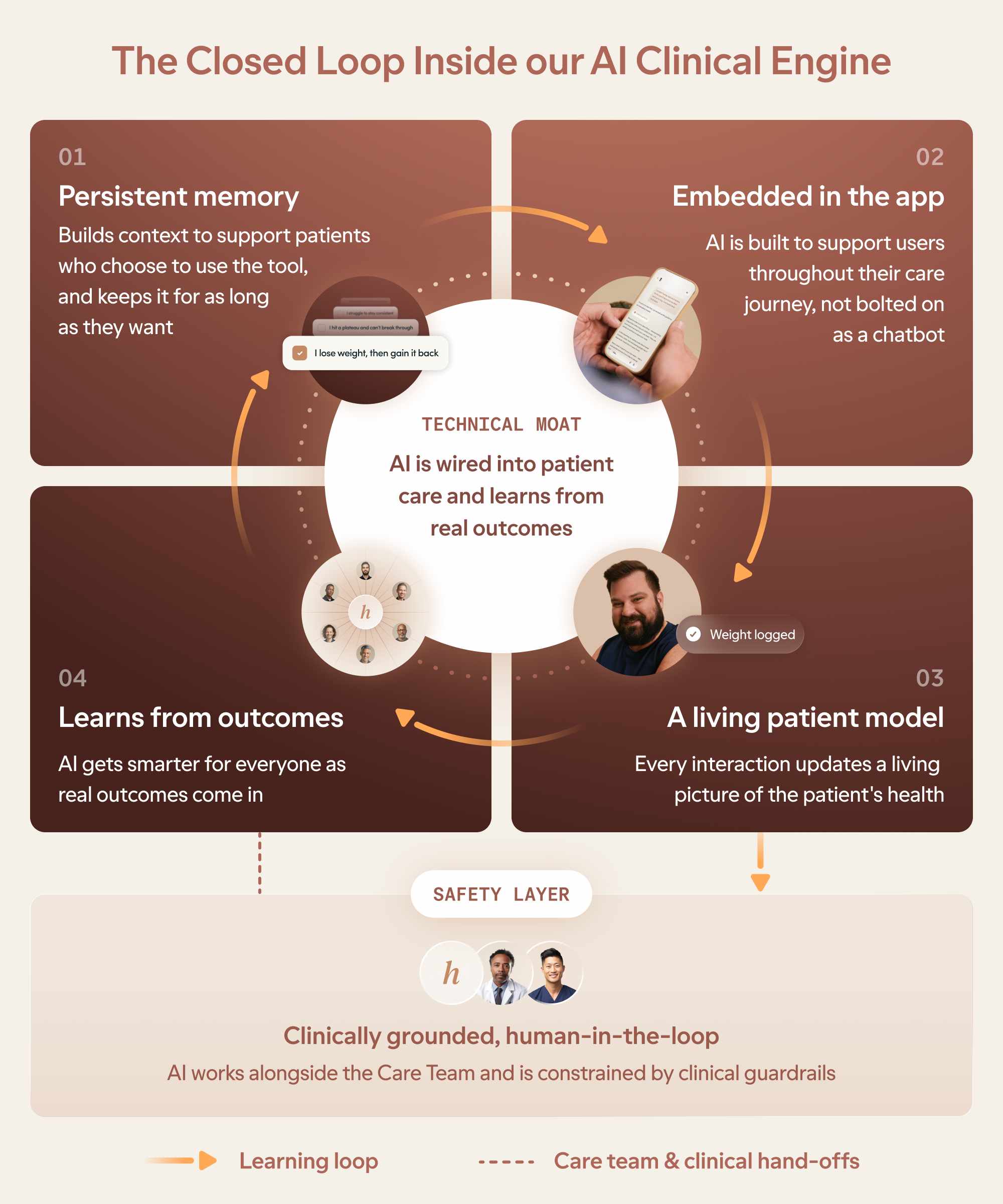
Digital health and direct-to-consumer healthcare leader Hims & Hers Health, Inc. announced the rollout of its AI-native care platform to Hims weight loss members, expanding foundational capabilities previously launched across Labs AI and the Hers ecosystem.Replaces legacy, asynchronous telehealth messaging models with a closed-loop clinical operating system designed to maintain longitudinal context, learn from patient outcomes, and eliminate repetitive patient intake
Read More