

• Skip to main content
  • Skip to secondary menu
  • Skip to primary sidebar
  • Skip to secondary sidebar
  • Skip to footer

  • Opinion
  • Health IT
    • Behavioral Health
    • Care Coordination
    • EMR/EHR
    • Interoperability
    • Patient Engagement
    • Population Health Management
    • Revenue Cycle Management
    • Social Determinants of Health
  • Digital Health
    • AI
    • Blockchain
    • Precision Medicine
    • Telehealth
    • Wearables
  • Life Sciences
  • Investments
  • M&A
  • Value-based Care
    • Accountable Care (ACOs)
    • Medicare Advantage

Amwell and Cigna Ranks High in Telehealth Patient Satisfaction, J.D. Power Finds

by Fred Pennic 10/02/2020 Leave a Comment

  • LinkedIn
  • Twitter
  • Facebook
  • Email
  • Print

What You Should Know:

– Amwell ranks highest among direct to consumer brands and Cigna ranks highest among health plans for telehealth patient satisfaction, according to the J.D. Power 2020 U.S. Telehealth Satisfaction Study

– Though telehealth has been pitched as a solution to improve access to healthcare for everyone, more than half (52%) of telehealth users say they encountered at least one barrier that made it difficult to use telehealth.


Patient satisfaction with telehealth services has been increasing during the COVID-19 pandemic, but several barriers to access still exist for many patients, including those most at risk, according to the J.D. Power 2020 U.S. Telehealth Satisfaction Study.

The J.D. Power U.S. Telehealth Satisfaction Study, now in its second year, measures consumer satisfaction with their telehealth service experience based on four factors (in order of importance): customer service (42%); consultation (28%); enrollment (19%); and billing and payment (11%). The study is based on responses of 4,302 health consumers who used a telehealth service within the past 12 months. It was fielded in June-July 2020.

“The COVID-19 pandemic has been a moment of truth for telehealth, and, by most accounts, the technology is rising to the challenge and delivering a high degree of satisfaction among those who use it,” said James Beem, managing director of global healthcare intelligence at J.D. Power. “However, even though the public awareness with Telehealth is higher due to the influence of COVID-19, the barriers for the consumer to engage with the technology has been a consistent theme in our research.”

Key Findings

Key findings of the 2020 study include:

– Amwell ranks highest in telehealth satisfaction among direct-to-consumer brands, with a score of 885. Doctor on Demand (879) ranks second.

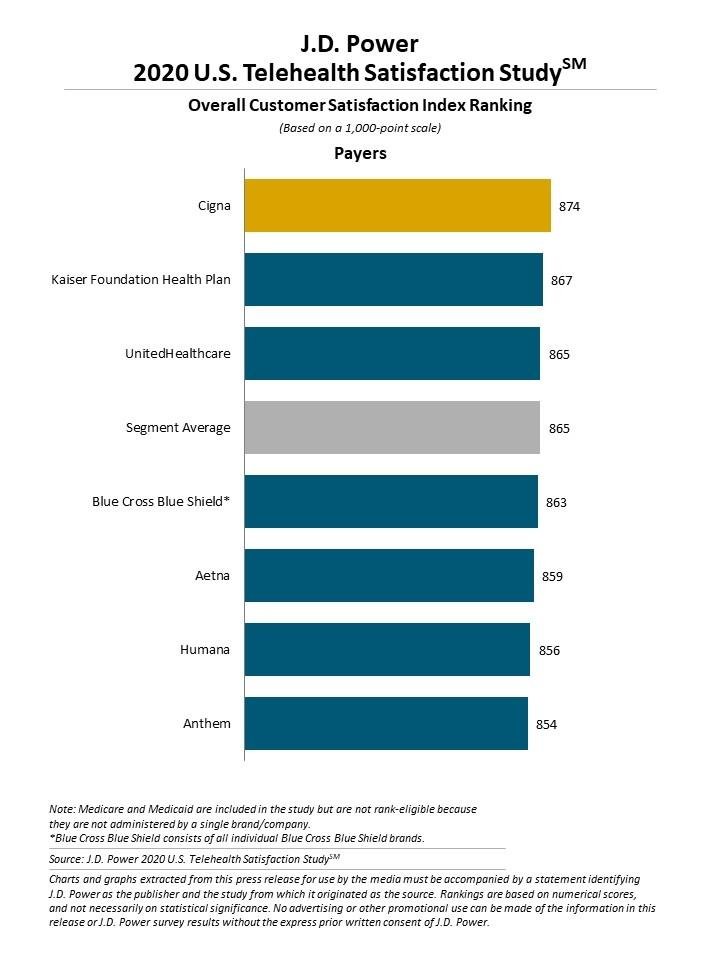
– Cigna ranks highest among payers of health plan-provided telehealth services with a score of 874. Kaiser Foundation Health Plan (867) ranks second and UnitedHealthcare (865) ranks third.

– Great patient experience: The overall customer satisfaction score for telehealth services is 860 (on a 1,000-point scale), which is among the highest of all healthcare, insurance and financial services industry studies conducted by J.D. Power.

– Barriers to access persist: Though telehealth has been pitched as a solution to improve access to healthcare for everyone, more than half (52%) of telehealth users say they encountered at least one barrier that made it difficult to use telehealth. The most common hurdles are limited services (24%); confusing technology requirements (17%); and lack of awareness of cost (15%). Additionally, 35% of telehealth users indicate they experienced a problem during a visit. Tech audio issues (26%) are the most common problem.

– At-risk patients have lower levels of satisfaction: Overall satisfaction is 117 points lower among patients with the lowest self-reported health status than among patients who consider themselves to be in excellent health. Similarly, healthier patients are significantly more likely to understand the information provided during the visit, receive clear explanations, feel their visits are highly personalized and obtain a high-quality diagnosis.

– Safety becomes a top driver of utilization: Among patients who used a telehealth offering this year, 46% say their top reason for choosing telehealth was safety. That compares with just 13% in 2019.

  • LinkedIn
  • Twitter
  • Facebook
  • Email
  • Print

Tagged With: Amwell, Cigna, Coronavirus (COVID-19), Doctor On Demand, global healthcare, Patient Experience, Patient Satisfaction, Payers, risk, Telehealth Services, UnitedHealthcare

Tap Native

Get in-depth healthcare technology analysis and commentary delivered straight to your email weekly

Reader Interactions

Primary Sidebar

Subscribe to HIT Consultant

Latest insightful articles delivered straight to your inbox weekly.

Submit a Tip or Pitch

2026 Predictions & Trends

Healthcare 2026 Forecast: Executives on AI Survival, Financial Reckoning, and the End of Point Solutions

2026 Healthcare Executive Predictions: Why the AI “Pilot Era” Is Officially Over

Most-Read

NYC Health + Hospitals to Acquire Maimonides in $2.2B Safety Net Overhaul

NYC Health + Hospitals to Acquire Maimonides in $2.2B Safety Net Overhaul

KLAS Report: Why Hospitals Are Choosing Efficiency Over 'Agentic' AI Hype in 2025

KLAS Report: Why Hospitals Are Choosing Efficiency Over ‘Agentic’ AI Hype in 2025

Advanced Primary Care 2026: Top 6 Investments for Health Systems According to Harvard Medical School

Advanced Primary Care 2026: Top 6 Investments for Health Systems According to Harvard Medical School

AI Nutrition Labels: The Key to Provider Adoption and Patient Trust?

AI Nutrition Labels: The Key to Provider Adoption and Patient Trust?

Kristen Hartsell, VP of Clinical Services, RedSail Technologies

The Pharmacy Closures Crisis: How Independent Pharmacies Are Fixing Pharmacy Deserts

HHS Launches 'OneHHS' AI Strategy to Integrate AI Across CDC, CMS, and FDA for Efficiency and Public Trust

HHS Launches ‘OneHHS’ AI Strategy to Integrate AI Across CDC, CMS, and FDA for Efficiency and Public Trust

From Overwhelmed to Optimized: How AI Agents Address Staffing Challenges and Burnout in Healthcare

From Overwhelmed to Optimized: How AI Agents Address Staffing Challenges and Burnout in Healthcare

The VBC Paradox: Why Hospitals Are Doubling Down on Value-Based Care While Revenue at Risk Lags

The VBC Paradox: Why Hospitals Are Doubling Down on Value-Based Care While Revenue at Risk Lags

Tebra Secures $250M to Challenge Legacy EHRs with AI-Powered Automation

Tebra Secures $250M to Challenge Legacy EHRs with AI-Powered Automation

AstraZeneca Selects Salesforce Agentforce Life Sciences to Deploy AI-Powered Global Customer Engagement

AstraZeneca Selects Salesforce Agentforce Life Sciences to Deploy AI-Powered Global Customer Engagement

Secondary Sidebar

Footer

Company

  • About Us
  • Advertise with Us
  • Reprints and Permissions
  • Op-Ed Submission Guidelines
  • Contact
  • Subscribe

Editorial Coverage

  • Opinion
  • Health IT
    • Care Coordination
    • EMR/EHR
    • Interoperability
    • Population Health Management
    • Revenue Cycle Management
  • Digital Health
    • Artificial Intelligence
    • Blockchain Tech
    • Precision Medicine
    • Telehealth
    • Wearables
  • Startups
  • Value-Based Care
    • Accountable Care
    • Medicare Advantage

Connect

Subscribe to HIT Consultant Media

Latest insightful articles delivered straight to your inbox weekly

Copyright © 2026. HIT Consultant Media. All Rights Reserved. Privacy Policy |