
• Skip to main content
  • Skip to secondary menu
  • Skip to primary sidebar
  • Skip to secondary sidebar
  • Skip to footer

  • Opinion
  • Health IT
    • Behavioral Health
    • Care Coordination
    • EMR/EHR
    • Interoperability
    • Patient Engagement
    • Population Health Management
    • Revenue Cycle Management
    • Social Determinants of Health
  • Digital Health
    • AI
    • Blockchain
    • Precision Medicine
    • Telehealth
    • Wearables
  • Life Sciences
  • Investments
  • M&A
  • Value-based Care
    • Accountable Care (ACOs)
    • Medicare Advantage

5 Must-Have Features for a Hospital Clinical Communications Platform

by Fred Pennic 04/06/2018 Leave a Comment

  • LinkedIn
  • Twitter
  • Facebook
  • Email
  • Print

5 Best Practices for Establishing a Unified Mobile Clinical Communications Strategy

According to a newly released report from Spyglass Consulting Group, 90% of hospitals surveyed are making significant enterprise-wide investments in Smartphones and secure mobile communications platforms to drive clinical transformation and address the mission- and patient-critical communications requirements of clinical and non-clinical mobile workers within the hospital and across the care continuum. 

Report Background/Overview

Conducted over a three-month period starting in September 2017, the Trends in Clinical Communications & Collaboration 2018 report spoke with over more than 100 healthcare professionals working in hospital-based environments who are technically competent and representative of a broad range of medical specialties, organization types, and organization sizes. 73 percent of hospitals surveyed have developed or were developing mobile strategies to address the communications, collaboration, and computing requirements of clinical professionals and other mobile workers across medical departments, standalone hospitals, and ambulatory environments. 

Common Clinical Communication Challenges

Hospitals surveyed have identified common clinical communications challenges experienced by mobile clinical workers that include:

1. Communications overload

Clinicians are overwhelmed by the overhead paging system, incoming voice and text communications, and a continuous stream of device alarms which is creating alarm fatigue and leaving them little time for direct patient care.

2. Lack of standardized processes

Clinicians are resistant to utilizing standardized communications processes and tools especially during transitions which can introduce medical errors into care process.

3. Dissatisfaction with existing communications tools

Clinicians are dissatisfied with the antiquated communication options provided by hospital IT including overhead paging, landline phones, pagers, and proprietary VoIP handsets. EHR-based messaging tools are poorly designed and not well integrated with their workflow. 

Related:  5 Best Practices for Establishing a Unified Mobile Clinical Communications Strategy

Must-Have Features for a Next-Generation Clinical Communications Platform

The report reveals five must-have features for a hospital clinical communications platform to help providers achieve the Triple AIM framework by reducing healthcare costs, improving care quality and outcomes, and increasing patient and staff satisfaction. 

1. Cross platform support: enabling clinicians to use a different mobile devices and/or webbased interfaces to support anytime, anywhere communications

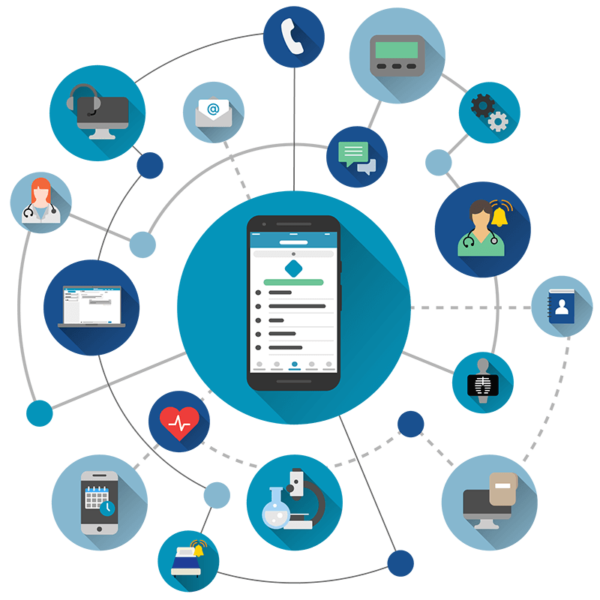
2. Unified Communication: enabling clinicians to use different communication modalities including Voice over IP, secure text messaging, and video conferencing

3. Enterprise-wide directories: integrated with the on-call scheduling system and care assignments database enabling clinicians to connect with team members

4. Event-driven communications: enabling clinicians to receive critical notifications from hospital legacy systems providing actionable content to close the communications loop

5. Analytics and reporting tools: enabling hospital IT to measure communications tools usage and effectiveness to drive clinical workflow improvements.

  • LinkedIn
  • Twitter
  • Facebook
  • Email
  • Print

Tagged With: Care Coordination, clinical collaboration, Clinical Communication, Secure Messaging

Tap Native

Get in-depth healthcare technology analysis and commentary delivered straight to your email weekly

Reader Interactions

Primary Sidebar

Subscribe to HIT Consultant

Latest insightful articles delivered straight to your inbox weekly.

Submit a Tip or Pitch

2026 Predictions & Trends

Healthcare 2026 Forecast: Executives on AI Survival, Financial Reckoning, and the End of Point Solutions

2026 Healthcare Executive Predictions: Why the AI “Pilot Era” Is Officially Over

Featured Research Report

The “Maturity” Pivot: Why Digital Health Funding Rebounded to $22.3B in 2025

Most-Read

Beyond the Hype: New KLAS Data Validates the Financial and Clinical ROI of Ambient AI

Beyond the Hype: New KLAS Data Validates the Financial and Clinical ROI of Ambient AI

Anthropic Debuts ‘Claude for Healthcare’ and Opus 4.5 to Engineer the Future of Life Sciences

Anthropic Debuts ‘Claude for Healthcare’ and Opus 4.5 to Engineer the Future of Life Sciences

OpenAI Debuts ChatGPT Health: A ‘Digital Front Door’ That Connects Medical Records to Agentic AI

OpenAI Debuts ChatGPT Health: A ‘Digital Front Door’ That Connects Medical Records to Agentic AI

From Genes to Hackers: The Hidden Cybersecurity Risks in Life Sciences

From Genes to Hackers: The Hidden Cybersecurity Risks in Life Sciences

Utah Becomes First State to Approve AI System for Prescription Renewals

Utah Becomes First State to Approve AI System for Prescription Renewals

NYC Health + Hospitals to Acquire Maimonides in $2.2B Safety Net Overhaul

NYC Health + Hospitals to Acquire Maimonides in $2.2B Safety Net Overhaul

KLAS Report: Why Hospitals Are Choosing Efficiency Over 'Agentic' AI Hype in 2025

KLAS Report: Why Hospitals Are Choosing Efficiency Over ‘Agentic’ AI Hype in 2025

Advanced Primary Care 2026: Top 6 Investments for Health Systems According to Harvard Medical School

Advanced Primary Care 2026: Top 6 Investments for Health Systems According to Harvard Medical School

AI Nutrition Labels: The Key to Provider Adoption and Patient Trust?

AI Nutrition Labels: The Key to Provider Adoption and Patient Trust?

Kristen Hartsell, VP of Clinical Services, RedSail Technologies

The Pharmacy Closures Crisis: How Independent Pharmacies Are Fixing Pharmacy Deserts

Secondary Sidebar

Footer

Company

  • About Us
  • 2026 Editorial Calendar
  • Advertise with Us
  • Reprints and Permissions
  • Op-Ed Submission Guidelines
  • Contact
  • Subscribe

Editorial Coverage

  • Opinion
  • Health IT
    • Care Coordination
    • EMR/EHR
    • Interoperability
    • Population Health Management
    • Revenue Cycle Management
  • Digital Health
    • Artificial Intelligence
    • Blockchain Tech
    • Precision Medicine
    • Telehealth
    • Wearables
  • Startups
  • Value-Based Care
    • Accountable Care
    • Medicare Advantage

Connect

Subscribe to HIT Consultant Media

Latest insightful articles delivered straight to your inbox weekly

Copyright © 2026. HIT Consultant Media. All Rights Reserved. Privacy Policy |