
What You Should Know
- AI-native radiology pioneer Raidium has announced the U.S. launch of its flagship platform, Raidium Read (R.Read), bringing agentic AI workflows directly to advanced oncology research institutions.
- The company’s system has been actively deployed at Moffitt Cancer Center, one of the nation’s preeminent oncology facilities, where it successfully replaced the center’s legacy radiomics applications.
- Rejecting the standard approach of placing basic point solutions on top of obsolete interfaces, Raidium engineered an AI-native PACS viewer from the ground up to streamline tedious reading room tasks.
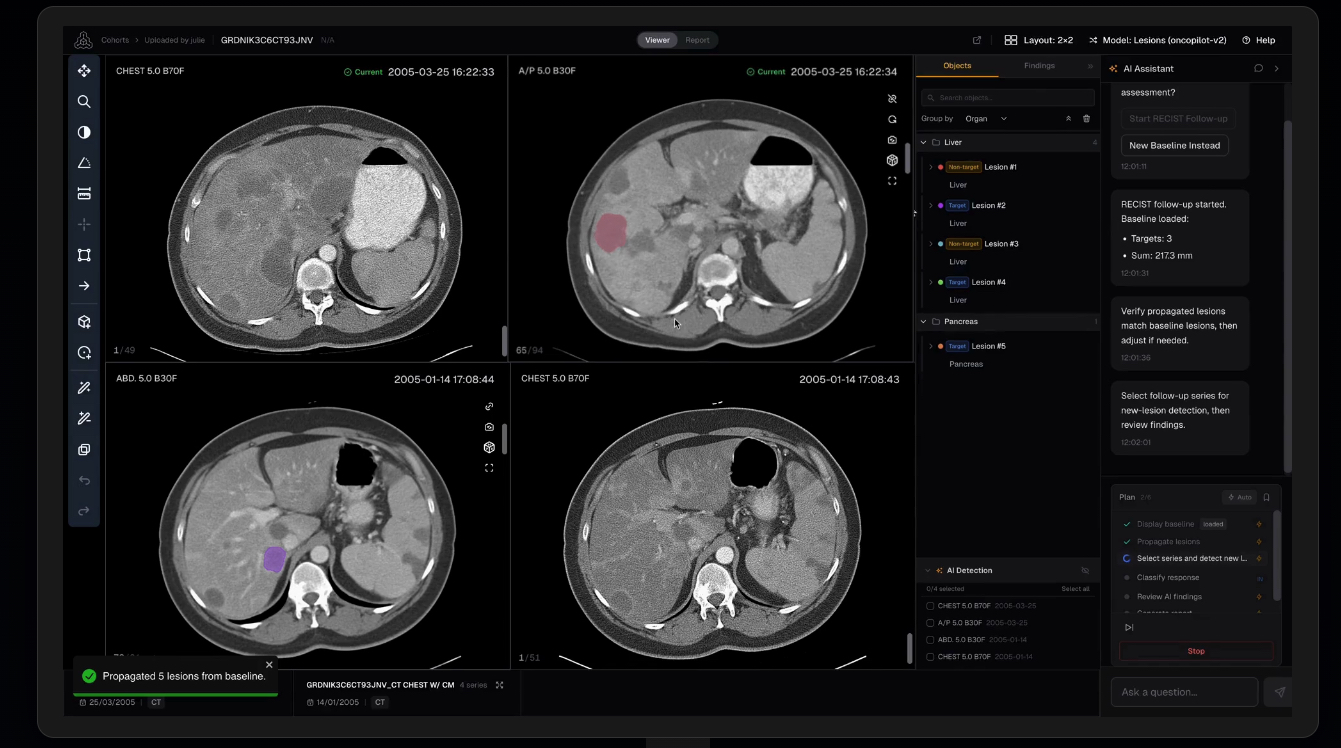
- Leveraging its core foundation model, Curia, R.Read delivers organ-agnostic automated RECIST measurements across time points, cutting inter-reader variability by a factor of three.
- Currently structured as a standalone pipeline for clinical trials and research environments, the platform features zero prerequisite backend integration hurdles, while formal FDA 510(k) clearances are projected before year-end 2026.
The Curia Foundation Execution Model
The architectural strategy driving Raidium moves entirely past the passivity of traditional imaging plugins to enforce a deeply integrated, context-aware environment. The system’s backend intelligence is anchored by its proprietary foundation model, Curia, which has demonstrated state-of-the-art performance parameters across multi-modal imaging tasks.
Operating from offices in Paris, France, and Silicon Valley, California, Raidium transforms the radiologist’s dashboard into an interactive, promptable canvas.
The platform streamlines the longitudinal lifecycle of oncology imaging through an automated execution loop:
- Whole-Body Lesion Tracking: The system autonomously scans large-volume diagnostic inputs, executing high-fidelity lesion detection and segmentation across diverse anatomical regions.
- Longitudinal Transfer Optimization: R.Read programmatically extracts historical lesion data from prior studies, mapping them against active follow-up imagery to eliminate manual search variables.
- Automated RECIST Quantification: Leveraging foundation-level logic, the application performs organ-agnostic, automated Response Evaluation Criteria in Solid Tumors (RECIST) measurements across time points.
- Variance Reduction Execution: By replacing manual, visual slide rules with structured, repeatable calculations, the engine decreases inter-reader variability by a full 3x.
“For twenty years, the standard PACS viewers have resisted evolution, easily outmatched by the rigid limitations of early AI,” stated Paul Herent, MD, CEO and Co-Founder of Raidium. “Today, however, agentic AI is driving a quiet revolution: a single, fluid convergence of everyday accessibility, conversational logic, and advanced reasoning that is finally poised to redefine the reading room. We are initially targeting oncology follow-up because no convincing AI solution has yet solved this complex workflow.”
Strategic Value: Streamlining the Tumor Board Pipeline
The clinical necessity underlying Raidium’s initial oncology focus is reinforced by changing clinical guidelines worldwide. Recent medical research demonstrates that early, precise lesion detection can successfully spare the majority of cancer patients from highly invasive surgical procedures. Concurrently, the World Health Organization is advancing aggressive new screening frameworks aimed at capturing precancerous lesions at an earlier, treatable stage.
By consolidating these workflows within a single workspace, Raidium significantly eases the documentation burden on radiologists while maintaining full physician oversight.
Dr. Cesar Lam, a radiologist in Moffitt Cancer Center’s Diagnostic Imaging and Interventional Radiology Department, validated the operational shift: “Raidium’s unified approach empowers us to explore research projects that would have seemed impossible not too long ago. It is transforming and empowering how we conduct oncology clinical research projects, giving our teams a tool designed for the complexity of real-world imaging data.”
Furthermore, by standardizing quantitative endpoints, the platform clarifies communication channels between radiologists and oncologists during high-stakes tumor boards, driving faster, data-backed medical decision-making.
