
What You Should Know
- Early metrics from the KLAS Arch Collaborative 2026 report confirm that clinicians using at least one artificial intelligence tool score 7 percentage points higher in believing the EHR enables operational efficiency compared to non-users.
- While clinical satisfaction surges as practitioners adopt up to four distinct AI tools, it rapidly plateaus; introducing five or more applications adds workflow clutter and digital noise rather than driving incremental value.
- A massive preparedness chasm exists across enterprise networks: less than 25% of clinicians who have adopted AI tools agree they received adequate training on managing AI-generated content within their active workflows.
- AI usage remains highly specialized by clinical background: physicians (54%) and advanced practice providers (52%) heavily prioritize ambient visit-note drafting, whereas nurses (30%) primarily engage tools for shift and patient-stay summaries.
- The largest positive efficiency spreads are captured by clinicians weaponizing automation for focused operational tasks, led by order creation (+9%) and summarizing shifts or patient stays (+6%).
Why the EHR Efficiency Spread Demands Role-Specific AI Enablement
The global healthcare information technology (HIT), clinical software development, and enterprise hospital informatics landscapes have reached a critical maturity milestone. For the past twenty-four months, enterprise healthcare delivery networks focused their strategic energy on the rapid technical integration of cognitive computing tools directly into core electronic health records (EHRs). Driven by severe clinician burnout, historic staffing deficits, and an unmanaged accumulation of clinical documentation requirements, executive boardrooms universally treated artificial intelligence activation as their number-one capital priority.
However, this initial rush to implement tools has brought health systems to an important operational inflection point. Executive teams are learning that simply turning on advanced capabilities does not automatically improve the day-to-day experience of the healthcare workforce.
According to the KLAS Arch Collaborative 2026 report, titled AI Insights from the Arch Collaborative 2026: An Early Look at How Epic Customers Are Leveraging AI to Improve the Clinician Experience, the conversation must urgently transition from basic technological deployment to role-specific workflow enablement.
Drawing on datasets from 12 progressive Epic-backed organizations alongside intensive interviews with clinical executive leaders, the report documents a powerful, definitive correlation: clinicians leveraging AI tools report a higher average Net EHR Experience Score (NEES) of 72.2, compared to a baseline of 64.9 among clinicians who don’t use AI.
Yet, beneath these promising indicators sits a highly complex operational challenge. While the potential benefits of clinical automation are deeply practical and intensely personal—promising less time spent digging, typing, and catching up on charts after hours—realizing sustainable returns requires moving past broad tool availability.
Health systems must construct role-specific training pathways and rigorous feedback loops to ensure that advanced software relieves administrative burdens rather than transforming into workspace noise.
The Complexity Ceiling: Navigating the 4-Tool Plateau and the Training Deficit
The primary technical insight documented by the Arch Collaborative dataset is the presence of a hard, counterintuitive saturation limit among fast adopters. While clinician satisfaction scales reliably as users adopt up to four individual AI tools, the operational return completely plateaus beyond that boundary. The small cohort of clinicians attempting to manage five or more AI tools reports no incremental gains in their overall EHR experience. This finding highlights a vital lesson for informatics leaders: stacking multiple uncoordinated applications onto already strained teams introduces excessive choice and leaves clinicians with too many half-finished, automated workflows to audit manually.
his saturation issue is severely compounded by a widespread clinical training deficit. While executive leadership teams express high confidence in their readiness to implement the next wave of automated enterprise capabilities, the frontline clinical workforce feels significantly under-equipped.
Less than 25% of clinicians who have adopted AI tools strongly agree that they have received adequate, formal training on how to safely validate and incorporate AI-generated content into their active patient workflows.
When organizations deploy tools without structured education, promising technology is quickly perceived as risky, confusing, and burdensome. Because adequate EHR training is tied to a massive 20-point swing in overall system satisfaction, addressing this gap remains an absolute prerequisite for successful enterprise-wide adoption.
Deconstructing the Workflow Matrix: Role-Specific Pain Points
The KLAS report confirms that a provider-centered AI strategy that focuses exclusively on physicians leaves massive experience gains on the table. Because the same automation menu will not feel equally relevant across diverse clinical backgrounds, health systems must target specific workflow failures for specific user groups rather than prioritizing generic tool volume.
The underlying metrics indicate that the first wave of meaningful adoption follows the primary friction points unique to each role:
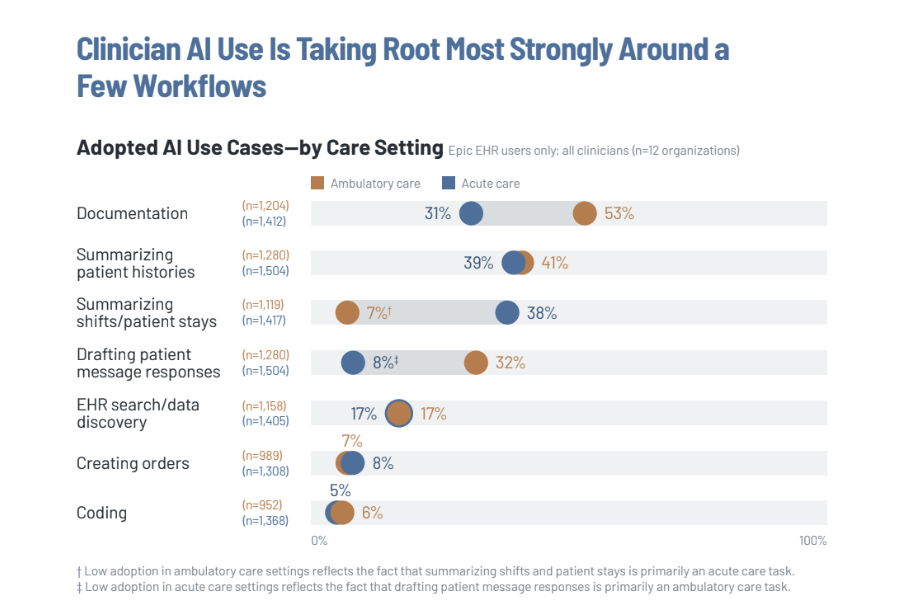
- Physicians & Advanced Practice Providers (APPs): Concentrated heavily around ambient visit-note documentation (71% / 61%) and patient-history summaries (51% / 52%), directly targeting the intense clerical burden of visit preparation.
- Nurses: Focused strongly on summarizing shifts and patient stays (30%), alongside managing high-volume patient-message workflows, reflecting the constant demand to keep charts current during complex handoffs.
- Allied Health Professionals: Demanding faster, semantic access to the patient story, showing high utilization of automated patient-history summaries (48%) and advanced EHR search/data discovery tools (23%).
This targeted variation is directly validated by the efficiency deltas reported by clinicians[cite: 3]. The largest positive impacts on perceived EHR efficiency are not driven by documentation tools alone, but by focused operational tasks, led by order creation (+9% efficiency spread), shift or patient-stay summaries (+6%), and EHR data discovery (+5%).
