
What You Should Know
- The KLAS Arch Collaborative has released its Clinician EHR Experience 2026: State of the Industry impact report, tracking EHR satisfaction benchmarks across 92 healthcare organizations and over 121,000 clinicians.
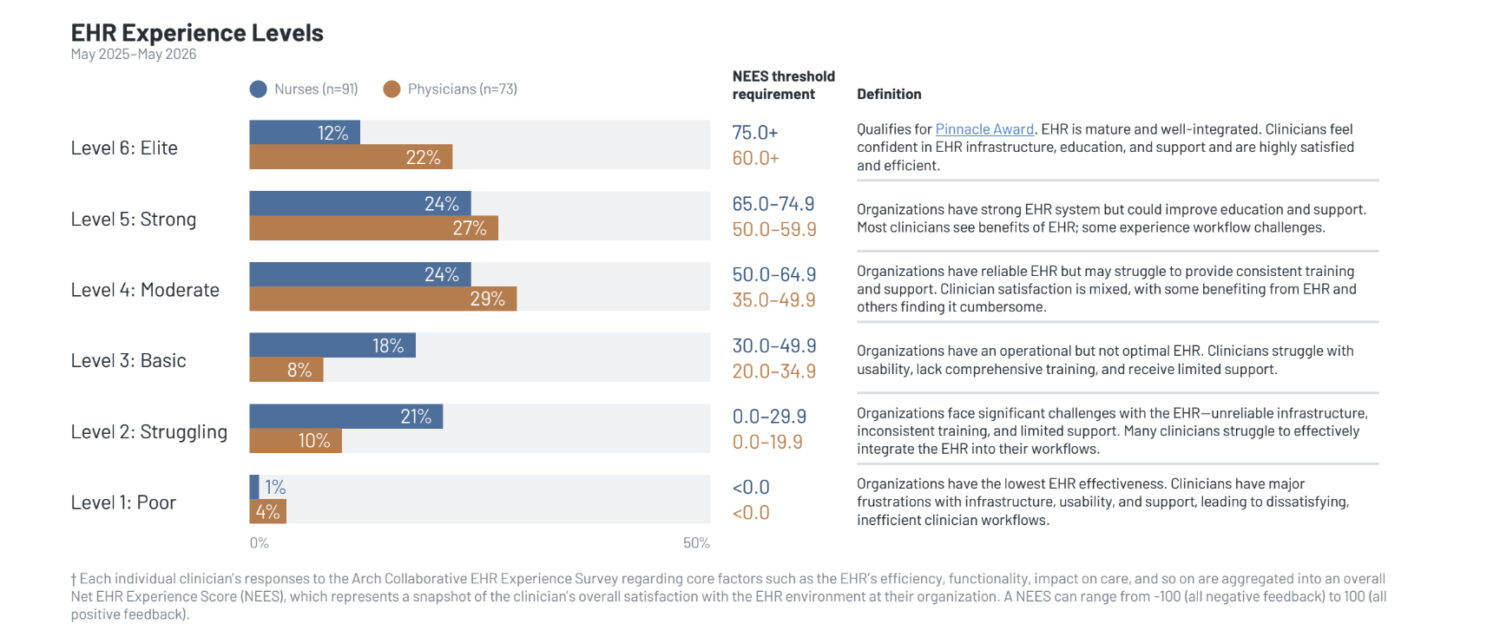
- A major clinical sentiment gap persists between disciplines: while 22% of physicians report an “Elite” (Level 6) EHR experience, only 12% of nurses achieve the same tier, with nurses far more likely to remain stuck in “Basic” or “Struggling” environments.
- Organizations prioritizing continuous optimization are moving the needle; institutions that remeasured their data saw an average 6.2-point increase in their Net EHR Experience Score (NEES) over the past year.
- Ambient AI documentation has emerged as one of the most powerful efficiency drivers for physicians, dramatically reducing after-hours charting and improving clinical quality of life.
- Reflecting macro industry shifts, the updated 2026 Arch Collaborative survey introduces an expanded focus on artificial intelligence, mandating new required metrics to track clinician AI adoption, training clarity, and desired automation support.
The Clinical Sentiment Gap: Why Nurses Are Left Behind in the Race for Elite EHR Maturity
The enterprise healthcare delivery and clinical information technology sectors are operating under an intense infrastructure strain. Hospital C-suites, chief medical information officers (CMIOs), and clinical operations leaders are forced to juggle an exhausting array of competing strategic priorities—from managing shifting payer reimbursement models to mitigating persistent workforce shortages.
Amid these financial pressures, a landmark data matrix from the KLAS Arch Collaborative provides critical executive clarity: organizations that systematically prioritize the frontline clinician experience see a powerful, positive ripple effect across their entire operational footprint, driving down net clinical costs while elevating the overall patient experience.
At the center of this workplace wellness equation sits electronic health record (EHR) satisfaction. Far from a simple software preference, a clinician’s daily interaction with their charting environment serves as a primary determinant of operational efficiency and professional burnout. Yet, this experience remains highly fragmented, varying wildly from institution to institution, even among users utilizing identical vendor software.
To map this digital divide and provide a repeatable blueprint for optimization, the KLAS Arch Collaborative has published its Clinician EHR Experience 2026: State of the Industry impact report. Synthesizing data across 92 healthcare organizations representing more than 121,000 surveyed clinicians, the report illuminates a stark reality: while technology adoption is accelerating, our largest clinical labor force is increasingly being left near the bottom of the digital maturity curve.
Deconstructing the Sentiment Divide: Nurses vs. Physicians
The overarching data from the 2026 cohort shows that a majority of measured clinicians report at least a moderate day-to-day EHR experience, with the bulk of participating health systems falling squarely into Level 4 (Moderate) or Level 5 (Strong) satisfaction tiers. However, when the data is stratified by clinical role, a deeply concerning functional divergence emerges between physicians and nursing teams.
According to the report, 22% of surveyed physician organizations achieved a Net EHR Experience Score (NEES) high enough to qualify for Level 6 (Elite) status—the premier benchmark required to secure the prestigious Arch Collaborative Pinnacle Award. By contrast, only 12% of nursing cohorts reached this elite execution tier.
More alarming is the density of nurses trapped near the bottom of the scale: 39% of nursing organizations are currently stalled in Level 2 (Struggling) or Level 3 (Basic) environments, compared to just 18% of their physician counterparts.
Because nurses represent the absolute largest clinical labor group in the care delivery model and maintain the highest density of continuous patient touchpoints, leaving them stranded with suboptimal, click-heavy software represents a severe threat to operational resilience and patient safety.
Identifying the Optimization Levers: What is Working Now
Despite the systemic challenges, the 2026 report explicitly proves that reversing clinician dissatisfaction is entirely achievable through targeted, data-driven optimization campaigns. Among the subset of 51 progressive healthcare organizations that executed repeat measurements over the past year, the data documents an average 6.2-point increase in the Net EHR Experience Score, with seven institutions engineering massive score surges of 15 points or more.
An analysis of qualitative commentary collected from the frontline highlights the precise functional areas driving these positive shifts:
The Ambient Al Infiltration (Physicians)
For physicians, the deployment of ambient speech and documentation AI stands out as the single clearest bright spot of the past year. Doctors using embedded ambient tools describe massive time savings, a substantial reduction in “pajama time” (after-hours charting), and an immediate quality-of-life improvement. Additional wins include the transition to problem-based note writing, auto-populated documentation templates, and faster ordering mechanisms driven by intuitive smartsets.
Click and Flowsheet Rationalization (Nurses)
For nursing teams, improvements were driven by health systems that actively targeted documentation redundancy. High-performing organizations succeed by stripping out duplicate charting fields, standardizing nursing notes, streamlining multi-click flowsheets, and introducing “one-screen” layouts that allow nurses to maintain patient context while reviewing tasks. Speed-enhancing smart tools like macros, copy-forward logic, and smart phrases were widely celebrated as genuine time-savers.
Moving From Mediocre to Elite: An Actionable Executive Roadmap
To transition an organization out of basic, frustrating technology loops into an Elite operating posture, the KLAS Arch Collaborative outlines a mandatory set of leadership mandates for both healthcare executives and their EHR vendor partners:
1. Stagger Onboarding and Layer Education
Traditional “one-and-done” classroom training schedules consistently fail. Elite organizations stagger their initial training—starting strictly with core workflow essentials during week one, then deliberately layering advanced education across the first 90 days as clinicians build confidence on the floor. Furthermore, providing as little as one hour of easily accessible ongoing education per year drives outsized returns in end-user satisfaction.
2. Enforce Clinician-Led Governance
Clinicians must maintain a direct, transparent voice in EHR configuration changes. Health systems must establish formal, clinician-driven optimization request channels backed by clear feedback loops. When a frontline request is modified or denied, leadership must communicate the why, when, and how directly to the affected department to maintain cultural trust.
3. Mandate Usability of External Data
Integrating information from external laboratories, imaging centers, and outside HIE networks remains a major pain point across the industry—especially for organizations utilizing non-Epic technology ecosystems. Clinicians report that 47% of the time they cannot quickly isolate critical external data, while another 47% find themselves forced to manually sift through duplicate data. Vendors must leverage advanced AI chart-summarization models to automatically synthesize external data streams into clean, actionable views.
