
• Skip to main content
  • Skip to secondary menu
  • Skip to primary sidebar
  • Skip to secondary sidebar
  • Skip to footer

  • Opinion
  • Health IT
    • Behavioral Health
    • Care Coordination
    • EMR/EHR
    • Interoperability
    • Patient Engagement
    • Population Health Management
    • Revenue Cycle Management
    • Social Determinants of Health
  • Digital Health
    • AI
    • Blockchain
    • Precision Medicine
    • Telehealth
    • Wearables
  • Life Sciences
  • Investments
  • M&A
  • Value-based Care
    • Accountable Care (ACOs)
    • Medicare Advantage

Only 27% of Heart Patients Use Activity Trackers to Manage Their Heart Condition

by Jasmine Pennic 02/02/2016 Leave a Comment

  • LinkedIn
  • Twitter
  • Facebook
  • Email
  • Print
Only 27% of Heart Patients Use Activity Trackers to Manage Their Heart Condition
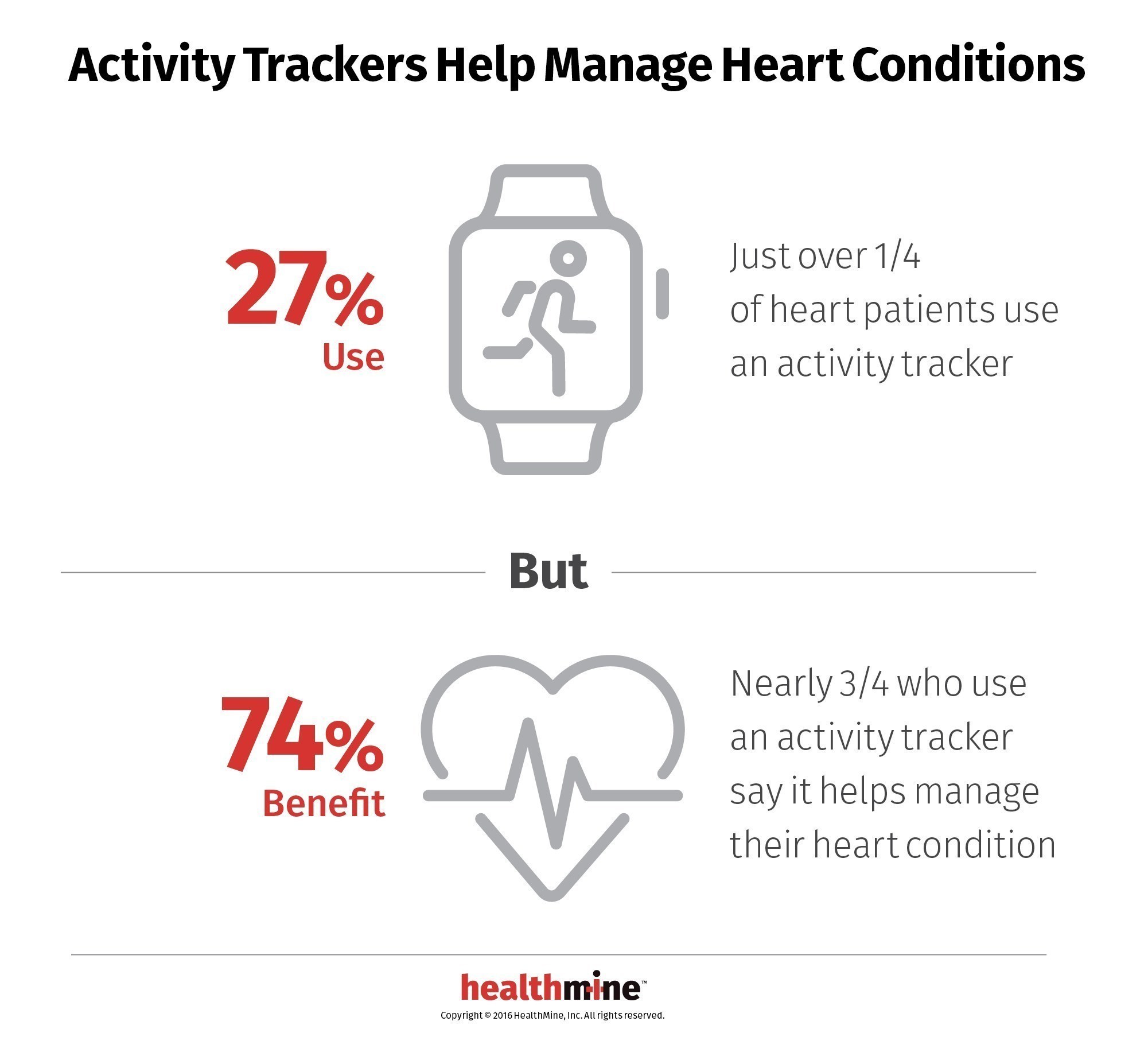
Source: HealthMine 2016 (PRNewsFoto/HealthMine)

Only 27% of consumers with known heart disease and/or risk are using an activity trackers with 16% say they are using their tracker to specifically manage their heart condition/risk. Yet 74% of those who do use an activity tracker report the device is helping them cope with their heart condition, according to January HealthMine survey of 501 consumers with known heart disease and/or risk.

Overall, HealthMine found that 31% of those with a heart condition/risk are using some type of mobile health tool to manage their condition/risk. Here’s what they are using:

31% of heart patients use mobile health tools to manage their condition

Mobile Tool

Percent Using to Manage Condition

Activity/fitness tracking device or app

50%

Blood pressure app

48%

Heart rate app

47%

Food/nutrition app

38%

The survey also revealed that 20% of respondents received a fitness or health-related gift for the holidays, and 10% say they were gifted a wearable activity tracker. As for the 69% of consumers with heart problems who aren’t using mobile health tools to manage their condition/risk, 36% say they prefer “traditional” methods to manage their health, and 34% say they don’t know which device/app to use. Another 20% say they don’t own a mobile device, and 15% find mobile health tools too confusing.

According to the American Heart Association, 27% of Americans are currently living with some form of cardiovascular disease. 47% of Americans have at least one of the three key risk factors for heart conditions: high blood pressure, high cholesterol or smoking. For heart patients, utilizing mobile devices and apps can provide a convenient way to help track risk factors and disease, including tools for self-data collection, fitness, diet, and more.

“Millions of wearable fitness tracking devices will be incorporated into wellness programs over the next few years. But they need to tie into a larger, clinically-based strategy to help consumers know where they stand with their health, what they need to do and stay motivated to do it,” said Bryce Williams, CEO and President of HealthMine.

  • LinkedIn
  • Twitter
  • Facebook
  • Email
  • Print

Tap Native

Get in-depth healthcare technology analysis and commentary delivered straight to your email weekly

Reader Interactions

Primary Sidebar

Subscribe to HIT Consultant

Latest insightful articles delivered straight to your inbox weekly.

Submit a Tip or Pitch

Featured Insights

Aligning IT & Clinical Teams: How to Reduce Friction and Improve Communication

Most-Read

M&A: Tempus AI to Acquire Personalis for $1.5B to Expand Precision Oncology and MRD Monitoring

M&A: Tempus AI to Acquire Personalis for $1.5B to Expand Precision Oncology and MRD Monitoring

Why Brain Health Is Entering Its Infrastructure Era

Brain Health’s Infrastructure Era: Proving Clinical Outcomes with Integrated Neuromotor Tracking

Why Catholic Health Inked a $500M Care Alliance with GE HealthCare to Automate Outpatient Triage

Catholic Health Inks $500M Care Alliance with GE HealthCare to Automate Outpatient Triage

KLAS Global HIT Trends 2026 Report: Artificial Intelligence Becomes the Top Investment Priority

KLAS Global HIT Trends 2026 Report: Artificial Intelligence Becomes the Top Investment Priority

Optum Partners with Anthropic to Deploy Claude Across Healthcare Claims and Revenue Workflows

Optum Partners with Anthropic to Deploy Claude Across Healthcare Claims and Revenue Workflows

Rock Health H1 2026 Digital Health Funding Recap: Startups Hit $7.4B in Venture Rebound

Rock Health H1 2026 Digital Health Funding Recap: Startups Hit $7.4B in Venture Rebound

M&A: ResMed to Sell MatrixCare Business to Frazier Healthcare Partners for $450M

M&A: ResMed to Sell MatrixCare Business to Frazier Healthcare Partners for $450M

The Real Risk in Healthcare AI Isn’t the Model. It’s the Data. 

Clinical Data Fidelity: The Real Blindspot in Healthcare AI Strategy

KLAS 2026 EHR Market Share Report: Epic Gains as Oracle Health Faces Third Year of Losses

KLAS 2026 EHR Market Share Report: Epic Gains as Oracle Health Faces Third Year of Losses

Qualtrics Acquires Press Ganey Forsta for $6.75B to Create the Most Comprehensive AI Experience Platform

M&A: Qualtrics Completes $6.75B Acquisition of Press Ganey Forsta

Secondary Sidebar

Footer

Company

  • About Us
  • 2026 Editorial Calendar
  • Advertise with Us
  • Reprints and Permissions
  • Op-Ed Submission Guidelines
  • Contact
  • Subscribe

Editorial Coverage

  • Opinion
  • Health IT
    • Care Coordination
    • EMR/EHR
    • Interoperability
    • Population Health Management
    • Revenue Cycle Management
  • Digital Health
    • Artificial Intelligence
    • Blockchain Tech
    • Precision Medicine
    • Telehealth
    • Wearables
  • Startups
  • Value-Based Care
    • Accountable Care
    • Medicare Advantage

Connect

Subscribe to HIT Consultant Media

Latest insightful articles delivered straight to your inbox weekly

Copyright © 2026. HIT Consultant Media. All Rights Reserved. Privacy Policy |