

What You Should Know
- KLAS latest report, Data Archiving 2026, interviewed 36 vendor-identified deep adopters between September 2025 and March 2026 to evaluate how health organizations utilize archiving software beyond basic legal and retention requirements.
- Advanced capabilities like AI-driven clinical decision support and real-time analytics are rarely in production, with 60% of deep adopters showing no interest in using archived data for AI or research enablement.
- Financial return on investment is most consistently realized through legacy system decommissioning, reduced IT infrastructure overhead, and eliminated vendor maintenance contracts.
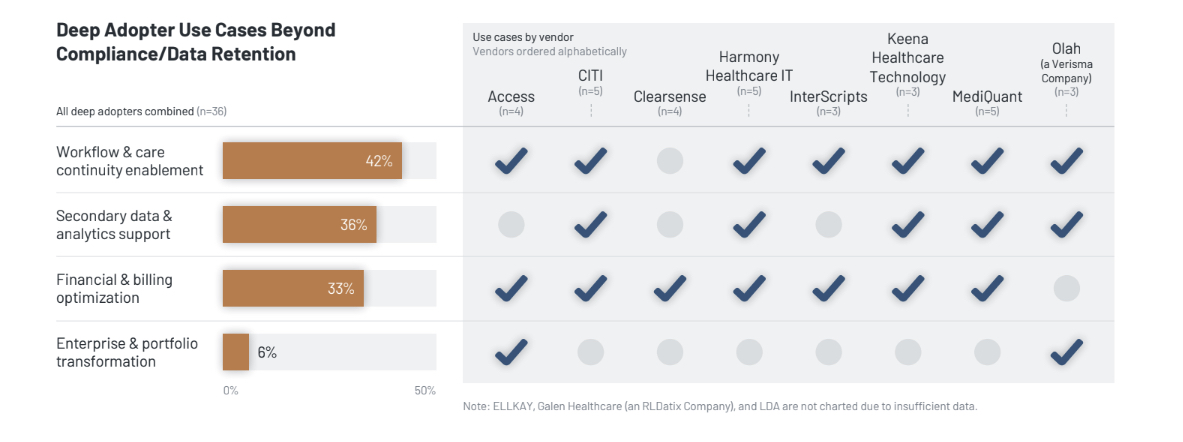
- Workflow and care continuity enablement represents the most dominant non-compliance use case, with 42% of deep adopters leveraging archives for EHR-integrated access to historical patient records.
- True enterprise analytics value cannot be delivered by the archive alone; achieving future-state data modeling goals typically requires distinct capital investments in external governance and normalization infrastructure.
Data Archiving Platforms in 2026: Moving Past Retention to Drive Workflow and Care Continuity
For years, healthcare data archiving occupied a predictable, unglamorous corner of the hospital IT budget. It was widely perceived as a passive tool designed strictly to satisfy state-level retention laws, manage compliance metrics, and store historical records safely out of sight. Recently, however, a noticeable marketing shift occurred across the technology vendor landscape. Modern archiving vendors have begun positioning their systems as broad data platforms capable of fueling advanced analytics, natural language processing (NLP), and artificial intelligence (AI) models.
This aggressive repositioning has left healthcare technology leaders with an expensive question: are these expanded, intelligent use cases actually taking hold at the bedside and in the back office, or are they merely creative marketing hype?
To uncover the ground truth, a May 2026 KLAS performance brief, Data Archiving 2026: How Deep Adopter Use Cases Go Beyond Compliance & Data Retention, investigated 36 deep adopters of archiving solutions across leading platforms—including Access, CITI, Clearsense, Harmony Healthcare IT, InterScripts, Keena Healthcare Technology, MediQuant, and Olah. The findings reveal a stark divergence between marketing roadmaps and real-world implementation. While vendors aggressively promote future-state algorithmic tools, the actual value driven by data archiving remains overwhelmingly operational, rooted in system consolidation, workflow enablement, and immediate cost reduction.
The AI Disconnect: Why Hype Meets Hostility on the Ground
The most striking revelation from the KLAS research is the massive industry pushback against archive-based artificial intelligence. Despite widespread discussion regarding machine learning adoption, a staggering 60% of surveyed deep adopters explicitly state they have zero interest in utilizing their archived records for AI modeling or research enablement.
On the production front, the numbers are microscopic: only two unique healthcare organizations report using archived data pools for AI/ML model training, and just one has operationalized NLP-based text extraction. Advanced capabilities like real-time data analytics or AI-driven clinical decision support (CDS) are rarely active at the point of care; instead, they are consistently categorized as distant, future-state operational goals.
This deployment gap exists because data archives are structurally isolated from the broader enterprise clinical pipeline. Deep adopters point out that realizing advanced analytics capabilities introduces complex organizational hurdles surrounding data extraction, normalization, and semantic workflow integration. The report delivers a vital warning for healthcare IT leaders: organizations should not evaluate data archiving vendors as if the archive alone will unlock enterprise AI value. Doing so successfully requires separate, heavy infrastructure investments in external data governance, clinical data refineries, and separate analytical platforms.
Real-World ROI: The Power of Decommissioning and Legacy Elimination
While advanced analytics remains a future goal, data archiving platforms are delivering massive, quantifiable financial value when matched with clear, operational objectives. The primary driver of this financial return is the systemic retirement of old applications, which effectively eliminates tech debt.
When a health system executes a modern enterprise EHR implementation, it is frequently forced to keep dozens of legacy software applications running on life support simply to maintain access to historical patient records for legal or clinical reference. This introduces a heavy financial tax via active infrastructure maintenance contracts, software licenses, and dedicated server costs.
Data archiving platforms provide an immediate solution to this financial drain:
- Targeted Capital Relief: Deep adopters most consistently achieve an immediate return on investment by executing total legacy system decommissioning, permanently removing expensive third-party maintenance contracts, and simplifying their application portfolios.
- Labor Efficiency Gains: Significant workflow value is felt directly within Health Information Management (HIM) departments. By consolidating legacy records into a centralized, searchable archive, organizations minimize administrative navigation, reduce the burden of manual chart reviews, and streamline the release-of-information process.
- Security Optimization: Retiring fragmented, unpatched legacy hardware configurations significantly improves the health system’s risk reduction posture, closing down forgotten network entry points that hackers routinely target.
The Dominance of Workflow and Care Continuity Enablement
When looking strictly at non-compliance use cases currently active in production, Workflow & Care Continuity Enablement emerges as the definitive market leader, cited by 42% of combined respondents. Rather than leaving historical charts isolated in a separate database, leading health systems are integrating their archives directly into active EHR workflows. This allows an active physician to pull up a patient’s historical longitudinal charts, old lab panels, or historical care documentations seamlessly within their primary record view, maintaining absolute care continuity across multi-year encounters.
Following workflow enablement, 36% of adopters leverage their archives for secondary data and analytics support—though this is heavily driven by exporting information into external databases rather than using native archive code—and 33% utilize systems for financial and billing optimization, such as legacy accounts receivable (A/R) rundown and patient accounting continuity.
Navigating Capital Realism
The real-world insights delivered by Benjamin Cassity and Jaren Day in this KLAS report align perfectly with the macroeconomic landscape dominating healthcare technology. With health systems navigating severe, unprecedented operational margin pressures and acute clinician burnout, the industry has universally entered a phase of strict capital realism.
The current trend reflects an aggressive reallocation of capital away from core transaction records to fund highly specialized systems of action. However, as healthcare leaders seek a clear Return on AI Investment (ROAI™), they must maintain absolute clarity regarding where their infrastructure boundaries sit.
The data confirms that treating a data archive as an out-of-the-box AI engine is a recipe for operational failure. The real value of an archive in 2026 is its ability to act as an exceptional, highly efficient operational safety net. By using archiving software to purge legacy technology debt, drive out manual labor costs, and fuel EHR-integrated care continuity, executives can cleanly optimize their financial baselines—giving them the exact fiscal breathing room required to fund true, scalable AI innovations elsewhere across the clinical enterprise.
