
• Skip to main content
  • Skip to secondary menu
  • Skip to primary sidebar
  • Skip to secondary sidebar
  • Skip to footer

  • Opinion
  • Health IT
    • Behavioral Health
    • Care Coordination
    • EMR/EHR
    • Interoperability
    • Patient Engagement
    • Population Health Management
    • Revenue Cycle Management
    • Social Determinants of Health
  • Digital Health
    • AI
    • Blockchain
    • Precision Medicine
    • Telehealth
    • Wearables
  • Life Sciences
  • Investments
  • M&A
  • Value-based Care
    • Accountable Care (ACOs)
    • Medicare Advantage

Tebra Report: 3 in 5 Staff Say ChatGPT Cuts Burnout—But 14% Admit They Can’t Function Emotionally Without It

by Fred Pennic 02/06/2026 Leave a Comment

  • LinkedIn
  • Twitter
  • Facebook
  • Email
  • Print

What You Should Know

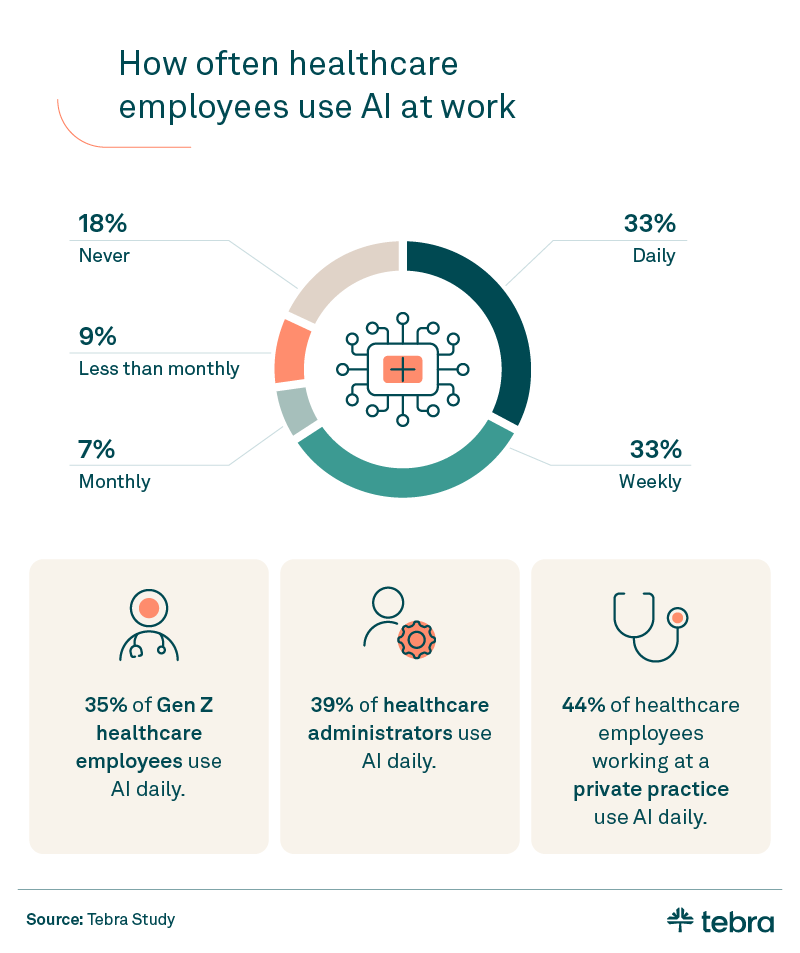
  • The Benefit: A new survey from Tebra reveals that 3 in 5 healthcare employees report ChatGPT has reduced burnout by streamlining documentation and communication. In private practices, 44% of staff now use AI daily.
  • The Dependency: The efficiency comes with a psychological cost. 14% of respondents admit to feeling “emotionally dependent” on AI (checking it impulsively or feeling anxiety without it), and 47% have used it for emotional processing.
  • The Risk: AI is now mission-critical infrastructure. 13% of staff say an AI outage is more stressful than an EHR crash, yet only 27% of organizations have a documented backup plan for when these tools go down.

The Burnout Antidote

First, the good news: AI is doing exactly what it promised to do. Three in five (60%) healthcare employees report that tools like ChatGPT have helped reduce burnout. By offloading the “pajama time” tasks—documentation, note-taking, and patient communication—AI has become a vital pressure valve for an overworked industry.

Adoption is particularly aggressive in the independent sector. 44% of private practice employees use AI daily, compared to 33% of the broader healthcare workforce. For these smaller organizations, AI isn’t just a tool; it’s the extra staff member they couldn’t afford to hire.

The “Shadow” Support System

However, the data reveals a complex psychological shift. AI is not just being used to draft emails; it is being used to cope.

  • 14% of employees admit to feeling “emotionally dependent” on AI—defined as checking it impulsively or feeling anxiety without access.
  • 47% have used ChatGPT or similar tools for “emotional processing.”
  • 27% have deleted inputs out of fear of judgment or privacy concerns.

This suggests that for a significant minority of the workforce, AI has morphed from a productivity software into a digital confidant. While 42% are aware of OpenAI’s new mental health guardrails, less than half believe they go far enough to protect vulnerable users.

The New Single Point of Failure

Perhaps the most alarming finding for IT leaders is the fragility of this new workflow. As AI integrates into the daily rhythm, it becomes a single point of failure. 13% of respondents stated that an AI tool outage is more stressful than an Electronic Health Record (EHR) crash. Even more surprising, 12% consider an AI outage more disruptive than a colleague calling out sick. Despite this, preparedness is dangerously low. Only 27% of healthcare employees are aware of a documented backup plan if their AI tools go offline.

  • LinkedIn
  • Twitter
  • Facebook
  • Email
  • Print

Tagged With: Artificial Intelligence

Tap Native

Get in-depth healthcare technology analysis and commentary delivered straight to your email weekly

Reader Interactions

Primary Sidebar

Subscribe to HIT Consultant

Latest insightful articles delivered straight to your inbox weekly.

Submit a Tip or Pitch

Doctors Don’t Buy Medical Tech Anymore. IT Does.

Best Practices for IT and Clinical Collaboration in Medical Tech Implementation

Most-Read

SAMHSA and ONC Invest $20M in Behavioral Health IT Initiative

HHS Reverses 2024 Tech Reorganization: Why HHS Just Stripped AI and Cyber Operations Out of the ONC

How Small Medical Practices Can Build HIPAA-Aligned DevSecOps Without Enterprise Budgets

How Small Medical Practices Can Build HIPAA-Aligned DevSecOps Without Enterprise Budgets

Insilico Medicine and Eli Lilly Form $2.75B AI Drug Discovery Collaboration

Insilico Medicine and Eli Lilly Form $2.75B AI Drug Discovery Collaboration

Microsoft Copilot Health, Integrates Apple Health, Oura, and 50,000 EHRs in New AI Push

Microsoft Launches Copilot Health, Integrates Apple Health, Oura, and 50,000 EHRs in New AI Push

Health Recovery Solutions (HRS) Acquires Rimidi for Chronic Care Management and RPM Integration

Health Recovery Solutions (HRS) Acquires Rimidi for Chronic Care Management and RPM Integration

RadNet Subsidiary DeepHealth Acquires French Radiology AI Leader Gleamer

RadNet’s $269M AI Play: DeepHealth Acquires French AI Gleamer

Walgreens Launches Virtual Weight Management Platform for Self-Pay GLP-1 Patients

Walgreens Launches Virtual Weight Management Platform for Self-Pay GLP-1 Patients

KLAS Digital Pathology 2026 Report: Top IMS, Scanner, and AI Vendors Evaluated

KLAS Digital Pathology 2026 Report: Top IMS, Scanner, and AI Vendors Evaluated

The "Platform" Squeeze: Epic Releases Native AI Charting, Putting Venture-Backed Scribes on Notice

The “Platform” Squeeze: Epic Releases Native AI Charting, Putting Venture-Backed Scribes on Notice

Analysis: Oracle Cerner’s Plans for a National EHR

Oracle May Cut 30k Jobs and Sell Cerner to Fund $156B OpenAI Deal

Secondary Sidebar

Footer

Company

  • About Us
  • 2026 Editorial Calendar
  • Advertise with Us
  • Reprints and Permissions
  • Op-Ed Submission Guidelines
  • Contact
  • Subscribe

Editorial Coverage

  • Opinion
  • Health IT
    • Care Coordination
    • EMR/EHR
    • Interoperability
    • Population Health Management
    • Revenue Cycle Management
  • Digital Health
    • Artificial Intelligence
    • Blockchain Tech
    • Precision Medicine
    • Telehealth
    • Wearables
  • Startups
  • Value-Based Care
    • Accountable Care
    • Medicare Advantage

Connect

Subscribe to HIT Consultant Media

Latest insightful articles delivered straight to your inbox weekly

Copyright © 2026. HIT Consultant Media. All Rights Reserved. Privacy Policy |