
What You Should Know
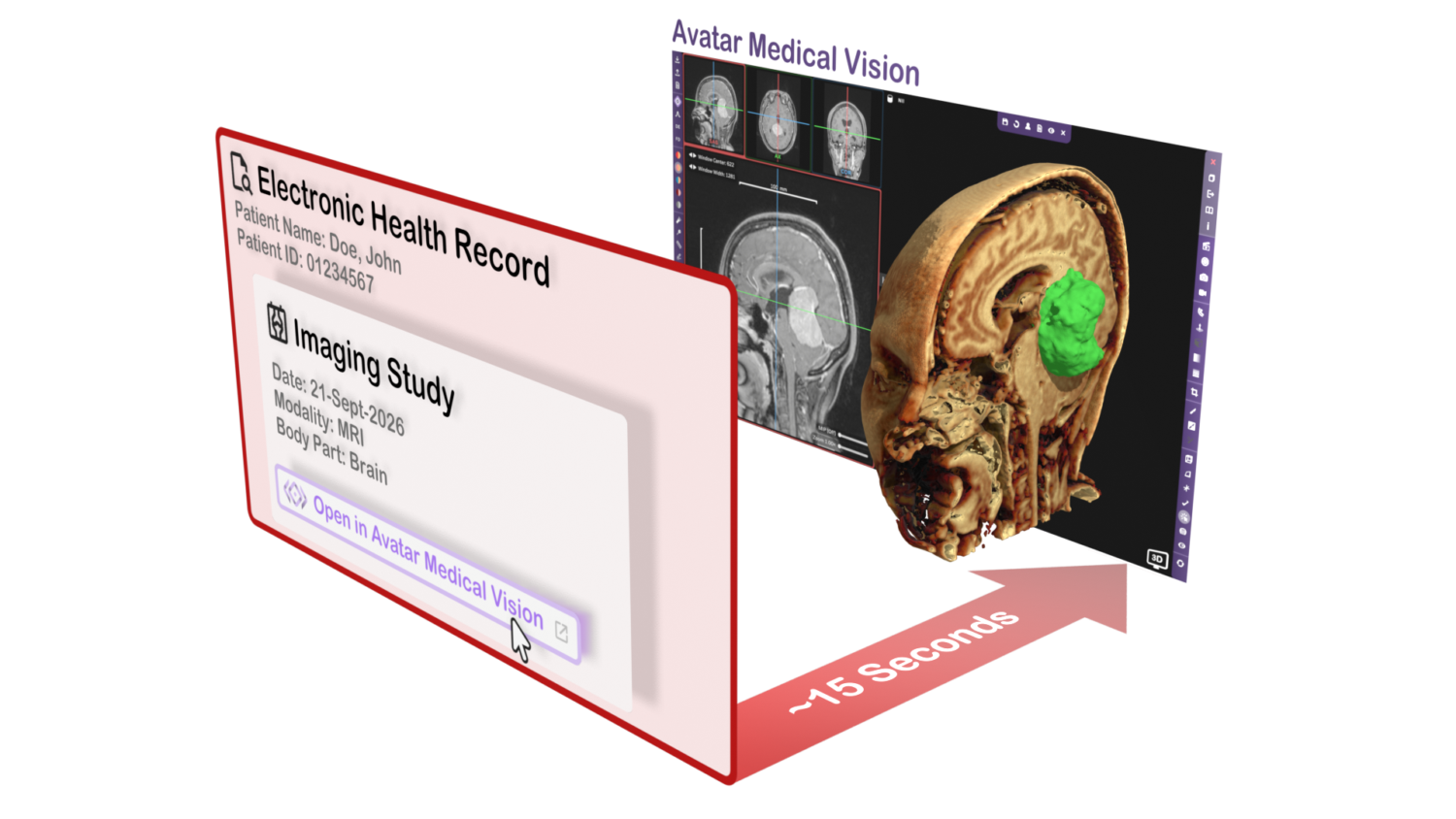
- Medical visualization company Avatar Medical announced that its flagship software, Avatar Medical Vision, can now be launched natively from within Epic’s EHR.
- The integration enables attending physicians and surgeons to transition from a patient’s active clinical record directly into interactive, patient-specific 3D anatomical models in a few clicks, carrying patient context automatically to eliminate manual imaging searches, credential logins, and duplicate data entry.
- The software converts standard cross-sectional CT and MRI DICOM scans into interactive 3D visualizations in real time without manual segmentation or preprocessing, rendering every voxel at native resolution.
- Deployed clinically via Eonis Vision—a turnkey solution combining Avatar Medical Vision software with Barco’s medical-grade Eonis 3D autostereoscopic display (built on Leia’s Immersity platform)—delivering true glasses-free, headset-free 3D visualization in standard outpatient consultation rooms and preoperative suites.
Real-Time Rendering Without Segmentation
Originating from biophysical imaging research conducted at Institut Curie and Institut Pasteur, Avatar Medical’s core technology differentiates itself by bypassing traditional rendering friction:
- Zero Segmentation Overhead: Avatar Medical Vision converts standard DICOM CT and MRI scan series into interactive, patient-specific 3D anatomical models instantly, eliminating the manual organ-contouring and segmentation steps that previously took hours or days.
- Glasses-Free 3D Display Delivery: Delivered via the Eonis Vision enterprise hardware-software bundle—co-developed with visualization leader Barco—the system pairs Avatar’s rendering software with Barco’s Eonis 3D autostereoscopic medical display. This allows clinicians and patients to experience depth-accurate, holographic-style 3D anatomy simultaneously in the exam room without wearing headsets, goggles, or specialized glasses.
- Global Regulatory Clearance: The underlying medical device software platform is FDA 510(k)-cleared in the United States and CE-marked in Europe, operating across more than 20 hospital systems internationally.
Initial Enterprise Deployment: UHealth Skull Base Surgery
The first clinical deployment of this native Epic-integrated workflow is currently underway at UHealth – University of Miami Health System led by Dr. Michael Ivan, Professor of Neurological Surgery and Director of Skull Base Surgery at UHealth and the Miller School of Medicine. In neurosurgery and complex skull base oncology, spatial understanding is critical for informed consent. The system gives patients an intuitive view of tumor margins, cranial nerves, and vascular anatomy, improving communication during preoperative decision-making.
Maximizing Enterprise PACS and EHR Capital
Health systems invest hundreds of millions in high-resolution CT/MRI scanners, enterprise Picture Archiving and Communication Systems (PACS), and EHR infrastructure. Yet, the resulting data remains largely illegible to the consumer. Converting routine DICOM slices into interactive visual assets extends the economic and clinical return on existing imaging assets.
Hospital CIOs and CMIOs routinely reject point tools that force clinicians to alt-tab out of the EHR, log into external portals, or re-enter patient MRNs. Launching directly within Epic ensures the visualization engine operates as an ambient feature of the encounter rather than an administrative distraction.
Clear anatomical comprehension directly improves patient agency, mitigates preoperative anxiety, and supports defensible informed consent—an increasingly vital operational factor as surgical practices work to enhance the consumer care experience and reduce post-operative dissatisfaction.
“Healthcare has invested for decades in technologies that help clinicians understand patients. Our mission is to help patients understand themselves,” said Xavier Wartelle, CEO of Avatar Medical. “Three-dimensional visualization has existed since the late 1980s but never made it into the clinic; it’s too slow, too complex. That changes now: letting a surgeon pull up a patient-specific 3D view in a couple of clicks, right from the medical record, is what finally unlocks adoption. This is the moment 3D moves from the radiology lab into everyday care.”
