
What You Should Know
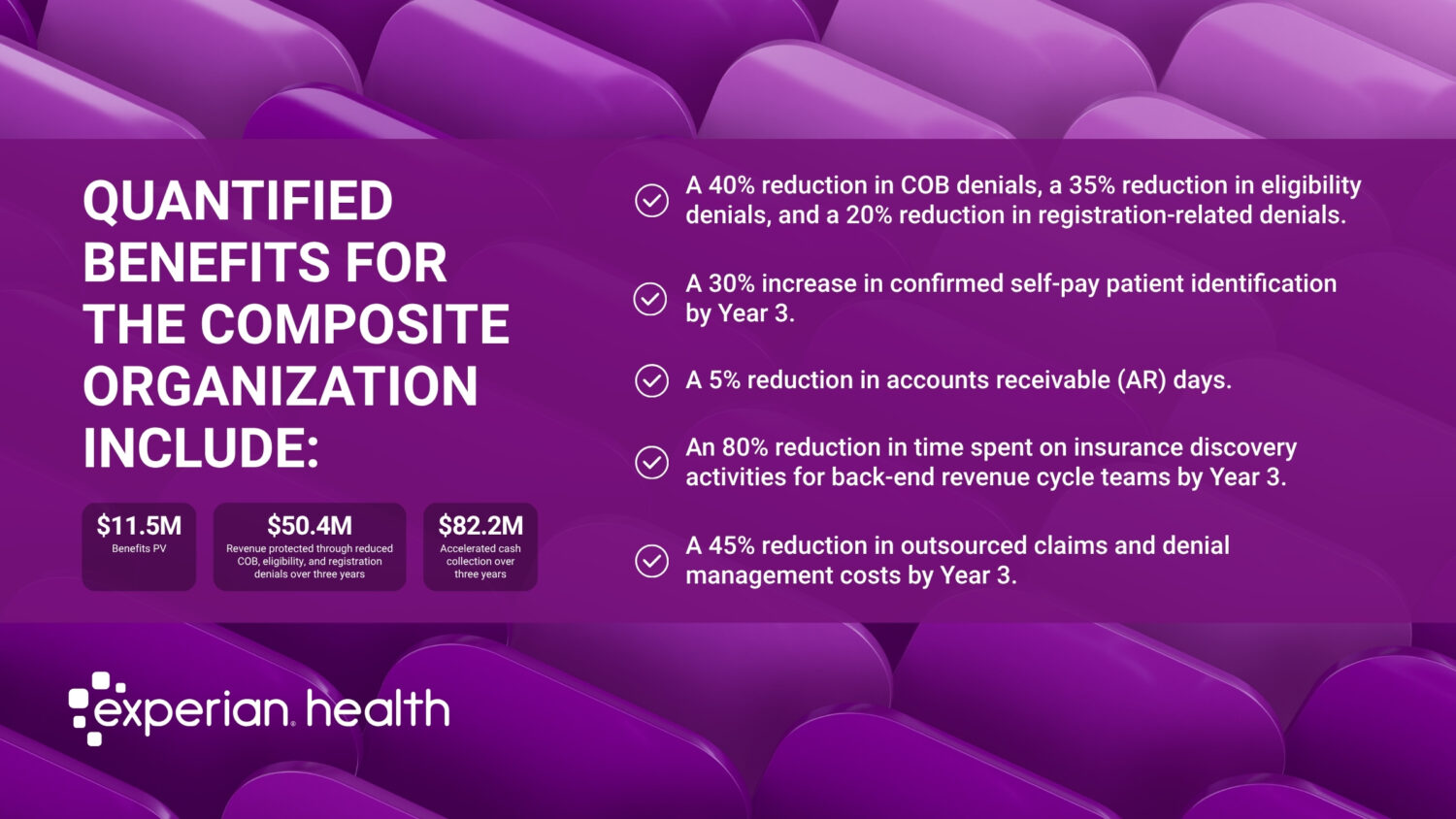
- A commissioned Total Economic Impact™ (TEI) study conducted by Forrester Consulting in August 2026 revealed that Experian Health’s Patient Access Curator™ protected $50.4M in revenue over three years for a modeled composite health system.
- Over a three-year implementation window, the platform reduced coordination of benefits (COB) denials by 40%, eligibility denials by 35%, and registration-related denials by 20%.
- The financial analysis evaluated a composite integrated delivery network modeled from five customer interviews, representing a U.S. health system generating $5 billion in annual revenue, employing 20,000 staff, and serving 700,000 patients annually.
- By Year 3, deployment of the AI-powered coverage intelligence engine produced an 80% reduction in time spent on manual insurance discovery, releasing approximately 10,400 hours annually (equivalent to five full-time employees and $887,000 in redirected workforce capacity across three years).
Front-Door Denial Reduction and Direct Cash Acceleration
By automating patient intake data curation—validating demographics, active coverage, coordination of benefits (COB), and Medicare Beneficiary Identifier (MBI) records before encounters take place—the platform delivered significant front-end denial reductions over the three-year modeled period:
- Coordination of Benefits (COB) Denials: Reduced by 40%, mitigating disputes over primary vs. secondary payer order.
- Eligibility Denials: Decreased by 35%, intercepting inactive policies and terminated plan enrollments at registration.
- Registration-Related Denials: Dropped by 20%, correcting mismatched demographic markers, misspelled names, and miskeyed policy IDs.
- Cash Flow Acceleration: Yielded $82.2M in accelerated cash collections and generated a 5% reduction in days in accounts receivable (A/R days), alongside a 30% increase in upfront self-pay collections by Year 3.
Labor Reallocation and Operational Efficiencies
Beyond top-line revenue defense, the study quantified significant administrative labor savings by eliminating manual insurance searches and reducing reliance on outsourced BPO clearinghouses:
- 80% Cut in Insurance Discovery Time: Freed up approximately 10,400 hours annually across a typical 25-person patient access team—translating to the capacity of five full-time employees (FTEs) and roughly $887,000 in redirected labor value over three years.
- 45% Reduction in Outsourced Denial Management Spend: Yielded an estimated $2.25M in external vendor savings for health systems with a baseline $5M annual BPO budget.
- 10% Front-End Staff Productivity Lift: Automated real-time verification relieved front-desk registrars from manual phone calls and portal hopping, cutting downstream billing rework.
- Risk-Adjusted Present Value: Translated into $11.5M in net present-value (NPV) benefits over three years, which the report contextualized as equivalent to funding annual wages for 115 registered nurses, conducting 115,000 primary care visits, or purchasing seven new MRI systems.
Shifting RCM Left
The findings demonstrate a structural transition across revenue cycle leadership: shifting investment away from reactive, post-bill denial recovery toward proactive pre-service clearance. While legacy RCM strategies deployed downstream accounts receivable teams to chase denied claims through payer appeals, health systems are increasingly using AI-driven verification engines at intake to eliminate preventable data errors at the source. This upstream automation protects operating margins, insulates health systems against payer audit clawbacks, and spares patients from surprise out-of-network balance bills caused by misassigned insurance.
