
What You Should Know
- Salesforce announced three major enterprise artificial intelligence additions to its life sciences portfolio: Regulated Content Management (RCM), Command Center for Life Sciences, and Life Sciences MCP (Model Context Protocol).
- Focuses on widespread industry inefficiencies, targeting scenarios where half of all pharmaceutical drug launches fail to meet pre-launch projections and commercial teams spend months waiting for manual Medical, Legal, and Regulatory (MLR) sign-offs.
- RCM arrives for early adopters in October 2026 (general availability in 2027); Command Center and Life Sciences MCP will launch generally in 2027, with headless connectivity capabilities available immediately.
1. Regulated Content Management (RCM): Shifting Compliance Upstream
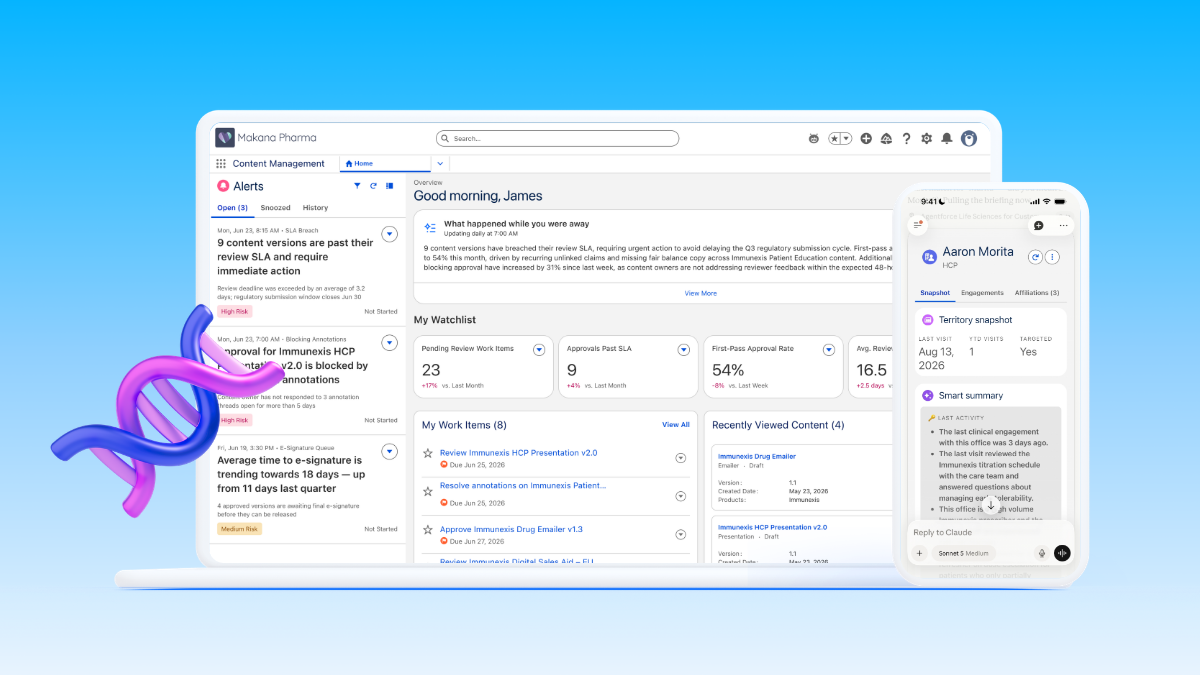
Rather than treating MLR review as an isolated bottleneck where reviewers must reconstruct scientific context from scratch, Regulated Content Management embeds compliance directly into content creation.
Built on Salesforce’s agentic architecture, RCM treats claims, supporting clinical evidence, literature citations, and market-specific obligations—such as Fair Balance and Important Safety Information (ISI)—as living, connected data.
- Governed Claims Management: Autonomous agents scan drafted promotional copy, match assertions against approved enterprise claim libraries, and surface linked substantiation and expiry dates in real time.
- Contextual Authoring: Content is generated and refined against brand playbooks, channel constraints, and target audience segments while dynamically enforcing compliance rules during drafting.
- Federated Architecture & 21 CFR Part 11 Auditability: RCM operates as an open compliance layer that connects to existing Digital Asset Management (DAM) and Content Management Systems (CMS) without requiring asset consolidation into a single repository. All actions, annotations, and approvals are recorded in an immutable, ALCOA+-compliant audit trail supporting 21 CFR Part 11 electronic signatures.
2. Command Center for Life Sciences: Signal Detection and Root-Cause Orchestration
The Command Center for Life Sciences acts as a cross-functional control plane linking clinical, medical affairs, commercial operations, and patient support.
Powered by Tableau Next, the Command Center consolidates real-time customer and market signals, identifies operational anomalies, and uses AI agents to execute mitigating actions:
- Clinical Operations: Identifies protocol deviations and missing patient data across trial sites, alerting teams via Clinical Command Hubs and contract research organization (CRO) portals before study milestones slip.
- Medical Affairs: Detects sentiment shifts and scientific knowledge gaps among Key Opinion Leaders (KOLs), dispatching Medical Science Liaisons (MSLs) for targeted peer-to-peer engagement.
- Commercial Strategy: Surfaces real-time formulary revisions and coverage restrictions, prompting Key Account Managers (KAMs) to mobilize payer and health system outreach.
- Patient Services: Flags therapy adherence drops within Patient Support Programs (PSPs) and coordinates timely interventions through Field Reimbursement Managers.
3. Life Sciences MCP: Headless, Governed Intelligence Beyond the CRM
Recognizing that clinical trial monitors, commercial specialists, and compliance officers rarely spend their entire workday inside a single CRM interface, Salesforce is using the open Model Context Protocol (MCP) to deploy Life Sciences MCP.
The framework allows organizations to project Agentforce Life Sciences capabilities into external surfaces—including Slack, Microsoft Teams, WhatsApp, partner portals, and developer environments like Claude Code—without rebuilding compliance logic. Platform-level guardrails automatically enforce zero data retention, personally identifiable information (PII) masking, and strict adherence to HIPAA, GxP, and 21 CFR Part 11 requirements across all external endpoints.
Rollout and Availability Roadmap
- Regulated Content Management: Enters early access in October 2026, with general availability scheduled for 2027.
- Command Center for Life Sciences: Slated for general enterprise release in 2027.
- Life Sciences MCP: Targeted for broad deployment in 2027, with underlying headless APIs available immediately.
