
What You Should Know
- Gartner advises healthcare Chief Supply Chain Officers (CSCOs) to replace manual inventory counting and legacy scanning tools with autonomous supply rooms driven by computer vision and artificial intelligence.
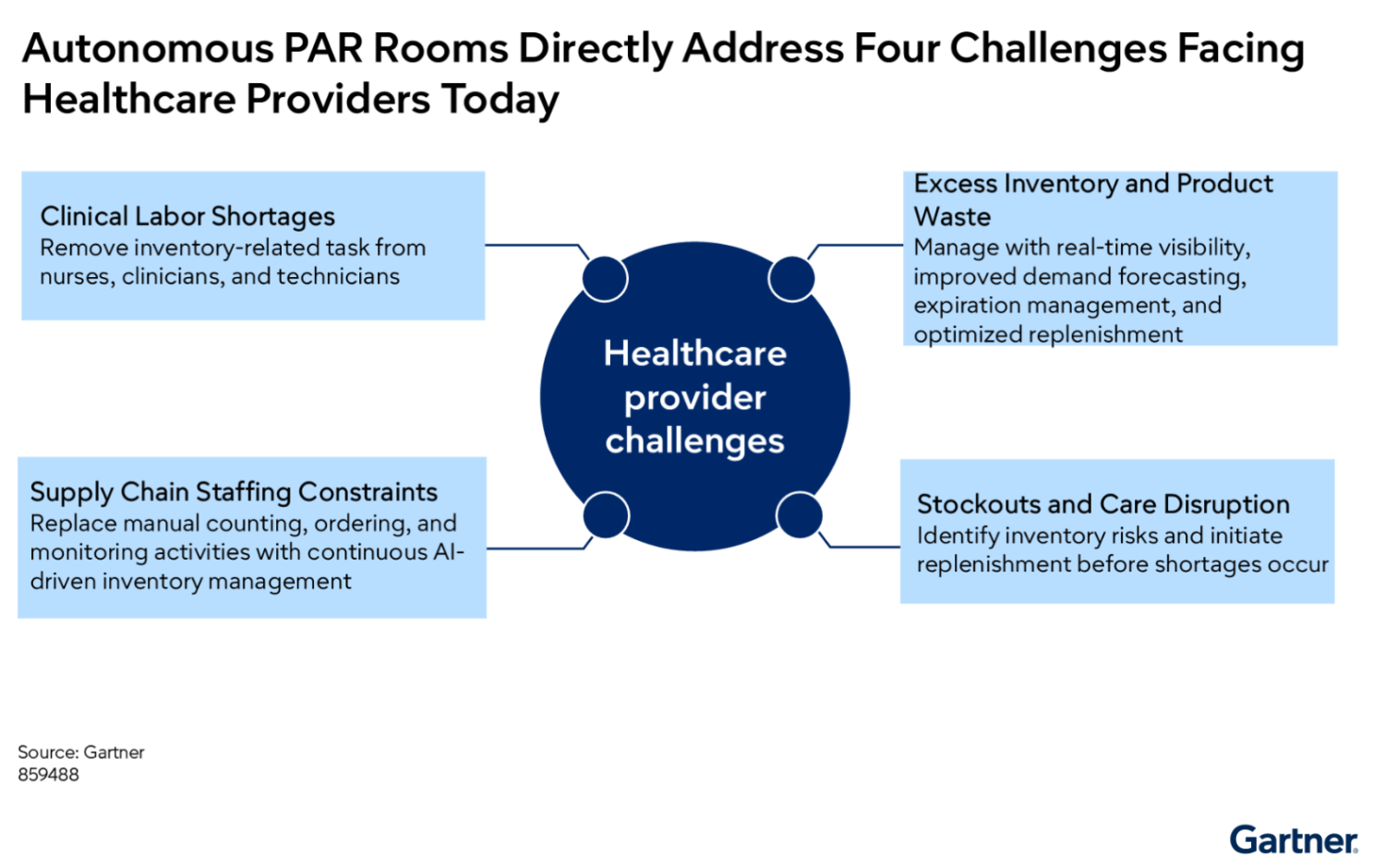
- Garner reveals advances in computer vision, spatial sensing, and workflow automation enable Periodic Automatic Replenishment (PAR) rooms to autonomously monitor inventory levels, predict demand, and trigger reorders with minimal human involvement.
- Autonomous supply rooms integrate overhead camera tracking, predictive replenishment algorithms, voice-directed guidance, illuminated pick-to-light bins, and electronic shelf labels (ESLs) to streamline clinician item retrieval.
Gartner Advises Healthcare CSCOs to Deploy Computer Vision for Autonomous Supply Rooms
Hospitals have spent decades equipping clinical staff with handheld barcode scanners, RFID wands, and smart inventory cabinets. Yet despite those digital tools, the underlying operational model has remained unchanged: human workers still spend countless hours manually walking stockrooms, counting boxes, and scanning shelves.
When materials technicians get bogged down in manual audits, visibility lapses, medical supplies expire quietly on back shelves, and bedside nurses lose valuable clinical time hunting through chaotic supply closets.
According to new research from Gartner, Inc., healthcare Chief Supply Chain Officers (CSCOs) should prepare to phase out manual stock counting entirely in favor of autonomous supply rooms driven by ceiling-mounted computer vision and predictive AI.
From Task Automation to True Operational Autonomy
Gartner draws a sharp operational distinction between technologies that merely assist manual tasks and systems that deliver true inventory autonomy. While barcodes, RFID tags, weighted bins, and badge-access smart cabinets improve individual data capture steps, they still force hospital staff to scan or count items.
Autonomous Periodic Automatic Replenishment (PAR) rooms eliminate human auditing from the equation:
- Continuous Optical Sensing: Ceiling-mounted cameras monitor stock levels, bin fullness, and shelf positions in real time, removing the need for manual physical counts.
- Predictive AI Replenishment: Machine learning models analyze historical usage patterns and upcoming clinical procedure schedules to automatically trigger purchase orders or warehouse picks before items hit critical shortages.
- Point-of-Care Clinician Guidance: Integrated pick-to-light bins, electronic shelf labels (ESLs), and voice prompts guide nurses directly to needed supplies in seconds.
Measuring Investments by Work Removed
Gartner advises supply chain executives not to let legacy hardware investments dictate future strategy, urging leadership to evaluate emerging technologies based on the physical labor they eliminate.
“Hospitals have spent years buying technology that helps employees count supplies, but employees are still doing the counting,” said Bruce Gilmore, VP Analyst in Gartner’s Supply Chain practice. “AI and computer vision create an opportunity to remove that work, rather than make it incrementally faster. This can enable nurses to spend more time with patients, rather than searching for missing items in stockrooms.”
Gartner clients can read more in: Getting to Inventory Autonomy: Build the Self-Managing Supply Room. Nonclients can learn more in: CSCO Roadmap for Building a Supply Chain AI Foundation.
