
What You Should Know
- Arintra, an autonomous medical coding startup headquartered in Austin, Texas, with engineering operations in Bengaluru, raised approximately $25 million in a Series B funding round led by Define Ventures.
- The syndicate includes new strategic backing from Yale New Haven Ventures and Endeavor Ventures, alongside participation from existing investors Y Combinator, Ten13 Capital, Counterpart Ventures, Spider Capital, and Peak XV Partners (which previously led Arintra’s $21 million Series A).
- Founded by AI PhDs Nitesh Shroff (CEO) and Preeti Bhargava (CTO), Arintra’s platform pairs large language models (LLMs) with clinical knowledge graphs to interpret unstructured medical charts in clinical context and autonomously apply specialty-specific CPT, ICD-10, HCC, and HCPCS billing codes.
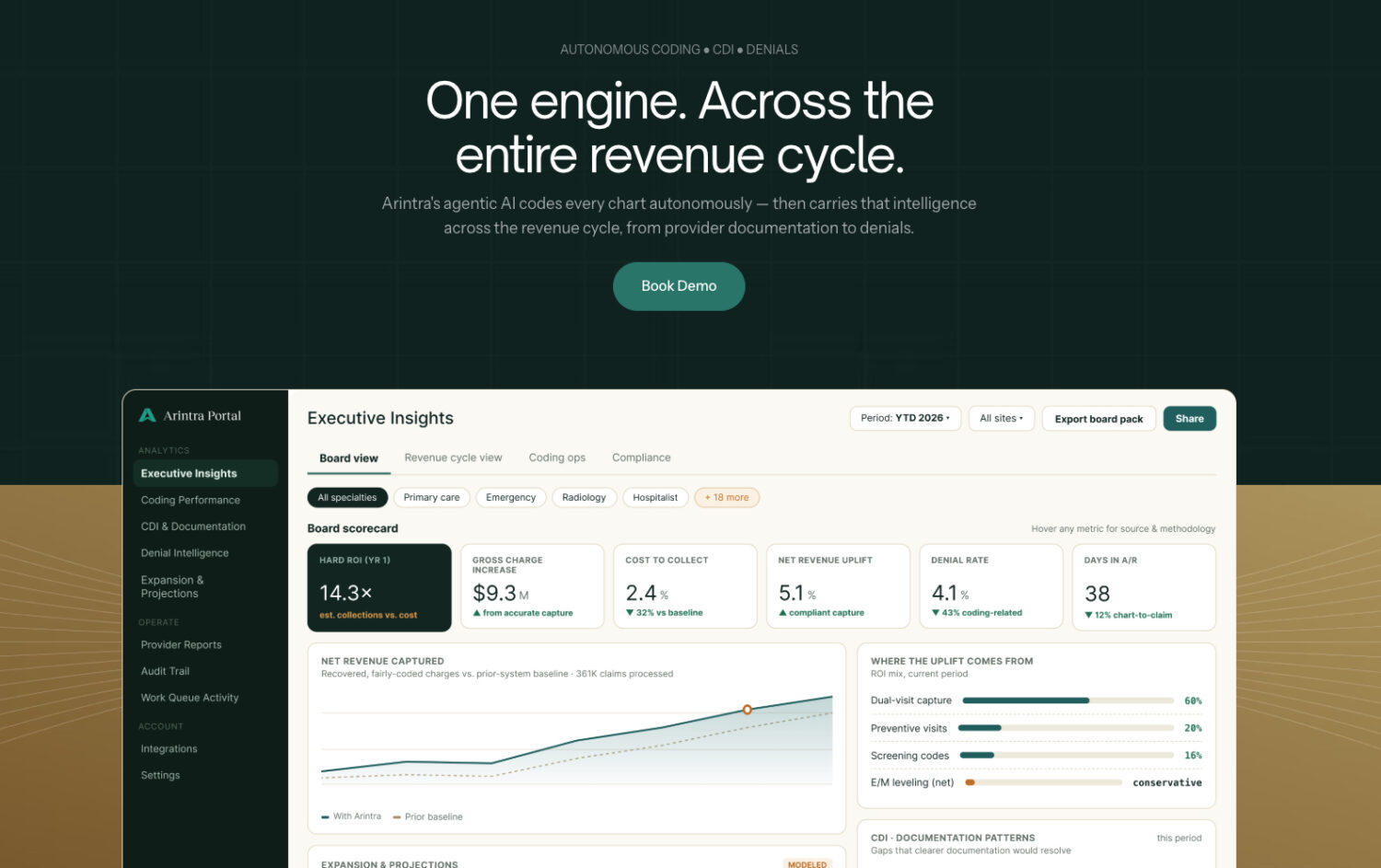
- The platform integrates bidirectionally with major electronic health record (EHR) systems—including Epic and Athenahealth—to create direct-to-billing claims with zero manual human retyping, driving documented operational outcomes including a 5%+ revenue uplift, 12%+ reduction in A/R days, and 43%+ reduction in coding-related denials.
Addressing the Mid-Revenue Cycle Bottleneck
Medical coding has been a headache for health systems for years, mostly because the gap between how doctors write notes and what billing systems require keeps getting wider. Turning complex operative notes, pathology reports, and daily visit summaries into accurate ICD-10, CPT, and HCPCS codes costs providers billions every year. Most hospitals are still running on older computer-assisted coding (CAC) tools that rely on basic keyword matching. When those tools miss the nuance of a chart, human coders get stuck reviewing massive backlogs by hand—dragging out accounts receivable (A/R) timelines, missing reimbursable charges, and running into avoidable payer denials.
To take that manual lift off revenue cycle teams, Arintra just closed a $25 million Series B round led by Define Ventures, bringing on support from Yale New Haven Ventures, Endeavor Ventures, Y Combinator, and Peak XV Partners.
Here is how their platform actually works and what it changes for hospital billing teams:
- Context-Aware Coding: Instead of searching for keywords, Arintra combines large language models with medical knowledge graphs. This lets the system understand clinical intent, track patient progression across a visit, and correctly determine E/M levels, diagnosis codes, and procedure modifiers on its own.
- Direct EHR Integration: The software hooks directly into major EHRs like Epic and Athenahealth. It pulls clinical notes straight from the encounter, generates the codes, and sends clean, verified claims back into the billing system without anyone having to re-enter data.
- Built-in Audit Trails: Every single code the system suggests is linked back to the exact sentence or phrase in the physician’s note that justified it, making it straightforward to defend during payer audits.
- Measurable Results: Across live health system rollouts, providers are seeing a 5% or higher increase in captured revenue, claim processing speeds improve by 12%, and coding-related denials drop by up to 43%.
The company was founded by AI researchers Nitesh Shroff and Preeti Bhargava, with commercial operations run out of Austin, Texas, and core engineering based in Bengaluru. With certified coders hard to find and hospital margins still razor-thin, this funding will help them scale their autonomous billing tech to more health systems and specialty groups looking to cut down on back-office rework.
