
What You Should Know
- Overall customer satisfaction with Medicare Advantage plans dropped 12 points in 2026 to 611 (on a 1,000-point scale), marking a 41-point cumulative decline since 2024 across all measured dimensions of the member experience, according to the JD Power 2026 U.S. Medicare Advantage Study.
- Fewer than half (43%) of plan members strongly agree that their Medicare Advantage insurer is a trusted partner in their health and wellness.
- The largest two-year satisfaction declines centered on core consumer value metrics: Helping to Save Me Time and Money (-51 points), Level of Trust (-49 points), and Product/Coverage Offerings Meet My Needs (-47 points).
- High-performing plans differentiated themselves through proactive communication and structured onboarding: members who report understanding their coverage well are nearly twice as likely to feel their plan anticipates their needs (29% vs. 16%) and prepares them for unexpected events (34% vs. 17%).
- Special Needs Plans (SNPs) generated substantially higher overall satisfaction and trust ratings, validating that high-touch care coordination and personalized navigation models improve member perception among complex, high-risk populations.
Key Drivers of Member Discontent and Trust Erosion
JD Power 2026 U.S. Medicare Advantage Study—based on responses from 14,559 Medicare Advantage enrollees across 12 major U.S. market regions—evaluates plan performance across eight core dimensions:
- Mounting Financial & Trust Deficits: Fewer than half (43%) of plan members strongly agree that their insurer is a trusted partner in their health and wellness. The steepest two-year declines occurred in Helping to Save Me Time and Money (-51 points), Level of Trust (-49 points), and Product/Coverage Offerings Meet My Needs (-47 points).
- The Onboarding Comprehension Multiplier: New member education serves as a major driver of downstream satisfaction. Among members who report a strong understanding of their coverage from day one, 34% feel their insurer prepares them for unexpected health expenses and 29% believe the plan anticipates their clinical needs, compared to just 17% and 16%, respectively, among poorly onboarded members.
- Special Needs Plans (SNPs) Outperform Standard Plans: Dual-Eligible Special Needs Plans (D-SNPs) and Chronic Condition SNPs (C-SNPs) delivered significantly higher overall satisfaction and trust scores, illustrating that high-touch care coordination, dedicated health advocates, and tailored in-home support structures directly elevate member perception.
Regional Market Leaders
- Tennessee: BlueCross BlueShield of Tennessee (690)
- Pennsylvania: UPMC for Life (689)
- Michigan: Blue Cross Blue Shield of Michigan (676)
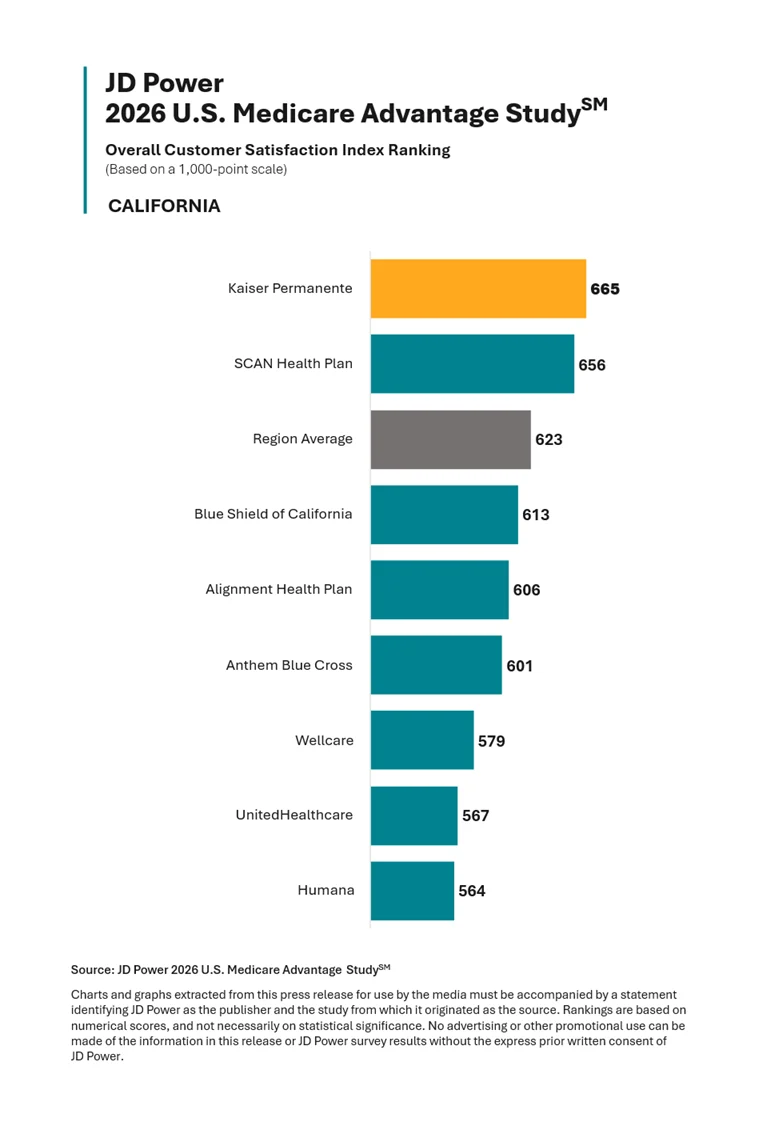
- California: Kaiser Permanente (665)
- Georgia: UnitedHealthcare (656)
- North Carolina: UnitedHealthcare (645)
- Texas: Humana (641)
- Ohio: Aetna Medicare (639)
- Illinois: Blue Cross Blue Shield of Illinois (638)
- Kentucky: Humana (625)
- Florida: UnitedHealthcare (621)
- New York: Excellus BlueCross BlueShield (618)
For more information about the U.S. Medicare Advantage Study, visit https://www.jdpower.com/business/u-s-medicare-advantage-study/.
