
What You Should Know
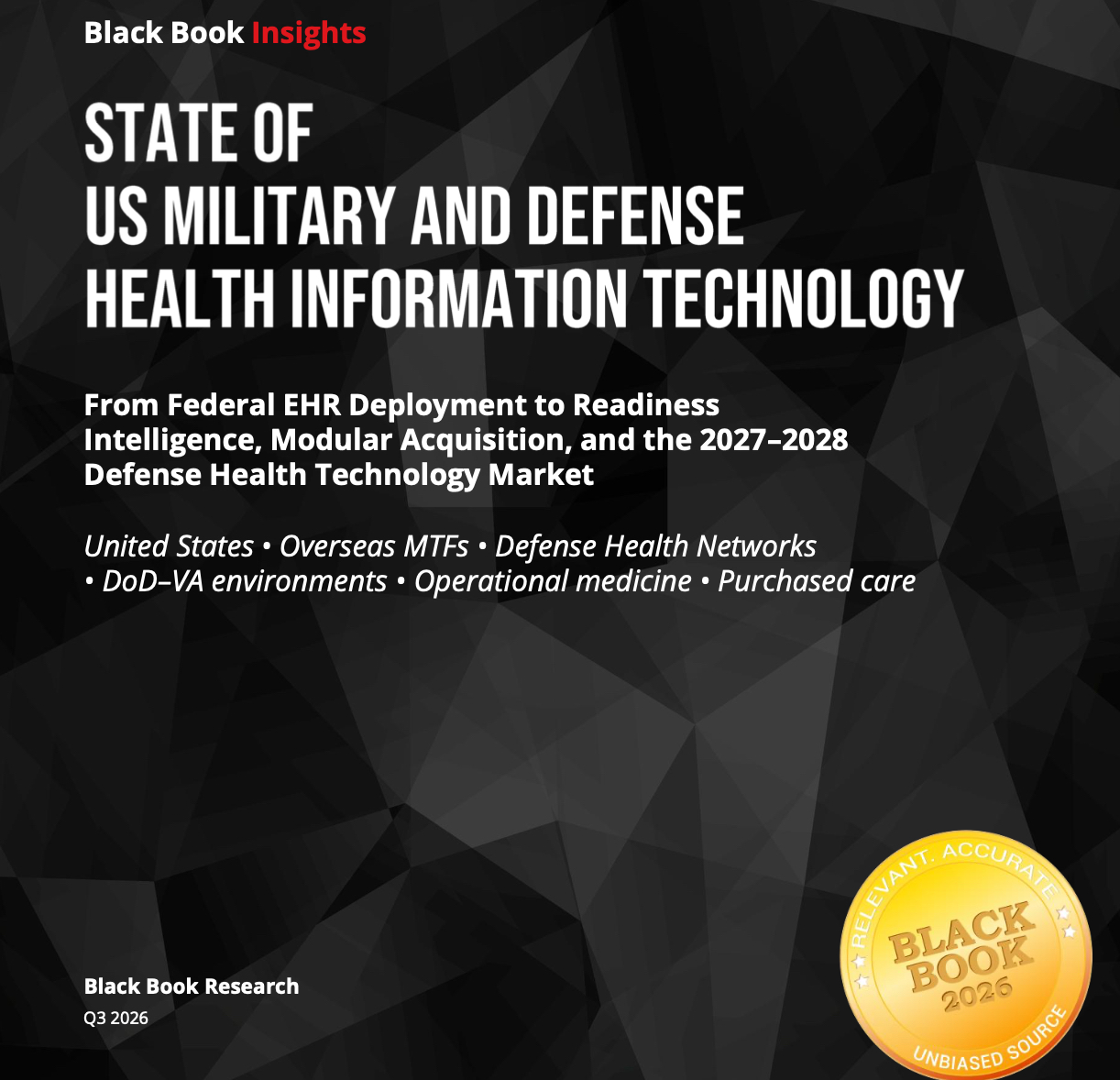
- Black Book Market Research released the State of U.S. Military and Defense Health Information Technology 2026, drawing on 1,037 survey responses and an 813-respondent analytical cohort of federal and defense health leaders.
- Released alongside the 2026 Defense Health Information Technology Symposium (DHITS) in New Orleans, the report marks the entry into a “post-EHR deployment era” following the completed worldwide rollout of MHS GENESIS.
- The FY2027 defense health IM/IT budget request reaches ~$2.6 billion (a 14.5% increase over FY2026 enacted levels), with over $200 million in growth targeted at digital health capabilities—including ambient clinical documentation, tele-critical care, and global teleconsultation.
- Strategic vendor opportunities are shifting away from core EHR replacement toward integration, clinical AI, DevSecOps, data provenance, and tactical edge operations in denied, disconnected, intermittent, and low-bandwidth (DDIL) environments.
- The Department of Veterans Affairs’ Oracle Health Federal EHR modernization continues as a major services and optimization market across data reconciliation, legacy VistA coexistence, automated testing, and scheduling controls.
$2.6B Shift Toward Military Health AI and Readiness
With the worldwide deployment of MHS GENESIS completed across military treatment facilities (MTFs), evaluation metrics have transitioned toward clinical productivity, force medical readiness, and continuity of care from fixed hospitals to forward-deployed operational environments.
The Black Book report details the architectural priorities and budget trajectories shaping defense health technology through 2028:
- Expanding Digital Health Appropriations: The FY2027 defense health information management and information technology (IM/IT) budget request totals approximately $2.6B, representing a 14.5% increase over FY2026. Over $200M of this growth is specifically allocated for digital health technologies, including ambient clinical scribes, tele-critical care platforms, mobile clinician tablets, and global teleconsultation networks.
- Operationalizing Clinical AI at Scale: Clinical artificial intelligence is moving beyond isolated pilots into operational deployment, prioritizing ambient documentation, longitudinal chart summarization, automated coding, referral management, and order-loop closure.
- The DDIL Tactical Continuum: Operational medicine mandates that military cloud infrastructure seamlessly synchronize with tactical edge systems in Denied, Disconnected, Intermittent, and Low-bandwidth (DDIL) operational environments, ensuring data provenance and patient tracking across echeloned care.
- VA Oracle Health Optimization: The VA Federal EHR deployment represents an ongoing multi-year implementation and services ecosystem—driving demand for data reconciliation, legacy VistA retirement strategies, automated regression testing, revenue cycle management, and role-based training.
- Complex Multi-Stakeholder Buyer Map: Identifies spending influence across the Defense Health Agency (DHA), PEO Defense Healthcare Management Systems (PEO DHMS), PEO Medical Systems, the Federal Electronic Health Record Modernization (FEHRM) office, individual service medical commands (Army, Navy, Air Force), USSOCOM, and VHA program offices.
“Military health has crossed from digital modernization into mission execution,” stated Doug Brown, Founder of Black Book Research. “For the Department of Defense and Department of War health enterprise, innovation only counts when it is implemented securely and produces measurable readiness: less clinical burden, faster decisions, closed care gaps, stronger continuity from hospital to battlefield and more service members returned to duty.”
Technology providers that can seamlessly integrate specialized AI and resilient edge data pipelines into the installed federal health record will capture the next decade of defense and military health procurement.
The future belongs exclusively to integrated intelligence networks that can seamlessly transform raw technology fragmentation into an automated, auditable, and entirely secure system of lifelong human care.
