
What You Should Know
- Cedar officially announced the Kora Platform, evolving its single AI billing agent into an integrated suite of purpose-built, autonomous AI agents designed for healthcare revenue recovery.
- Built on a foundation of 1.5 billion+ patient interactions, $13.6 billion in processed payments, and 63 million+ patients served, Kora integrates directly into existing EHR, telephony, and contact center environments.
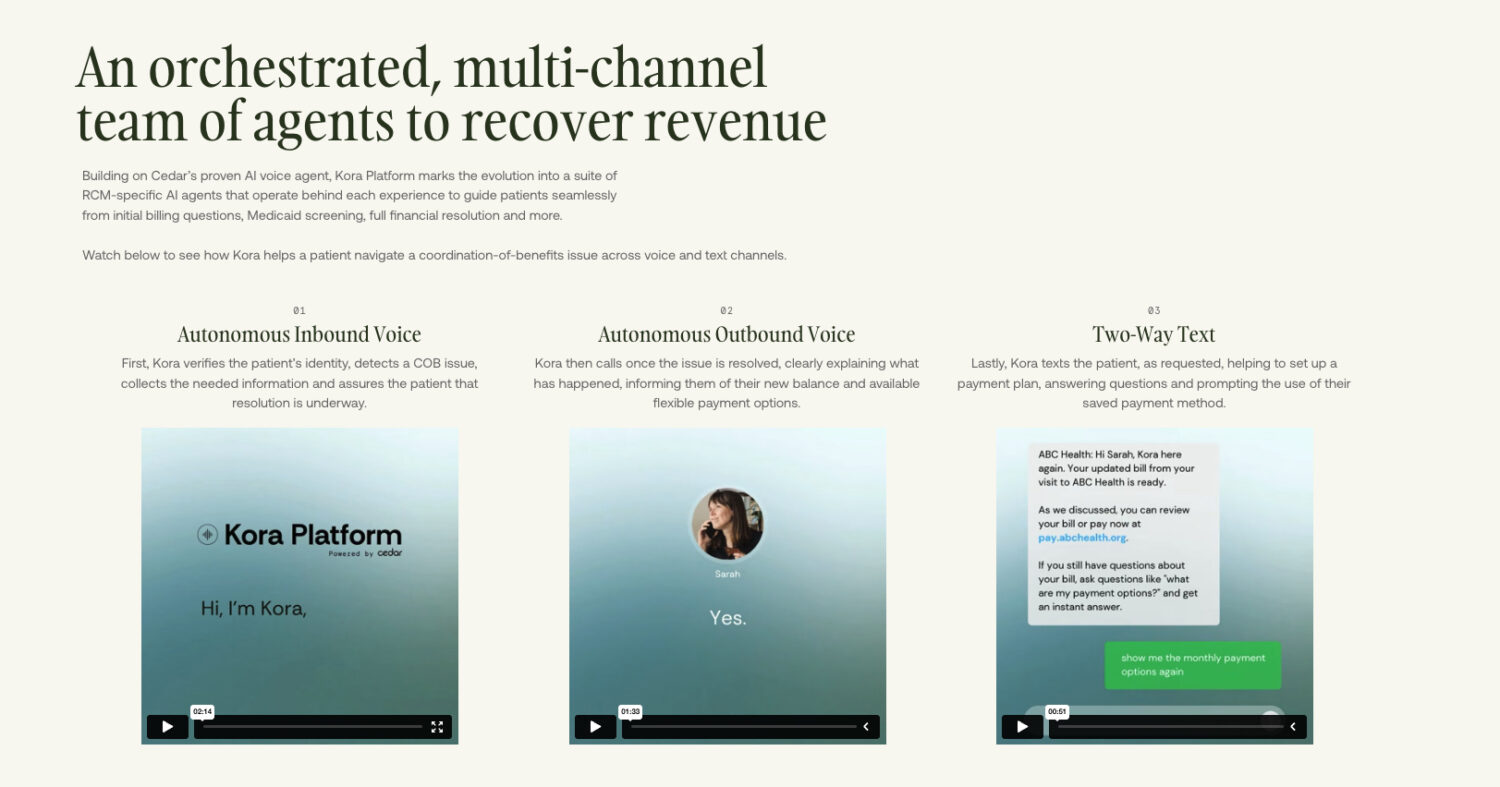
- The platform features Autonomous Inbound Voice, Autonomous Outbound Voice, and Two-Way Text (English and Spanish) to handle balance explanations, insurance capture, Medicaid enrollment, and coordination-of-benefits (COB) denials.
- Early deployment metrics demonstrate a 40% inbound call containment rate, a 7.4% increase in payment attempts compared to live agents, and a 20% outbound pickup rate (4x the industry average).
- Addressable market dynamics highlight that nearly 40% of collectible dollars across Cedar’s network now stem from self-pay patients, while national hospital revenue impacts from the One Big Beautiful Bill Act (OBBBA) could reach $68.6 billion across 2026 and 2027.
Converting Billing Notifications into Conversational Action
With nearly 40% of collectible healthcare dollars now originating from self-pay balances and out-of-pocket obligations, traditional patient access tools—such as rigid Interactive Voice Response (IVR) phone trees and static EHR portals—often route patients into long call center queues rather than resolving financial inquiries.
The Kora Platform addresses this friction by integrating natively into existing Electronic Health Records (EHR), telephony infrastructure, and contact center systems to drive automated financial resolution across voice and two-way text:
- Persistent Journey Memory: Maintains contextual memory across multi-step financial resolution cycles. Whether updating documentation, reprocessing a Coordination of Benefits (COB) denial, or establishing a payment plan over several weeks, the system retains past interaction context so patients do not have to restart conversations.
- Autonomous Multi-Agent Capabilities: Executes inbound and outbound voice calls alongside two-way text. Inbound agents verify caller identity, perform real-time eligibility checks, and process payments. Outbound agents proactively assist with Medicaid enrollment, secure missing coverage, and resolve denied claims.
- Grounded Data Foundation: Trained on Cedar’s proprietary dataset covering more than 1.5 billion patient interactions and $13.6 billion in processed payments to distinguish whether a patient is confused, experiencing temporary financial hardship, or attempting to access HSA funds.
- Compliance & Guardrails: Operates with regression-tested guardrails, HITRUST/PCI DSS compliance standards, and automated escalation logic that routes clinical or out-of-scope questions to human agents.
Operational Benchmarks
Early deployments across more than 600,000 patient conversations demonstrate measurable revenue cycle yield:
- 40% Inbound Containment Rate: Resolves common billing inquiries autonomously without live agent transfer.
- 7.4% Relative Payment Increase: Outperforms live agents in payment attempts during inbound interactions.
- 20% Outbound Pickup Rate: Achieves 4x the industry average for outbound outreach, driving a 21% relative payment rate within seven days.
“When patients are facing unexpected healthcare costs, they need clarity, flexibility, and empathy, not a rigid phone tree or transactional chatbot,” said Dugan Winkie, Chief Strategy Officer at Cedar. “With Kora Platform, we’re providing health systems with an always-on advocate that builds trust and resolves balances seamlessly across every channel.”
