
What You Should Know
- Nabla has launched Nabla Dictation for Mac, an AI-native clinical speech-to-text application engineered specifically to run locally on Apple Silicon hardware.
- Rebuilt using Swift and Apple’s Core ML Tools, the platform executes speech activation, speech-to-text, and medical vocabulary post-processing on the Apple Neural Engine—eliminating cloud token costs, network latency, and server-side audio processing.
- Integrates natively into Epic workflows (including Epic Hyperdrive and Hyperspace), allowing clinicians to dictate directly at the cursor across inbox messages, referrals, and chart updates.
- Maintains full backward compatibility with industry-standard dictation hardware—such as Nuance PowerMic and Philips SpeechMike—allowing health systems to modernize without replacing physical peripherals.
How Nabla Dictation for Mac Uses Apple Silicon for Zero-Server Clinical Voice
For health systems operating on macOS environments, clinical dictation options have remained historically limited, carrying server-side audio privacy risks, cloud token overhead, and noticeable transcription latency. To unify ambient documentation with asynchronous dictation while eliminating cloud infrastructure dependencies, Nabla has officially announced Nabla Dictation for Mac.
Built natively for macOS and optimized for Apple Silicon, the application delivers enterprise-grade clinical speech recognition directly on the local device, offering deep integration into Epic EHR environments.
Core ML Migration and Apple Neural Engine Optimization
Nabla Dictation for Mac represents a technical migration from cloud-hosted deep learning models to localized hardware execution:
- In-House Speech Stack Migration: Rebuilt using Swift and Apple Core ML Tools, transferring years of PyTorch-based medical speech models directly onto Apple Silicon architectures.
- Apple Neural Engine Acceleration: Offloads voice activation, speech-to-text conversion, and medical post-processing to the local Neural Engine, achieving low-latency transcription without sending audio to external servers.
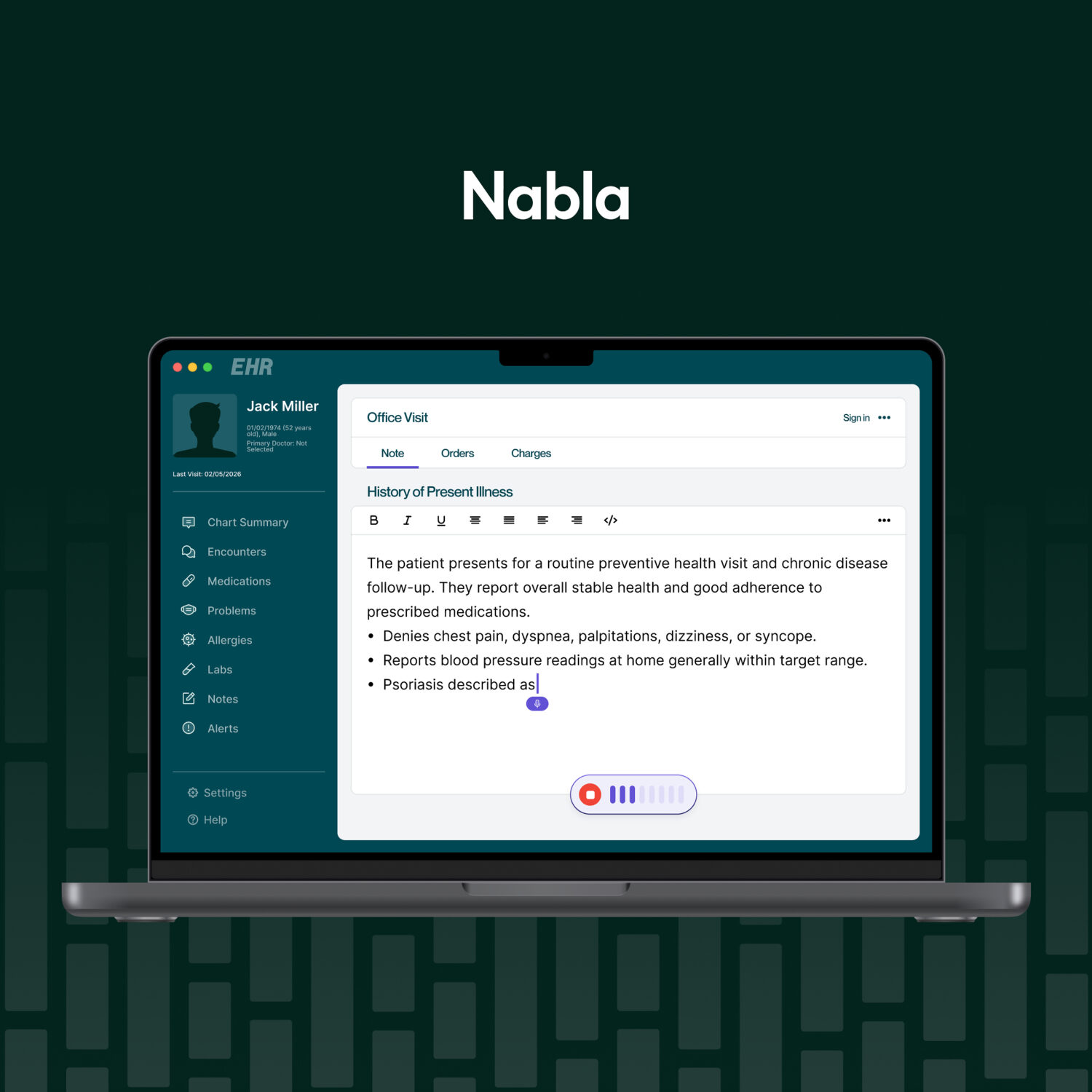
- At-Cursor EHR Insertion: Embeds directly into Epic Hyperdrive, Hyperspace, and third-party desktop environments, enabling at-cursor dictation, anchor-speech focus, custom voice commands, and dot-phrase triggering.
- Hardware & Microphone Backward Compatibility: Native support for physical handheld microphones (Nuance PowerMic, Philips SpeechMike) alongside an iOS companion app that converts an iPhone into a wireless desktop microphone.
“For decades, clinicians have been forced to adapt their workflows to software,” stated Laurent Landowski, Chief Product Officer at Nabla. “Core ML and the Apple Neural Engine made it possible for us to bring our entire speech pipeline on-device for Mac without compromising the performance clinicians expect from medical-grade dictation… That means clinicians get the speed and responsiveness they need, while keeping speech processing entirely on their device.”
As health systems like M Health Fairview scale Nabla across their provider networks, the transition to local, edge-processed clinical AI sets a technical benchmark for how enterprise healthcare software will operate: fast, private, and natively embedded into daily clinical routines.
