
What You Should Know
- Gravity Rail has officially launched with a $2.75M seed investment led by Redesign Health.
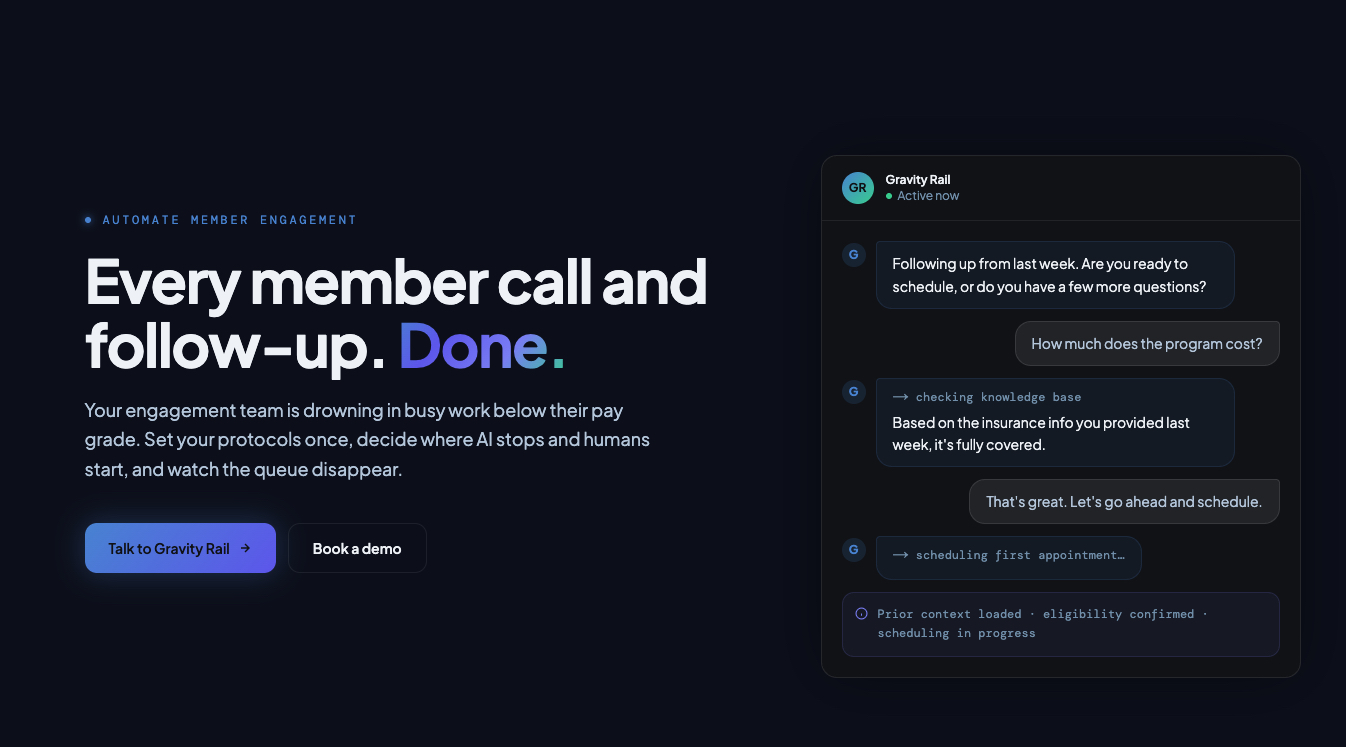
- The platform functions as a model-agnostic operating system, allowing healthcare teams to build and manage AI engagement workflows across voice, SMS, email, and web without writing code.
- Unlike outsourced “black box” solutions, Gravity Rail enables operations teams to translate Standard Operating Procedures (SOPs) into live AI infrastructure using natural language.
- Early deployments have resulted in a 30% increase in first-scheduled appointment rates for referral workflows and a 10x increase in volume capacity for clinical trial recruitment.
- The infrastructure is HIPAA-compliant with zero data retention and supports all major enterprise AI models, preventing vendor lock-in as technology evolves.
The healthcare industry currently spends over $1 trillion annually on administrative costs, much of which is swallowed by manual outreach and fragmented patient coordination. While AI has long been touted as the solution, many organizations find themselves trapped in a cycle of “vendor lock-in,” where rigid outsourced tools fail to adapt to changing protocols. Gravity Rail, a newly launched platform co-founded by Dan Walmsley and Scott Hoch, aims to break this cycle by shifting AI control from external vendors directly to the clinical operations teams doing the work.
Gravity Rail does not offer a single AI agent or a narrow point solution. Instead, it provides a model-agnostic “operating system” for engagement. This architecture allows health plans, provider groups, and clinical trial platforms to build, certify, and evolve their own AI workflows in-house. By putting the power to “program” AI into the hands of non-technical staff using natural language, the company ensures that AI protocols can change as fast as payer rules or clinical guidelines.
From Outsourced Automation to Team-Owned Systems
The core philosophy behind Gravity Rail is that AI works most effectively when it is an extension of the internal team rather than a detached service. Through the platform, operations teams can automate complex, multi-touch journeys—such as medication adherence, enrollment, and care coordination—using their own specific protocols. This “Team-Owned” approach ensures that the AI behaves exactly as a human agent would, following the organization’s unique voice and compliance boundaries.
In real-world applications, this shift in ownership has yielded measurable operational gains. Leapcure, a clinical trial recruitment platform, utilized Gravity Rail to engage 30,000 patients—nearly ten times the volume of a standard study—without a proportional increase in staff burden. Similarly, companies like Harmonic Health have used the platform to manage referral surges, seeing a significant “lift” in appointment rates by deploying AI in a focused, controlled manner to handle follow-ups.
Model-Agnostic Infrastructure for an Evolving AI Landscape
As AI models continue to commoditize, the strategic advantage for healthcare organizations lies not in the model itself, but in the ability to switch models and adapt workflows quickly. Gravity Rail’s architecture supports all major enterprise AI models under a HIPAA-compliant Business Associate Agreement (BAA). This allows organizations to adopt new technical capabilities or benefit from cost improvements in the AI market without needing to rebuild their entire engagement infrastructure.
Crucially, the platform is designed for “Human + AI” collaboration. High-volume, repeatable tasks are handled by the AI, while complex decisions and escalations are routed back to human staff. The system includes structured certification and full auditability, providing a “governed ecosystem” where autonomous agents operate within defined clinical and compliance boundaries. This ensures that while the scale of engagement increases, the quality and safety of patient interactions remain under strict human oversight.
Why This Matters
For the healthcare executive, this platform offers a path to digital transformation that doesn’t require a massive increase in technical headcount. The ability to increase patient outreach by 2–3x while simultaneously reducing handle times is a powerful value proposition in a sector defined by labor shortages and margin compression.
