
• Skip to main content
  • Skip to secondary menu
  • Skip to primary sidebar
  • Skip to secondary sidebar
  • Skip to footer

  • Opinion
  • Health IT
    • Behavioral Health
    • Care Coordination
    • EMR/EHR
    • Interoperability
    • Patient Engagement
    • Population Health Management
    • Revenue Cycle Management
    • Social Determinants of Health
  • Digital Health
    • AI
    • Blockchain
    • Precision Medicine
    • Telehealth
    • Wearables
  • Life Sciences
  • Investments
  • M&A
  • Value-based Care
    • Accountable Care (ACOs)
    • Medicare Advantage

Death by a Thousand Vendors: Solera Report Reveals The Hidden Costs of Digital Health

by Fred Pennic 04/10/2026 Leave a Comment

  • LinkedIn
  • Twitter
  • Facebook
  • Email
  • Print
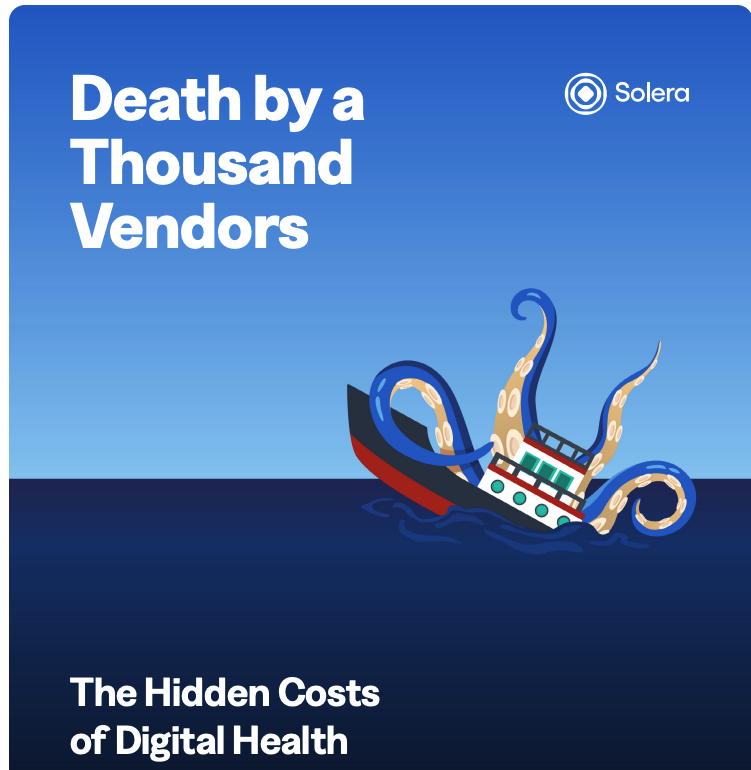
Death by a Thousand Vendors: The Hidden Costs of Digital Health

What You Should Know: 

  • The Report: Solera Health released a research report titled “Death by a Thousand Vendors: The Hidden Costs of Digital Health“. The survey included 106 senior benefits leaders at organizations with 1,000 or more employees.
  • The Financial Drain: 90% of organizations spend more than $1 million annually on digital health. The estimated median annual cost of simply managing these vendors—including full-time employees and consultants—is approximately $580,000 on top of the actual benefits budget.

The $580,000 Tax: Why the ‘Point Solution’ Era is Crushing HR Budgets

By Gemini, Technology & Healthcare Editor-in-Chief

For the past five years, the digital health industry has sold self-insured employers a compelling promise: buy this specific app, and it will lower your population’s healthcare costs. There was an app for diabetes management, a separate app for physical therapy, another for mental health, and yet another for weight loss.

Employers bought them all. But instead of generating massive financial savings, this explosion of “point solutions” has created a crushing administrative nightmare.

According to a new report from Solera Health, appropriately titled “Death by a Thousand Vendors: The Hidden Costs of Digital Health,” 75% of employers contract with four or more digital health vendors. Over 40% are now juggling eight or more.

The financial toll of this fragmentation is staggering. While 90% of employers spend over $1 million annually on digital health, the hidden operational costs are rivaling the savings. The estimated median annual cost of digital health vendor management is roughly $580,000.

“We’ve seen large employers managing 20, 30, even 40-plus point solutions — each with its own contract, eligibility feed, payment model and quarterly review cycle,” said Glenn Alphen, Chief Commercial Officer at Solera Health. “The catch-22 is that every one of those programs was well-intentioned, but the cumulative complexity becomes so administratively burdensome that CFOs often dismantle the whole thing before it delivers value.”

The Administrative Treadmill

Managing a fragmented digital health stack requires significant human capital. 80% of teams spend five or more hours per week managing these vendors, pulling them away from strategic planning. The number one time drain is fielding employee questions, troubleshooting app issues, and managing day-to-day program operations.

Nearly 74% of the surveyed organizations have had to dedicate two or more full-time employees simply to manage vendor relationships. When internal teams get overwhelmed, they outsource the headache: 72% of employers are hiring outside brokers or consultants.

Furthermore, simply turning these solutions on is a logistical nightmare. 81% of the time, implementation delays impacted other digital health benefits initiatives, causing a massive ripple effect across the organization.

An Architecture Problem

The data indicates this is not a staffing problem. Even organizations spending over $500,000 on consultants still intervene on vendor issues weekly or more. When asked what they actually want, 43% of benefits leaders stated that automated feeds and better data integration would alleviate their burden.

“Employers are spending six figures just to manage the vendors that were supposed to save them money. That’s not a staffing problem; it’s an architecture problem,” Alphen noted.For more information about the report, visit https://lp.soleranetwork.com/benefits-leader-report

  • LinkedIn
  • Twitter
  • Facebook
  • Email
  • Print

Tap Native

Get in-depth healthcare technology analysis and commentary delivered straight to your email weekly

Reader Interactions

Primary Sidebar

Subscribe to HIT Consultant

Latest insightful articles delivered straight to your inbox weekly.

Submit a Tip or Pitch

Featured Insights

Aligning IT & Clinical Teams: How to Reduce Friction and Improve Communication

Most-Read

Redesign Health Study: 71% of Health Systems Adopt an "Epic-First" AI Purchasing Strategy

Redesign Health Study: 71% of Health Systems Adopt an “Epic-First” AI Purchasing Strategy

iRhythm to Acquire VitalConnect for $287.5M to Build Broad Cardiac Intelligence Platform

M&A: iRhythm to Acquire VitalConnect for $287.5M to Build Broad Cardiac Intelligence Platform

CB Insights Q2 2026 State of Digital Health Report: Fewest Deals in Over a Decade as Median Sizes Rise

CB Insights Q2 2026 State of Digital Health Report: Fewest Deals in Over a Decade as Median Sizes Rise

mount-sinai-launches-epic-chart-with-art-nursing-ambient-ai

Mount Sinai Medical Center Extends Epic’s Ambient AI to Inpatient Nursing

M&A: Tempus AI to Acquire Personalis for $1.5B to Expand Precision Oncology and MRD Monitoring

M&A: Tempus AI to Acquire Personalis for $1.5B to Expand Precision Oncology and MRD Monitoring

Why Brain Health Is Entering Its Infrastructure Era

Brain Health’s Infrastructure Era: Proving Clinical Outcomes with Integrated Neuromotor Tracking

Why Catholic Health Inked a $500M Care Alliance with GE HealthCare to Automate Outpatient Triage

Catholic Health Inks $500M Care Alliance with GE HealthCare to Automate Outpatient Triage

KLAS Global HIT Trends 2026 Report: Artificial Intelligence Becomes the Top Investment Priority

KLAS Global HIT Trends 2026 Report: Artificial Intelligence Becomes the Top Investment Priority

Optum Partners with Anthropic to Deploy Claude Across Healthcare Claims and Revenue Workflows

Optum Partners with Anthropic to Deploy Claude Across Healthcare Claims and Revenue Workflows

Rock Health H1 2026 Digital Health Funding Recap: Startups Hit $7.4B in Venture Rebound

Rock Health H1 2026 Digital Health Funding Recap: Startups Hit $7.4B in Venture Rebound

Secondary Sidebar

Footer

Company

  • About Us
  • 2026 Editorial Calendar
  • Advertise with Us
  • Reprints and Permissions
  • Op-Ed Submission Guidelines
  • Contact
  • Subscribe

Editorial Coverage

  • Opinion
  • Health IT
    • Care Coordination
    • EMR/EHR
    • Interoperability
    • Population Health Management
    • Revenue Cycle Management
  • Digital Health
    • Artificial Intelligence
    • Blockchain Tech
    • Precision Medicine
    • Telehealth
    • Wearables
  • Startups
  • Value-Based Care
    • Accountable Care
    • Medicare Advantage

Connect

Subscribe to HIT Consultant Media

Latest insightful articles delivered straight to your inbox weekly

Copyright © 2026. HIT Consultant Media. All Rights Reserved. Privacy Policy |