
What You Should Know
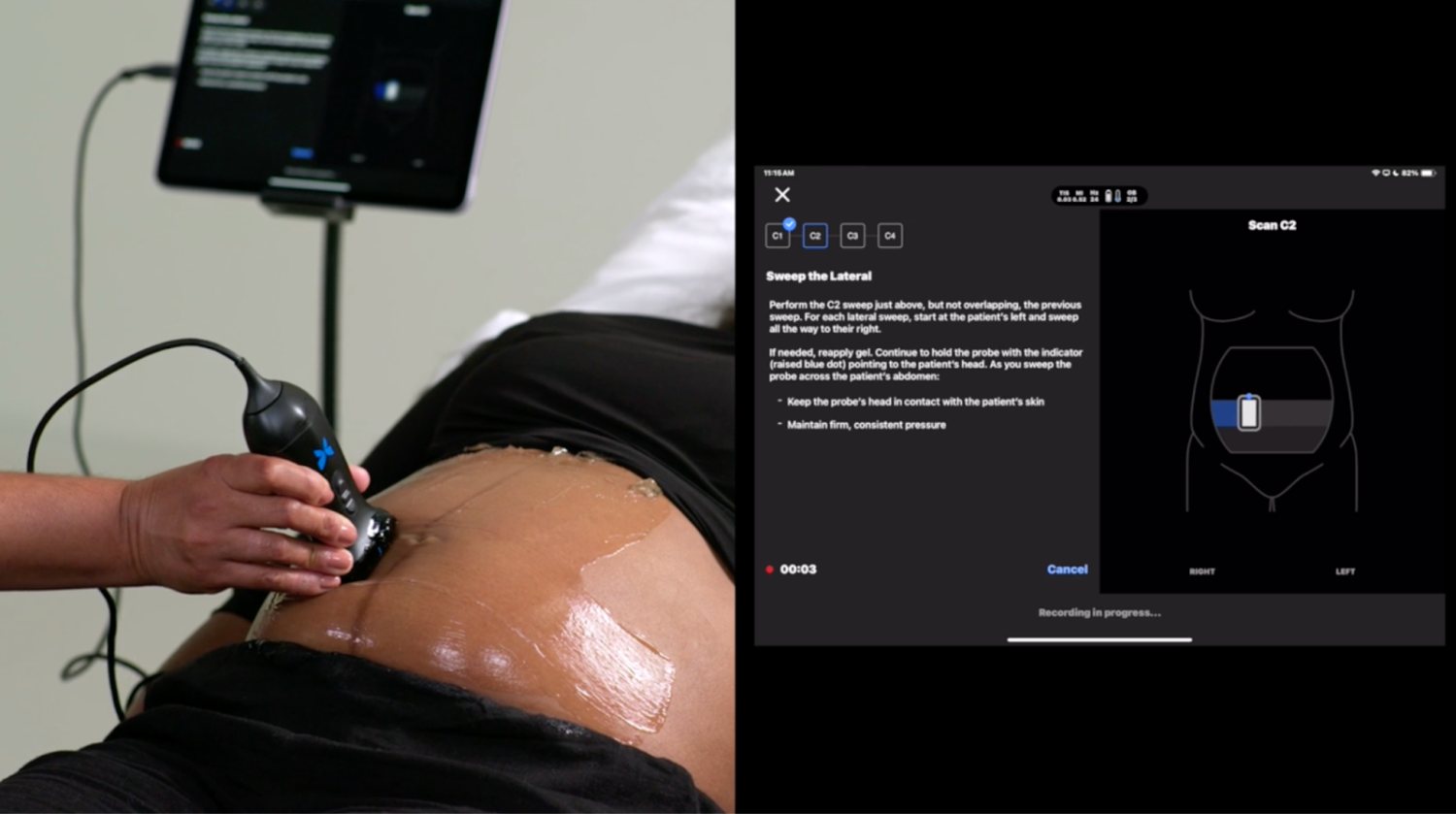
- The Milestone: Butterfly Network has received FDA clearance for a fully automated Gestational Age (GA) Tool integrated directly into its handheld, semiconductor-based ultrasound devices. It is the first FDA-cleared “blind-sweep” ultrasound AI tool for estimating gestational age.
- The Efficacy & Scale: The tool is proven to deliver results equivalent to a trained sonographer for patients between 16 and 37 weeks. Backed by the Gates Foundation, the tool is already deployed in Malawi and Uganda, with FDA clearance now paving the way for massive U.S. rural expansion.
How Butterfly Network is Automating the Obstetric Ultrasound
In modern medicine, the ultrasound is arguably the most critical diagnostic tool that is still fundamentally broken by its own operational requirements. Traditional ultrasounds are highly operator-dependent. You cannot simply hand a wand to an ER nurse or a rural health clinic worker and expect them to accurately measure a fetal femur length to determine gestational age; it requires years of specialized sonography training.
This personnel bottleneck has created a global crisis. In the U.S., maternal care deserts are expanding rapidly, with nearly half of rural counties lacking obstetric services. Globally, the lack of basic prenatal imaging contributes to the 92% of maternal and neonatal deaths that occur in low- and middle-income countries.
Today, Butterfly Network announced a regulatory milestone that effectively bypasses this bottleneck. The company has received FDA clearance for a fully automated Gestational Age (GA) Tool. By introducing the first-ever “blind-sweep” AI to the market, Butterfly isn’t just upgrading the ultrasound; they are completely de-skilling it.
“Improving maternal health outcomes and expanding access to prenatal imaging has become an urgent priority, and Butterfly is proud to be the first to bring this type of technology to mothers globally,” said Sachita Shah, MD, Vice President of Global Health at Butterfly Network.
De-Skilling the Diagnostic
Developed by Dr. Jeffrey Stringer and his team at UNC Chapel Hill and trained on over 21 million images, the AI eliminates the need for a trained specialist to capture specific fetal biometric measurements.
Historically, determining gestational age required a trained specialist to carefully manipulate the probe, find the perfect acoustic window, capture specific cross-sections of the fetus’s head or abdomen, and manually measure the biometry.
Butterfly’s AI requires none of that. It utilizes a “blind-sweep” method. The user inputs the fundal height, applies the gel, and performs six simple, guided sweeps across the mother’s abdomen. They do not need to look at the screen or interpret the image. The AI, trained on more than 21 million images, processes the visual data in the background and spits out a highly accurate gestational age estimate in under two minutes.
For patients between 16 and 37 weeks, the results are equivalent to those of a trained, veteran sonographer.
Software as the Ultimate Medical Scale
“Ultimately, it’s about helping clinicians act faster, earlier, and with greater confidence, at critical moments and in any setting,” noted Steve Cashman, Butterfly’s Chief Business Officer.
From an enterprise technology perspective, this FDA clearance represents the exact maturation point we have been waiting for in the point-of-care ultrasound (POCUS) market. For years, companies like Butterfly competed primarily on hardware—shrinking the machine down to a semiconductor chip that fits in your pocket.
Already deployed in Uganda and Malawi via the Gates Foundation, this technology is now primed to flood rural American emergency departments and clinics. When you can turn any frontline healthcare worker into a highly accurate obstetric diagnostician with a two-minute software update, you haven’t just improved the device—you have fundamentally rewritten the economics and reach of maternal care.
