
• Skip to main content
  • Skip to secondary menu
  • Skip to primary sidebar
  • Skip to secondary sidebar
  • Skip to footer

  • Opinion
  • Health IT
    • Behavioral Health
    • Care Coordination
    • EMR/EHR
    • Interoperability
    • Patient Engagement
    • Population Health Management
    • Revenue Cycle Management
    • Social Determinants of Health
  • Digital Health
    • AI
    • Blockchain
    • Precision Medicine
    • Telehealth
    • Wearables
  • Life Sciences
  • Investments
  • M&A
  • Value-based Care
    • Accountable Care (ACOs)
    • Medicare Advantage

PGxAI Unveils AI-Driven Genetic Tool to Personalize GLP-1 Treatment

by Jasmine Pennic 04/23/2025 Leave a Comment

  • LinkedIn
  • Twitter
  • Facebook
  • Email
  • Print

What You Should Know: 

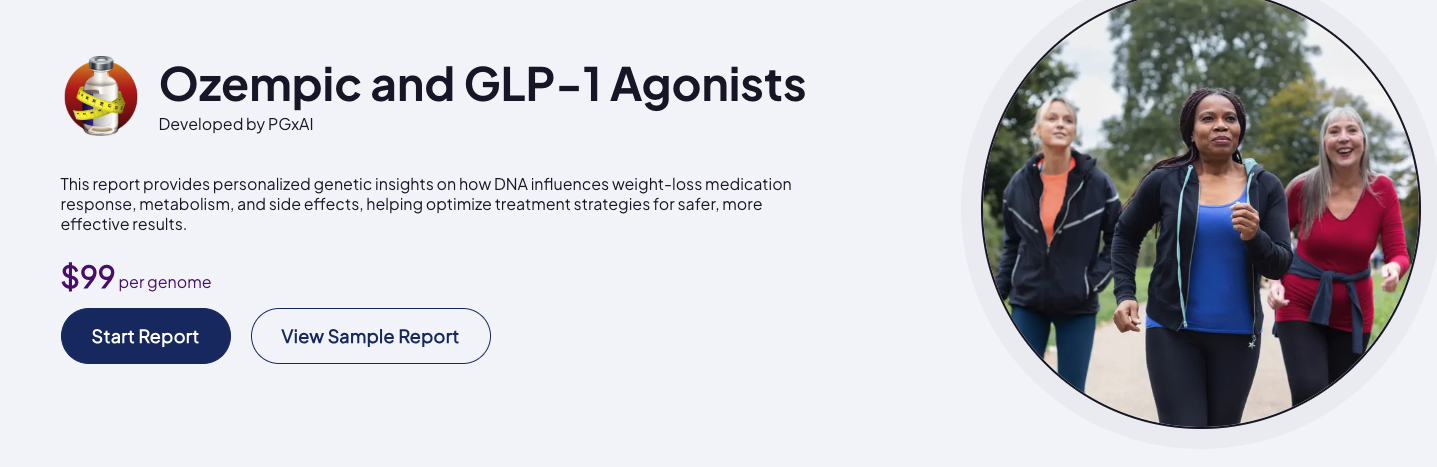
– PGxAI, a leader in AI-powered pharmacogenomics released a new report aimed at personalizing treatment regimens for patients taking semaglutide (commonly known by brand names Ozempic and Wegovy) and other widely used weight-management drugs. 

– Utilizing advanced artificial intelligence models, the report analyzes patient-specific genetic data to identify and quantify genetic variants that impact drug efficacy and safety, finding that up to a third of patients on semaglutide may be at increased genetic risk for adverse effects.

Addressing Genetic Risks in Popular Weight-Loss Drugs

Semaglutide, a GLP-1 receptor agonist, has gained prominence for its effectiveness in promoting weight loss and improving glycemic control. However, its use is associated with significant potential risks, including pancreatitis, gallbladder complications, kidney impairment, and possible thyroid tumors. PGxAI’s findings highlight a critical genetic component to these risks, suggesting that up to one-third of patients prescribed the drug may carry specific genetic variants that predispose them to such adverse reactions.

AI-Powered Genetic Insights for Safer Prescribing

The new PGxAI report leverages AI to rapidly correlate a patient’s genetic profile with established pharmacogenomic markers and the latest clinical evidence. This process pinpoints individuals who may be genetically inclined to experience complications from semaglutide and over ten other leading weight-management therapies, encompassing GLP-1s, dual incretins, and CNS-targeting drugs. “With nearly one in three patients potentially at increased risk, trial-and-error prescribing of Ozempic is no longer acceptable,” stated Dr. Mike Zack, PGxAI co-founder and CEO. “Our AI-driven report translates complex genetic data into clear clinical guidance… It empowers physicians to focus on patient care, evaluating a wider range of options while reducing the likelihood of serious adverse reactions.” This allows clinicians to proactively adjust dosages or consider safer alternative treatments when appropriate.

Transforming Personalized Prescribing into Clinical Reality

Historically, the detailed interpretation of a patient’s genetic data for pharmacogenomic insights could take weeks or even months, rendering it impractical for routine clinical application. PGxAI’s AI platform drastically reduces this turnaround time to minutes. Critically, through integrations facilitated by partnerships with companies like InterSystems (via its HealthShare platform), PGxAI delivers this actionable clinical decision support directly into physicians’ existing Electronic Health Record (EHR) and hospital workflows, enabling immediate implementation without disrupting care processes.

Precision Medicine at Scale for a Growing Public Health Need

The development comes amidst soaring rates of obesity – affecting nearly three-quarters of U.S. adults – and the mainstream adoption of GLP-1 medications, now prescribed to tens of millions. “For health systems, this isn’t just a tool for mitigating adverse events — it’s an on-ramp to precision prescribing at scale,” commented Allan Gobbs, PGxAI co-founder and Executive Chairman. Citing the $173 billion annual cost of obesity to the healthcare system, he emphasized, “we can’t afford one-size-fits-all. Wide adoption demands personalization.” PGxAI’s report offers a scalable solution to integrate genetic personalization into widespread prescribing practices.

  • LinkedIn
  • Twitter
  • Facebook
  • Email
  • Print

Tagged With: Artificial Intelligence, GLP-1

Tap Native

Get in-depth healthcare technology analysis and commentary delivered straight to your email weekly

Reader Interactions

Primary Sidebar

Subscribe to HIT Consultant

Latest insightful articles delivered straight to your inbox weekly.

Submit a Tip or Pitch

Featured Insights

Aligning IT & Clinical Teams: How to Reduce Friction and Improve Communication

Most-Read

Aidoc Secures $150M to Accelerate Enterprise-Scale Clinical AI Across 2,000 Hospitals

OpenAI Launches ChatGPT for Clinicians: Free AI Documentation and Research Tool for Verified Physicians

OpenAI Launches ChatGPT for Clinicians: Free AI Documentation and Research Tool for Verified Physicians

IKS Health Acquires TruBridge for Rural EHR and RCM Solutions Expansion

IKS Health Acquires TruBridge for Rural EHR and RCM Solutions Expansion

UT Austin is Building the Nation's First 'AI-Native' Hospital, Backed by $750M

Why UT Austin is Building an ‘AI-Native’ Hospital from Scratch

The Medtech Pitch Deck Casino: Why Hype Still Wins, and How Scrutiny Could Improve Everyone’s Odds

The Casino Model: Why Medtech VCs Are Betting Billions on Unproven AI

Oracle Lays Off 539 Kansas City Employees as Focus Shifts to AI Data Centers

Oracle Lays Off 539 Kansas City Employees as Focus Shifts to AI Data Centers

SAMHSA and ONC Invest $20M in Behavioral Health IT Initiative

HHS Reverses 2024 Tech Reorganization: Why HHS Just Stripped AI and Cyber Operations Out of the ONC

How Small Medical Practices Can Build HIPAA-Aligned DevSecOps Without Enterprise Budgets

How Small Medical Practices Can Build HIPAA-Aligned DevSecOps Without Enterprise Budgets

Insilico Medicine and Eli Lilly Form $2.75B AI Drug Discovery Collaboration

Insilico Medicine and Eli Lilly Form $2.75B AI Drug Discovery Collaboration

Microsoft Copilot Health, Integrates Apple Health, Oura, and 50,000 EHRs in New AI Push

Microsoft Launches Copilot Health, Integrates Apple Health, Oura, and 50,000 EHRs in New AI Push

Secondary Sidebar

Footer

Company

  • About Us
  • 2026 Editorial Calendar
  • Advertise with Us
  • Reprints and Permissions
  • Op-Ed Submission Guidelines
  • Contact
  • Subscribe

Editorial Coverage

  • Opinion
  • Health IT
    • Care Coordination
    • EMR/EHR
    • Interoperability
    • Population Health Management
    • Revenue Cycle Management
  • Digital Health
    • Artificial Intelligence
    • Blockchain Tech
    • Precision Medicine
    • Telehealth
    • Wearables
  • Startups
  • Value-Based Care
    • Accountable Care
    • Medicare Advantage

Connect

Subscribe to HIT Consultant Media

Latest insightful articles delivered straight to your inbox weekly

Copyright © 2026. HIT Consultant Media. All Rights Reserved. Privacy Policy |