
• Skip to main content
  • Skip to secondary menu
  • Skip to primary sidebar
  • Skip to secondary sidebar
  • Skip to footer

  • Opinion
  • Health IT
    • Behavioral Health
    • Care Coordination
    • EMR/EHR
    • Interoperability
    • Patient Engagement
    • Population Health Management
    • Revenue Cycle Management
    • Social Determinants of Health
  • Digital Health
    • AI
    • Blockchain
    • Precision Medicine
    • Telehealth
    • Wearables
  • Life Sciences
  • Investments
  • M&A
  • Value-based Care
    • Accountable Care (ACOs)
    • Medicare Advantage

Scaling-Up Inclusive Healthcare Initiatives in Low- and Middle-Income Countries

by Fred Pennic 06/03/2022 Leave a Comment

  • LinkedIn
  • Twitter
  • Facebook
  • Email
  • Print
Scaling-Up Inclusive Healthcare Initiatives in Low- and Middle-Income Countries

Non-communicable diseases (NCDs) are on the rise in low- and middle-income countries (LMICs), increasing the financial and health burden affecting these vulnerable populations. To reverse this trend will require not only resources, but also new business models for LMICs that can overcome the barriers patients face to receiving care, such as unaffordable, unavailable, or inaccessible healthcare services and treatments, and limited awareness of disease and preventative care.

Over the past decade, a new wave of pioneer healthcare initiatives has emerged that aims to improve the quality of care and access to healthcare of vulnerable populations in LMICs by building commercially viable and scalable enterprises. These pioneers are developing novel delivery models – inclusive clinics and hospitals, pharmacy-based, community-based, and risk-prevention models – and are innovating to solve patient pain points by making use of mobile and digital technologies, offering financing and insurance solutions, and improving access to preventative and primary care.

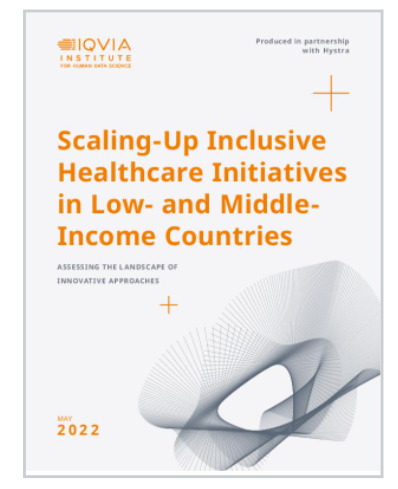
This report reviews the preliminary findings of a study performed by the IQVIA Institute for Human Data Science, together with Hystra – a consultancy specialized in inclusive business solutions – to learn from pioneer organizations what underlies their early successes and what is limiting them from reaching further scale or impact. It reviews the landscape of global inclusive initiatives and identifies innovations that can strengthen the impact of businesses. This work is intended to feed a later phase of research whose ultimate intent is to identify and scale up effective inclusive businesses.

Key findings:

– Though low- and middle-income countries are experiencing a rising prevalence of noncommunicable diseases such as diabetes, cancer, and heart and lung diseases, and now account for 57% of NCD deaths globally, NCDs account for only 1% of development assistance for health to these areas in 2018.

– Led by pioneers, promising inclusive initiatives are emerging to address, in a holistic way, the rising chronic disease burden and improve diagnosis, treatment, and care for those in low- and middle-income countries.

– Initiatives can be categorized based on their approach to improving health into one of four business models — inclusive clinics and hospitals, and pharmacy-based, community-based, and risk-prevention models — which differ in the level of care they provide and their setting.

– However, the speed at which these models are being developed remains slow, and only few have reached their ambition for economic sustainability and scale.

– Analyzing the global landscape of current inclusive healthcare initiatives, along with factors influencing their effectiveness and efficiency and barriers to reaching more significant scale, can help identify which approaches are most likely to be successful in LMICs.

– Among 244 health initiatives identified and profiled, 41% of these are based in Sub-Saharan Africa, 29% in South Asia, with the rest in Latin America and Southeast Asia.

Learn more by downloading the report and graphic exhibits at iqviainstitute.org

  • LinkedIn
  • Twitter
  • Facebook
  • Email
  • Print

Tagged With: cancer, diabetes, Heart, lung, Pharmacy, Primary Care, risk

Tap Native

Get in-depth healthcare technology analysis and commentary delivered straight to your email weekly

Reader Interactions

Primary Sidebar

Subscribe to HIT Consultant

Latest insightful articles delivered straight to your inbox weekly.

Submit a Tip or Pitch

2026 Predictions & Trends

Healthcare 2026 Forecast: Executives on AI Survival, Financial Reckoning, and the End of Point Solutions

2026 Healthcare Executive Predictions: Why the AI “Pilot Era” Is Officially Over

Most-Read

NYC Health + Hospitals to Acquire Maimonides in $2.2B Safety Net Overhaul

NYC Health + Hospitals to Acquire Maimonides in $2.2B Safety Net Overhaul

KLAS Report: Why Hospitals Are Choosing Efficiency Over 'Agentic' AI Hype in 2025

KLAS Report: Why Hospitals Are Choosing Efficiency Over ‘Agentic’ AI Hype in 2025

Advanced Primary Care 2026: Top 6 Investments for Health Systems According to Harvard Medical School

Advanced Primary Care 2026: Top 6 Investments for Health Systems According to Harvard Medical School

AI Nutrition Labels: The Key to Provider Adoption and Patient Trust?

AI Nutrition Labels: The Key to Provider Adoption and Patient Trust?

Kristen Hartsell, VP of Clinical Services, RedSail Technologies

The Pharmacy Closures Crisis: How Independent Pharmacies Are Fixing Pharmacy Deserts

HHS Launches 'OneHHS' AI Strategy to Integrate AI Across CDC, CMS, and FDA for Efficiency and Public Trust

HHS Launches ‘OneHHS’ AI Strategy to Integrate AI Across CDC, CMS, and FDA for Efficiency and Public Trust

From Overwhelmed to Optimized: How AI Agents Address Staffing Challenges and Burnout in Healthcare

From Overwhelmed to Optimized: How AI Agents Address Staffing Challenges and Burnout in Healthcare

The VBC Paradox: Why Hospitals Are Doubling Down on Value-Based Care While Revenue at Risk Lags

The VBC Paradox: Why Hospitals Are Doubling Down on Value-Based Care While Revenue at Risk Lags

Tebra Secures $250M to Challenge Legacy EHRs with AI-Powered Automation

Tebra Secures $250M to Challenge Legacy EHRs with AI-Powered Automation

AstraZeneca Selects Salesforce Agentforce Life Sciences to Deploy AI-Powered Global Customer Engagement

AstraZeneca Selects Salesforce Agentforce Life Sciences to Deploy AI-Powered Global Customer Engagement

Secondary Sidebar

Footer

Company

  • About Us
  • Advertise with Us
  • Reprints and Permissions
  • Op-Ed Submission Guidelines
  • Contact
  • Subscribe

Editorial Coverage

  • Opinion
  • Health IT
    • Care Coordination
    • EMR/EHR
    • Interoperability
    • Population Health Management
    • Revenue Cycle Management
  • Digital Health
    • Artificial Intelligence
    • Blockchain Tech
    • Precision Medicine
    • Telehealth
    • Wearables
  • Startups
  • Value-Based Care
    • Accountable Care
    • Medicare Advantage

Connect

Subscribe to HIT Consultant Media

Latest insightful articles delivered straight to your inbox weekly

Copyright © 2026. HIT Consultant Media. All Rights Reserved. Privacy Policy |
