
• Skip to main content
  • Skip to secondary menu
  • Skip to primary sidebar
  • Skip to secondary sidebar
  • Skip to footer

  • Opinion
  • Health IT
    • Behavioral Health
    • Care Coordination
    • EMR/EHR
    • Interoperability
    • Patient Engagement
    • Population Health Management
    • Revenue Cycle Management
    • Social Determinants of Health
  • Digital Health
    • AI
    • Blockchain
    • Precision Medicine
    • Telehealth
    • Wearables
  • Life Sciences
  • Investments
  • M&A
  • Value-based Care
    • Accountable Care (ACOs)
    • Medicare Advantage

Analysis: CMS Data Underestimates Hospital Labor Spending

by Jasmine Pennic 04/21/2022 Leave a Comment

  • LinkedIn
  • Twitter
  • Facebook
  • Email
  • Print
Analysis: CMS Data Underestimates Hospital Labor Spending

What You Should Know:

– Centers for Medicare & Medicaid Services’ (CMS) payment adjustments did not adequately address hospitals increased costs for FY 2021, according to new data from Premier.

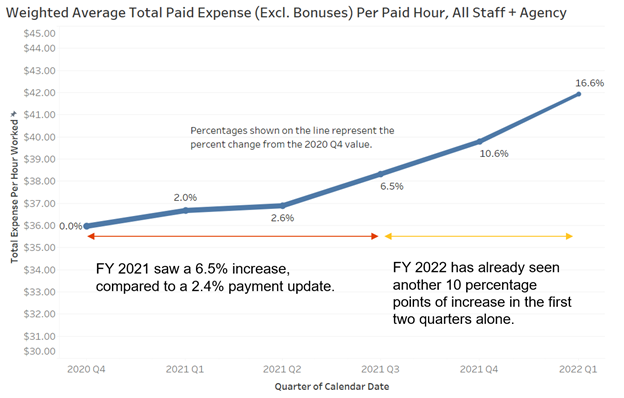
– The data reveals this discrepancy has resulted in hospitals receiving only a 2.4 percent rate increase, compared to a 6.5 percent increase in hospital labor rates, which account for 76 percent of hospital costs.

– The data CMS uses to account for real inflation in the cost of labor and other expenses is unlikely to reflect reality and produce an accurate payment update for the FY 2023 IPPS rule, due this spring.


PINC AI™ Data Analysis

CMS is expected to release proposed rules for the Inpatient Prospective Payment System (IPPS). For the FY 2021 and FY 2022 rules, CMS applied upward payment adjustments of 2.4 and 2.7 percent, respectively. However, a recent PINC AI™ analysis finds that CMS’s payment adjustments did not adequately address hospitals’ increased costs. According to new data, hospitals’ labor rates alone jumped 16.6 percent on a per-paid-hour basis since Q4 2020 (start of government FY 2021) and do not show signs of slowing. Labor makes up about 67.6 percent of the CMS market basket calculation used to adjust hospital payments. A very high payment update in FY 2023 will be needed to match the rates most acute care providers are now paying their staff. These costs do not appear to be exclusively related to the impacts COVID-19 has had on labor shortages as many clinical staff were in short supply long before the pandemic.

  • LinkedIn
  • Twitter
  • Facebook
  • Email
  • Print

Tagged With: Acute Care, AI, CMS, medicaid, medicare, Premier

Tap Native

Get in-depth healthcare technology analysis and commentary delivered straight to your email weekly

Reader Interactions

Primary Sidebar

Subscribe to HIT Consultant

Latest insightful articles delivered straight to your inbox weekly.

Submit a Tip or Pitch

Featured Insights

Aligning IT & Clinical Teams: How to Reduce Friction and Improve Communication

Most-Read

Why Brain Health Is Entering Its Infrastructure Era

Brain Health’s Infrastructure Era: Proving Clinical Outcomes with Integrated Neuromotor Tracking

Why Catholic Health Inked a $500M Care Alliance with GE HealthCare to Automate Outpatient Triage

Catholic Health Inks $500M Care Alliance with GE HealthCare to Automate Outpatient Triage

KLAS Global HIT Trends 2026 Report: Artificial Intelligence Becomes the Top Investment Priority

KLAS Global HIT Trends 2026 Report: Artificial Intelligence Becomes the Top Investment Priority

Optum Partners with Anthropic to Deploy Claude Across Healthcare Claims and Revenue Workflows

Optum Partners with Anthropic to Deploy Claude Across Healthcare Claims and Revenue Workflows

Rock Health H1 2026 Digital Health Funding Recap: Startups Hit $7.4B in Venture Rebound

Rock Health H1 2026 Digital Health Funding Recap: Startups Hit $7.4B in Venture Rebound

M&A: ResMed to Sell MatrixCare Business to Frazier Healthcare Partners for $450M

M&A: ResMed to Sell MatrixCare Business to Frazier Healthcare Partners for $450M

The Real Risk in Healthcare AI Isn’t the Model. It’s the Data. 

Clinical Data Fidelity: The Real Blindspot in Healthcare AI Strategy

KLAS 2026 EHR Market Share Report: Epic Gains as Oracle Health Faces Third Year of Losses

KLAS 2026 EHR Market Share Report: Epic Gains as Oracle Health Faces Third Year of Losses

Qualtrics Acquires Press Ganey Forsta for $6.75B to Create the Most Comprehensive AI Experience Platform

M&A: Qualtrics Completes $6.75B Acquisition of Press Ganey Forsta

Viz.ai Launches Viz Pulmonary™ Suite: AI-Powered Workflows for COPD, Lung Nodules, and PE

Viz.ai Launches Viz Pulmonary™ Suite: AI-Powered Workflows for COPD, Lung Nodules, and PE

Secondary Sidebar

Footer

Company

  • About Us
  • 2026 Editorial Calendar
  • Advertise with Us
  • Reprints and Permissions
  • Op-Ed Submission Guidelines
  • Contact
  • Subscribe

Editorial Coverage

  • Opinion
  • Health IT
    • Care Coordination
    • EMR/EHR
    • Interoperability
    • Population Health Management
    • Revenue Cycle Management
  • Digital Health
    • Artificial Intelligence
    • Blockchain Tech
    • Precision Medicine
    • Telehealth
    • Wearables
  • Startups
  • Value-Based Care
    • Accountable Care
    • Medicare Advantage

Connect

Subscribe to HIT Consultant Media

Latest insightful articles delivered straight to your inbox weekly

Copyright © 2026. HIT Consultant Media. All Rights Reserved. Privacy Policy |