

• Skip to main content
  • Skip to secondary menu
  • Skip to primary sidebar
  • Skip to secondary sidebar
  • Skip to footer

  • Opinion
  • Health IT
    • Behavioral Health
    • Care Coordination
    • EMR/EHR
    • Interoperability
    • Patient Engagement
    • Population Health Management
    • Revenue Cycle Management
    • Social Determinants of Health
  • Digital Health
    • AI
    • Blockchain
    • Precision Medicine
    • Telehealth
    • Wearables
  • Life Sciences
  • Investments
  • M&A
  • Value-based Care
    • Accountable Care (ACOs)
    • Medicare Advantage

Providers Struggle to Integrate Revenue Cycle Operations with Clinical Operations

by Fred Pennic 10/01/2019 Leave a Comment

  • LinkedIn
  • Twitter
  • Facebook
  • Email
  • Print

Providers Struggle to Integrate Revenue Cycle Operations with Clinical Operations

– Navigant executive survey conducted by HFMA finds providers struggle to integrate revenue cycle operations with clinical operations.

– Survey of 108 hospital and health system chief financial officers and revenue cycle executives find 62% suggest EHR adoption challenges have been equal to or outweighed benefits specific to their organization’s revenue cycle performance.

– More than 60% of providers struggle to derive optimal value from their electronic health records (EHRs).

Only 3% percent of provider organizations feel their organizations are fully successful at integrating revenue cycle operations with clinical operations, according to an annual HFMA/Navigant survey. The 2019 HFMA/Navigant survey of 108 hospital and health system chief financial officers and revenue cycle executives reveals EHR adoption challenges have been equal to or outweighed benefits specific to their organization’s revenue cycle performance.

Providers Struggle to Integrate Revenue Cycle Operations with Clinical Operations

In addition, more than half of executives say their organizations can’t keep up with EHR upgrades or underuse available EHR functions.  In an ongoing effort to better manage these challenges, 69% of executives predict their organization’s IT budgets will increase over the next year, up from 68% last year but below 74% in 2017.

Consumer Pay Concerns
Providers Struggle to Integrate Revenue Cycle Operations with Clinical Operations

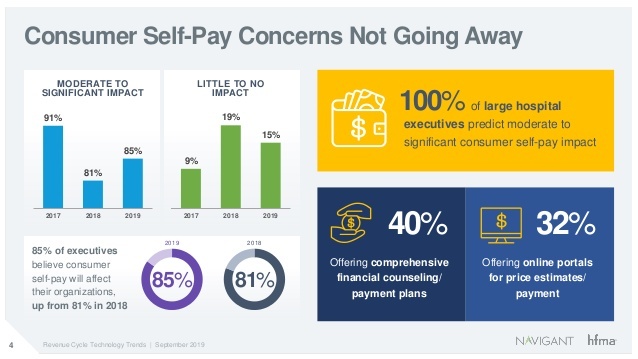
Consumer self-pay concerns also persist for provider executives. Eighty-five percent of respondents – including all large hospital executives – believe the increase in consumer responsibility for healthcare costs will continue to affect their organizations, up from 81% last year but down from 92% in 2017. 

Collaboration with External Entities to Improve Revenue Cycle Performance

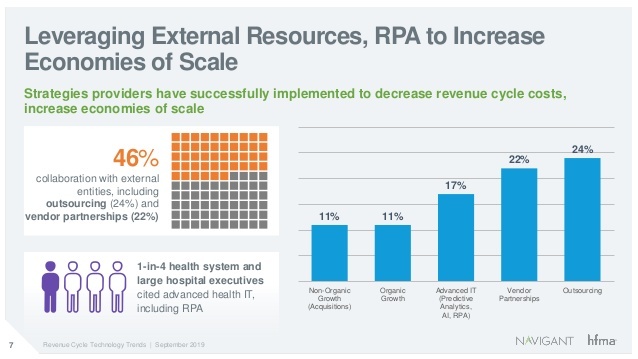
When asked which strategies they’ve already implemented to successfully decrease revenue cycle costs and increase economies of scale, 46% of executives selected collaboration with external entities, including outsourcing and vendor partnerships. In addition, one-in-four of both health system and large provider executives cited advanced health IT, including robotic process automation (RPA).
Moving forward, the majority of executives (87%) again suggest they’re most focused on technology-related capabilities to drive future revenue cycle improvements. Revenue integrity was the top area of focus for the third straight year, cited by 28% of executives, a 21% increase from 2017. Furthermore, RPA saw a major jump among health system executives – 15% cited the capability, which wasn’t selected by any health system executive in 2018.

Impact of 2019 HFMA/Navigant Survey Findings

“It was anticipated that EHRs would be the main driver of broad performance improvement, but that has not occurred in many cases,” said Timothy Kinney, managing director at Navigant. “Instead, providers are now taking other steps, including looking outside their organizations to collaborate with external entities and leveraging advanced technology solutions, and they’re seeing successes.”

  • LinkedIn
  • Twitter
  • Facebook
  • Email
  • Print

Tagged With: EHR Adoption, Health IT, integrity, Navigant, revenue cycle, Revenue Cycle Management, revenue cycle operations, revenue integrity, Robotic Process Automation

Tap Native

Get in-depth healthcare technology analysis and commentary delivered straight to your email weekly

Reader Interactions

Primary Sidebar

Subscribe to HIT Consultant

Latest insightful articles delivered straight to your inbox weekly.

Submit a Tip or Pitch

2026 Predictions & Trends

Healthcare 2026 Forecast: Executives on AI Survival, Financial Reckoning, and the End of Point Solutions

2026 Healthcare Executive Predictions: Why the AI “Pilot Era” Is Officially Over

Most-Read

HHS Launches 'OneHHS' AI Strategy to Integrate AI Across CDC, CMS, and FDA for Efficiency and Public Trust

HHS Launches ‘OneHHS’ AI Strategy to Integrate AI Across CDC, CMS, and FDA for Efficiency and Public Trust

Kristen Hartsell, VP of Clinical Services, RedSail Technologies

The Pharmacy Closures Crisis: How Independent Pharmacies Are Fixing Pharmacy Deserts

From Overwhelmed to Optimized: How AI Agents Address Staffing Challenges and Burnout in Healthcare

From Overwhelmed to Optimized: How AI Agents Address Staffing Challenges and Burnout in Healthcare

The VBC Paradox: Why Hospitals Are Doubling Down on Value-Based Care While Revenue at Risk Lags

The VBC Paradox: Why Hospitals Are Doubling Down on Value-Based Care While Revenue at Risk Lags

Tebra Secures $250M to Challenge Legacy EHRs with AI-Powered Automation

Tebra Secures $250M to Challenge Legacy EHRs with AI-Powered Automation

AstraZeneca Selects Salesforce Agentforce Life Sciences to Deploy AI-Powered Global Customer Engagement

AstraZeneca Selects Salesforce Agentforce Life Sciences to Deploy AI-Powered Global Customer Engagement

Aidoc Partners with NVIDIA MONAI to Scale Open-Source Clinical AI

Aidoc Partners with NVIDIA MONAI to Scale Open-Source Clinical AI

RapidAI Secures FDA Clearance for Five New Deep Clinical AI Modules, Expanding Enterprise Imaging Platform

RapidAI and AWS Deepen Partnership to Scale Clinical AI in Healthcare

Greece and Sword Health to Build AI-Powered Healthcare Front Door

Greece and Sword Health to Build AI-Powered Healthcare Front Door

GE HealthCare Acquires Intelerad for $2.3B to Create Cloud-First, AI-Enabled Imaging Ecosystem

GE HealthCare Acquires Intelerad for $2.3B to Create Cloud-First, AI-Enabled Imaging Ecosystem

Secondary Sidebar

Footer

Company

  • About Us
  • Advertise with Us
  • Reprints and Permissions
  • Op-Ed Submission Guidelines
  • Contact
  • Subscribe

Editorial Coverage

  • Opinion
  • Health IT
    • Care Coordination
    • EMR/EHR
    • Interoperability
    • Population Health Management
    • Revenue Cycle Management
  • Digital Health
    • Artificial Intelligence
    • Blockchain Tech
    • Precision Medicine
    • Telehealth
    • Wearables
  • Startups
  • Value-Based Care
    • Accountable Care
    • Medicare Advantage

Connect

Subscribe to HIT Consultant Media

Latest insightful articles delivered straight to your inbox weekly

Copyright © 2025. HIT Consultant Media. All Rights Reserved. Privacy Policy |