
• Skip to main content
  • Skip to secondary menu
  • Skip to primary sidebar
  • Skip to secondary sidebar
  • Skip to footer

  • Opinion
  • Health IT
    • Behavioral Health
    • Care Coordination
    • EMR/EHR
    • Interoperability
    • Patient Engagement
    • Population Health Management
    • Revenue Cycle Management
    • Social Determinants of Health
  • Digital Health
    • AI
    • Blockchain
    • Precision Medicine
    • Telehealth
    • Wearables
  • Life Sciences
  • Investments
  • M&A
  • Value-based Care
    • Accountable Care (ACOs)
    • Medicare Advantage

Report: Only 1.6% of Claims Have Been Denied Post ICD-10

by Fred Pennic 02/29/2016 Leave a Comment

  • LinkedIn
  • Twitter
  • Facebook
  • Email
  • Print

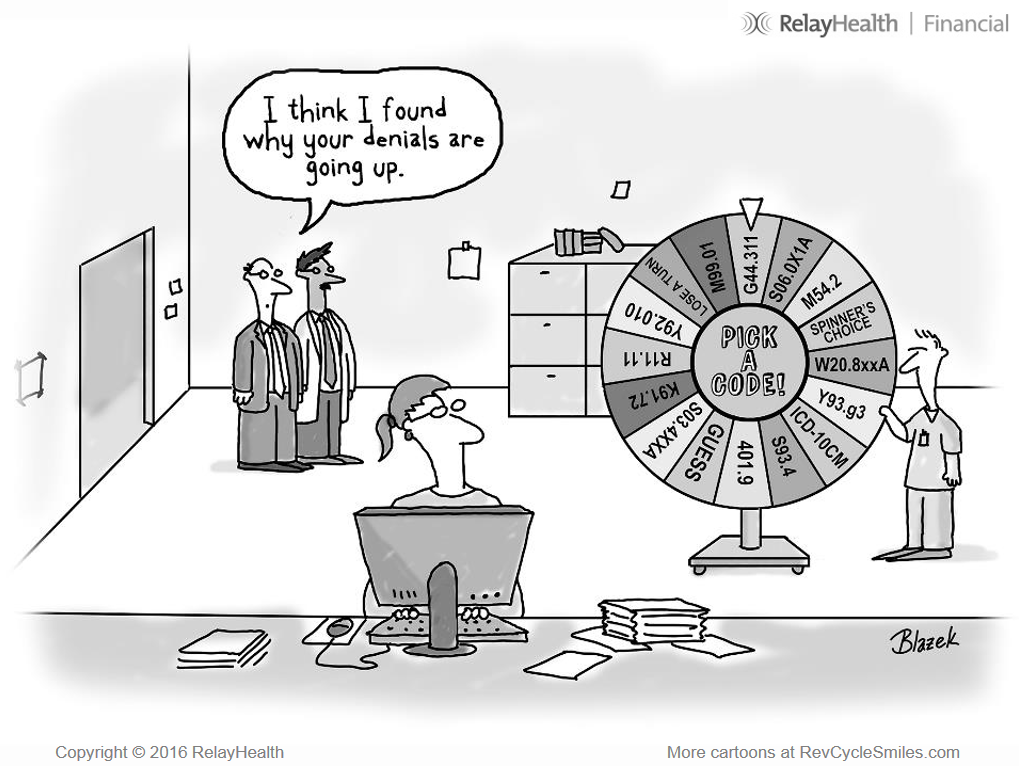
Denials (1)

Of the $810 billion in claims processed by more than 2,400 hospitals and 630,000 providers using RelayHealth Financial clearinghouse, just 1.6% have been denied. This denial rate has remained unchanged since November and represents approximately $12.9 billion in denied claims since October 1st. The disclosed denial rate data from RelayHealth Financial is based on for more than 262 million claims processed between October 1, 2015 and February 15, 2016.  A low denial rate indicates a healthy cash flow which is critical to a provider’s revenue cycle. 

“The good news is that we’re not seeing a marked increase in claim denial rates, and there is heightened interest in denial management and prevention,” said Marcy Tatsch, vice president and general manager of Reimbursement Solutions for RelayHealth Financial. “The bad news is that as many as 1 in 5 claims is still denied or delayed–which can mean a dip of as much as 3% in a hospital or health system’s revenue stream2. While it’s important to keep monitoring those KPIs that are monitored on RelayHealth Financial’s Denials Dashboard, healthcare providers should now ramp up their broader denial prevention and management efforts.”

Defining Denial Rate

Denial rate is defined as the original denial rate expressed as percentage of claim dollars that were initially denied for ICD impacted denial categories in relation to dollars billed on remitted claims. Denial rates displayed reflect only the denial categories of Authorization/Pre-Certification, Medical Coding, Medical Necessity, and Untimely Filing.

Highest denial rates by payers include:

– Missisippi Medicaid (59.7%)

– Washington Medicaid (10.5%)

– Florida Health Options HMO (8.2%)

– Great Lakes Health Plan (7.8%)

– Gateway Health Plan -Medicaid PA (7.5%)

– Florida Blue Cross (7%)

– Michigan Medicaid (6.5%)

– Horizon NJ Health (6.4%)

– Blue Care Network (6.1%)

– South Carolina Medicaid (5.8%)

Days to Payment 

Days to Payment is the number of days from statement through date until payment is received from the payer (excludes all self-pay including patient responsibility portion of claim) for primary claims only. Payers who had the highest days to payment include: 

Days to Payment Payer Name
117.5 Days
GEORGIA MEDICAID
108.8 Days
VETERANS ADMINISTRATION FEE BASIS PROGRAMS
102.5 Days
NEW JERSEY MEDICAID
88.4 Days
KAISER PERMANENTE of COLORADO
87.7 Days
SOUTH CAROLINA MEDICAID
87.1 Days
LOUISIANA MEDICAID
86.6 Days
UNITED RESOURCES NETWORK
85.0 Days
KAISER PERMANENTE of GEORGIA
81.1 Days
ARKANSAS MEDICAID
78.5 Days
ARIZONA MEDICAID

Payers who had the lowest days to payment include:

Days to Payment Payer Name
16.8 Days
MVP HEALTH PLANS of NEW YORK
18.4 Days
KAISER SELF FUNDED PLAN – HARRINGTON/FISERV
19.8 Days
FIRSTCARE (VALLEY BAPTIST HEALTH PLAN)
20.7 Days
COMMUNITY HEALTH CHOICE
21.7 Days
PHYSICIAN HEALTH PLAN of NORTHERN INDIANA – PHP
21.9 Days
PENNSYLVANIA FREEDOM BLUE MEDICARE ADVANTAGE
22.5 Days
INLAND EMPIRE HEALTH PLAN
22.5 Days
SUNSHINE STATE HEALTH PLAN
22.6 Days
PASSPORT HEALTH PLAN
23.6 Days
SUPERIOR HEALTH PLAN – TEXAS

To help providers understand and navigate the challenges surrounding strategic denial prevention and management, RelayHealth Financial now offers an online resource: ReduceMyDenials.com. The site features a number of resources that focus on best practices and operational considerations, with links to case studies, white papers, and a webinar focused on helping providers reduce and manage denials.

  • LinkedIn
  • Twitter
  • Facebook
  • Email
  • Print

Tagged With: Relay Health

Tap Native

Get in-depth healthcare technology analysis and commentary delivered straight to your email weekly

Reader Interactions

Primary Sidebar

Subscribe to HIT Consultant

Latest insightful articles delivered straight to your inbox weekly.

Submit a Tip or Pitch

2026 Predictions & Trends

Healthcare 2026 Forecast: Executives on AI Survival, Financial Reckoning, and the End of Point Solutions

2026 Healthcare Executive Predictions: Why the AI “Pilot Era” Is Officially Over

Most-Read

Utah Becomes First State to Approve AI System for Prescription Renewals

Utah Becomes First State to Approve AI System for Prescription Renewals

NYC Health + Hospitals to Acquire Maimonides in $2.2B Safety Net Overhaul

NYC Health + Hospitals to Acquire Maimonides in $2.2B Safety Net Overhaul

KLAS Report: Why Hospitals Are Choosing Efficiency Over 'Agentic' AI Hype in 2025

KLAS Report: Why Hospitals Are Choosing Efficiency Over ‘Agentic’ AI Hype in 2025

Advanced Primary Care 2026: Top 6 Investments for Health Systems According to Harvard Medical School

Advanced Primary Care 2026: Top 6 Investments for Health Systems According to Harvard Medical School

AI Nutrition Labels: The Key to Provider Adoption and Patient Trust?

AI Nutrition Labels: The Key to Provider Adoption and Patient Trust?

Kristen Hartsell, VP of Clinical Services, RedSail Technologies

The Pharmacy Closures Crisis: How Independent Pharmacies Are Fixing Pharmacy Deserts

HHS Launches 'OneHHS' AI Strategy to Integrate AI Across CDC, CMS, and FDA for Efficiency and Public Trust

HHS Launches ‘OneHHS’ AI Strategy to Integrate AI Across CDC, CMS, and FDA for Efficiency and Public Trust

From Overwhelmed to Optimized: How AI Agents Address Staffing Challenges and Burnout in Healthcare

From Overwhelmed to Optimized: How AI Agents Address Staffing Challenges and Burnout in Healthcare

The VBC Paradox: Why Hospitals Are Doubling Down on Value-Based Care While Revenue at Risk Lags

The VBC Paradox: Why Hospitals Are Doubling Down on Value-Based Care While Revenue at Risk Lags

Tebra Secures $250M to Challenge Legacy EHRs with AI-Powered Automation

Tebra Secures $250M to Challenge Legacy EHRs with AI-Powered Automation

Secondary Sidebar

Footer

Company

  • About Us
  • Advertise with Us
  • Reprints and Permissions
  • Op-Ed Submission Guidelines
  • Contact
  • Subscribe

Editorial Coverage

  • Opinion
  • Health IT
    • Care Coordination
    • EMR/EHR
    • Interoperability
    • Population Health Management
    • Revenue Cycle Management
  • Digital Health
    • Artificial Intelligence
    • Blockchain Tech
    • Precision Medicine
    • Telehealth
    • Wearables
  • Startups
  • Value-Based Care
    • Accountable Care
    • Medicare Advantage

Connect

Subscribe to HIT Consultant Media

Latest insightful articles delivered straight to your inbox weekly

Copyright © 2026. HIT Consultant Media. All Rights Reserved. Privacy Policy |