
• Skip to main content
  • Skip to secondary menu
  • Skip to primary sidebar
  • Skip to secondary sidebar
  • Skip to footer

  • Opinion
  • Health IT
    • Behavioral Health
    • Care Coordination
    • EMR/EHR
    • Interoperability
    • Patient Engagement
    • Population Health Management
    • Revenue Cycle Management
    • Social Determinants of Health
  • Digital Health
    • AI
    • Blockchain
    • Precision Medicine
    • Telehealth
    • Wearables
  • Life Sciences
  • Investments
  • M&A
  • Value-based Care
    • Accountable Care (ACOs)
    • Medicare Advantage

Patient Portal Features: Which Is The Most Beneficial & Frustrating for Consumers?

by Fred Pennic 08/19/2014 Leave a Comment

  • LinkedIn
  • Twitter
  • Facebook
  • Email
  • Print

To successfully attest for Meaningful Use Stage 2, providers must have a patient portal that is used by at least 5 percent of patients in order to receive financial incentives. Reports have shown that providers have struggled with patient portal adoption which caused CMS to lower the objective to 5 percent from the initial 10 percent. While educating patients about patient portals is clearly the first step, maintaining their involvement depends heavily on understanding both the features they find beneficial and the frustrations that can drive them away.

To find out more, Software Advice conducted a three-day online survey of four questions, and gathered 1,540 responses from random patients within the United States. The survey questions were worded to ensure that each respondent fully understood their meaning and topic. The key findings uncovers what motivates patients to engage and disengage with a patient portal.

Most Requested Patient Portal Features  
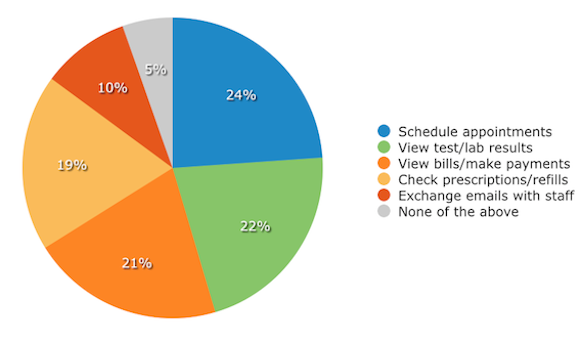
Patient Portal Features

Online appointment scheduling is the most requested patient portal feature for patients at 24 percent that would provide a streamlined experience while eliminating hassles of making appointments over the phone. Viewing test/lab results was the second most desired patient portal feature, with 22 percent of respondents expressing a preference for this. Kaiser Permanente is one example of the benefit this feature can have: when it added a feature to its portal allowing patients to view test results, registration jumped from 9 to 27 percent. Other most requested patient portal features include: 

– Another 21 percent of patients in our sample wanted a portal that would allow them to view and pay bills online. This data aligns with a recent study by Intuit, which found that 77 percent of patients would be willing to pay medical bills online if the option was made available to them. 

– Checking prescriptions and requesting refills was favored by 19 percent of patients; a finding that has positive implications for patient outcomes. One study, for example, found that diabetic patients who used an online portal to request refills were more likely to take their medication.

– Only 10 percent of patients expressed interest in exchanging emails with staff.  This may be a result of frustration stemming from prior attempts at communication; e.g. patients may have sent messages to staff via a portal in the past that went ignored.

Most Frustrating Patient Portal Features

Patient Portal Features1

Unresponsive staff (34 percent) and confusing portal interfaces (33 percent) topped the list of what patients find most irksome about patient portals. One reason for slow staff response times may be the relative novelty of patient portals. Automatic emails, often viewed as annoying and impersonal, were also disliked by patients, with 22 percent citing this as the most frustrating feature. Finally, while the use of medical jargon in patient notes is often cited as a point of confusion, only 11 percent of patients surveyed said it would frustrate them most when using a portal. 

Recommendations for Providers

To ensure providers choose the right patient portal, the report suggests:

– Ensure features align with practice demographics

– Take it for a test drive

– Consider future patient preferences

Keeping an eye on what features patients increasingly desire will help ensure they continue to engage with your patient portal—both now and in the future.

For more information, access the full report here: http://www.softwareadvice.com/medical/industryview/patient-portals-2014/

  • LinkedIn
  • Twitter
  • Facebook
  • Email
  • Print

Tap Native

Get in-depth healthcare technology analysis and commentary delivered straight to your email weekly

Reader Interactions

Primary Sidebar

Subscribe to HIT Consultant

Latest insightful articles delivered straight to your inbox weekly.

Submit a Tip or Pitch

2026 Predictions & Trends

Healthcare 2026 Forecast: Executives on AI Survival, Financial Reckoning, and the End of Point Solutions

2026 Healthcare Executive Predictions: Why the AI “Pilot Era” Is Officially Over

Most-Read

KLAS Report: Why Hospitals Are Choosing Efficiency Over 'Agentic' AI Hype in 2025

KLAS Report: Why Hospitals Are Choosing Efficiency Over ‘Agentic’ AI Hype in 2025

Advanced Primary Care 2026: Top 6 Investments for Health Systems According to Harvard Medical School

Advanced Primary Care 2026: Top 6 Investments for Health Systems According to Harvard Medical School

AI Nutrition Labels: The Key to Provider Adoption and Patient Trust?

AI Nutrition Labels: The Key to Provider Adoption and Patient Trust?

Kristen Hartsell, VP of Clinical Services, RedSail Technologies

The Pharmacy Closures Crisis: How Independent Pharmacies Are Fixing Pharmacy Deserts

HHS Launches 'OneHHS' AI Strategy to Integrate AI Across CDC, CMS, and FDA for Efficiency and Public Trust

HHS Launches ‘OneHHS’ AI Strategy to Integrate AI Across CDC, CMS, and FDA for Efficiency and Public Trust

From Overwhelmed to Optimized: How AI Agents Address Staffing Challenges and Burnout in Healthcare

From Overwhelmed to Optimized: How AI Agents Address Staffing Challenges and Burnout in Healthcare

The VBC Paradox: Why Hospitals Are Doubling Down on Value-Based Care While Revenue at Risk Lags

The VBC Paradox: Why Hospitals Are Doubling Down on Value-Based Care While Revenue at Risk Lags

Tebra Secures $250M to Challenge Legacy EHRs with AI-Powered Automation

Tebra Secures $250M to Challenge Legacy EHRs with AI-Powered Automation

AstraZeneca Selects Salesforce Agentforce Life Sciences to Deploy AI-Powered Global Customer Engagement

AstraZeneca Selects Salesforce Agentforce Life Sciences to Deploy AI-Powered Global Customer Engagement

Aidoc Partners with NVIDIA MONAI to Scale Open-Source Clinical AI

Aidoc Partners with NVIDIA MONAI to Scale Open-Source Clinical AI

Secondary Sidebar

Footer

Company

  • About Us
  • Advertise with Us
  • Reprints and Permissions
  • Op-Ed Submission Guidelines
  • Contact
  • Subscribe

Editorial Coverage

  • Opinion
  • Health IT
    • Care Coordination
    • EMR/EHR
    • Interoperability
    • Population Health Management
    • Revenue Cycle Management
  • Digital Health
    • Artificial Intelligence
    • Blockchain Tech
    • Precision Medicine
    • Telehealth
    • Wearables
  • Startups
  • Value-Based Care
    • Accountable Care
    • Medicare Advantage

Connect

Subscribe to HIT Consultant Media

Latest insightful articles delivered straight to your inbox weekly

Copyright © 2025. HIT Consultant Media. All Rights Reserved. Privacy Policy |
