
What You Should Know
- Cardiovascular imaging AI innovator Elucid has received U.S. FDA 510(k) clearance (K262015, authorized September 29, 2026) for FFR-IQ™, its software for the non-invasive estimation of fractional flow reserve derived from coronary computed tomography angiography (CCTA).
- Introduces BioIntegrated FFR-CT: a computational modeling approach that integrates coronary vascular anatomy, plaque tissue morphology, and vascular biology directly into hemodynamic estimations, departing from legacy fluid dynamic models that rely strictly on luminal geometry.
The ELUCIDATE Benchmark: Diagnostic Accuracy Grounded in Invasive Truth
First-generation computational fluid dynamics (CFD) platforms typically model blood flow using coronary lumen geometry and estimated myocardial mass. However, vessels with identical physical caliber often display markedly different vasodilatory responses depending on the underlying biology of the vessel wall.
FFR-IQ was cleared based on results from the multicenter ELUCIDATE FFR-CT clinical trial (NCT06018194), which evaluated 491 vessels across 347 patients, directly benchmarking non-invasive FFR-IQ estimates against invasive wire-based FFR.
The validation study demonstrated:
- Sensitivity: 92.2% in identifying hemodynamically significant, flow-limiting stenosis.
- Specificity: 93.1%, setting a new high-water mark among FDA-cleared FFR-CT validation trials and minimizing the false positives that send non-ischemic patients to the catheterization laboratory.
Unifying Anatomy, Physiology, and Histology on a Single Platform
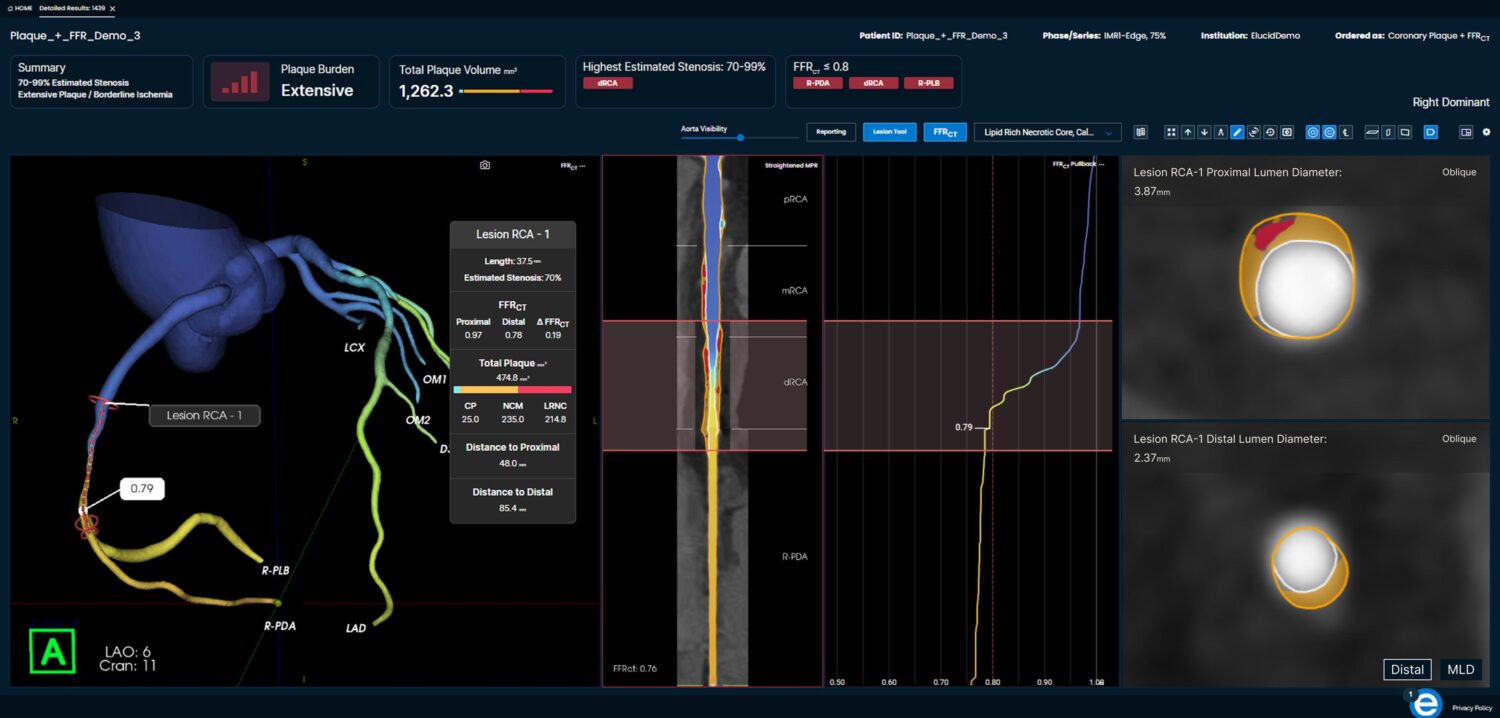
The clearance of FFR-IQ completes Elucid’s core product strategy: creating a unified clinical software suite that links FFR-IQ with Plaque-IQ™, its FDA-cleared CT plaque analysis software.
Plaque-IQ is trained and validated against ground-truth human histopathology specimens—correlating with near-infrared spectroscopy intravascular ultrasound (NIRS-IVUS) to quantify plaque volume, evaluate stenosis, and detect high-risk features like lipid-rich necrotic cores (LRNC).
By feeding these tissue-level plaque parameters directly into FFR-IQ’s deep-learning neural network, the platform accounts for how specific plaque phenotypes alter microvascular resistance and structural vessel compliance:
- Concordant Lesion Analysis: Clinicians can evaluate whether an individual plaque is physically vulnerable to rupture while simultaneously measuring its ischemic, hemodynamic impact along the entire coronary tree from a single CCTA scan.
- Streamlined Cath Lab Triage: By distinguishing benign anatomical narrowings from functionally ischemic blockages, the combined platform helps interventional cardiologists avoid non-therapeutic diagnostic catheterizations while identifying flow-limiting lesions that require stent placement or surgical bypass.
- Longitudinal Disease Management: The dual output informs both local revascularization decisions and systemic medical therapy, such as aggressive lipid-lowering regimens for patients harboring high necrotic core burdens.
Dr. Amir Ahmadi, Clinical Associate Professor of Medicine at the Icahn School of Medicine at Mount Sinai and Elucid’s lead scientific advisor, highlighted the clinical shift: “Plaque composition, coronary anatomy, and physiology are closely connected. BioIntegrated FFR-CT incorporates anatomy and plaque characteristics into the physiological estimate itself. Together with plaque assessment, this approach can help physicians evaluate the significance of an individual lesion while also addressing the patient’s broader atherosclerotic disease and need for preventive treatment.”