

• Skip to main content
  • Skip to secondary menu
  • Skip to primary sidebar
  • Skip to secondary sidebar
  • Skip to footer

  • Opinion
  • Health IT
    • Behavioral Health
    • Care Coordination
    • EMR/EHR
    • Interoperability
    • Patient Engagement
    • Population Health Management
    • Revenue Cycle Management
    • Social Determinants of Health
  • Digital Health
    • AI
    • Blockchain
    • Precision Medicine
    • Telehealth
    • Wearables
  • Life Sciences
  • Investments
  • M&A
  • Value-based Care
    • Accountable Care (ACOs)
    • Medicare Advantage

CCM and KLAS Research Report: 63% of Health Systems Lack Advanced AI Strategy Frameworks

by Fred Pennic 08/06/2026 Leave a Comment

  • LinkedIn
  • Twitter
  • Facebook
  • Email
  • Print
CCM and KLAS Research Report: 63% of Health Systems Lack Advanced AI Strategy Frameworks

What You Should Know

  • A report by the Center for Connected Medicine (CCM) at UPMC and KLAS Research reveals that while 93% of surveyed health system leaders have deployed third-party AI, strategy and testing infrastructure lag far behind.
  • Clinical documentation and ambient scribing lead deployment at 52%, followed by revenue cycle and coding (36%), medical imaging (32%), and EHR-embedded clinical decision support (32%).
  • While 92% of organizations conduct pre-deployment testing, less than half (44%) possess a dedicated data platform or sandbox environment to validate model accuracy, safety, and drift.
  • 63% of health system AI strategies remain “developing” or ad hoc, with only 4% described as “advanced”.
  • Top operational pain points include reliance on manual spreadsheets (17 respondents), inconsistent data definitions across teams (14 respondents), and severe talent or resource constraints (11 respondents).

CCM and KLAS Research Expose Health IT’s Governance and Testing Deficit

The enterprise health IT, clinical transformation, and healthcare analytics sectors face a structural operational challenge: health system AI procurement is significantly outpacing the internal governance, data architecture, and testing pipelines required to validate algorithms safely.

While executive boards face immense pressure to adopt clinical and administrative AI, deploying algorithms without dedicated testing environments exposes health systems to algorithmic drift, unvetted bias, security vulnerabilities, and unvalidated ROI.

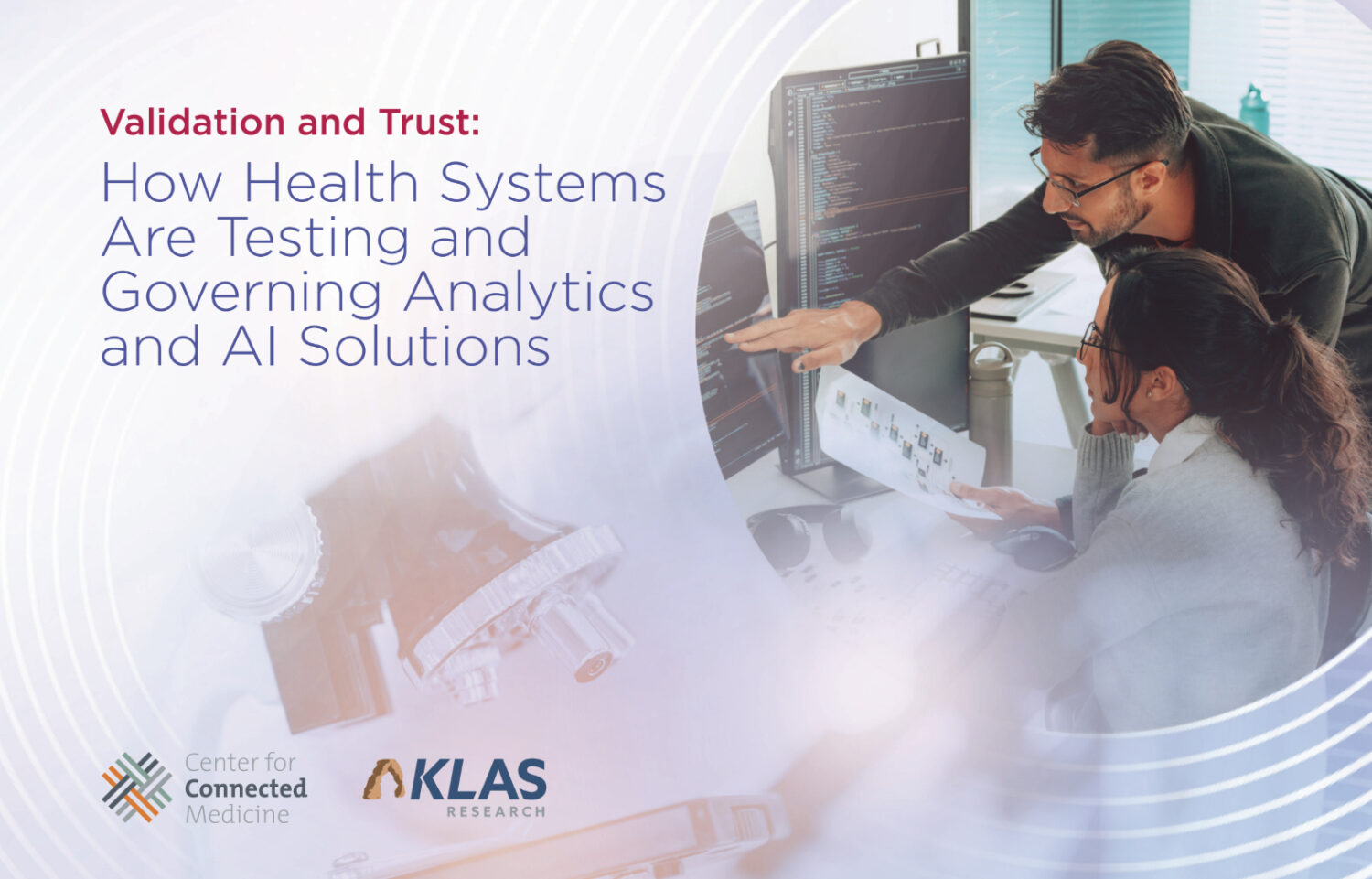
To quantify this operational gap, the Center for Connected Medicine (CCM) at UPMC and KLAS Research released a comprehensive report titled “Validation and Trust: How Health Systems Are Testing and Governing Analytics and AI Solutions“.

Surveying C-suite, clinical informatics, and IT executives across 27 health systems, the research demonstrates that the primary bottleneck in healthcare AI has shifted from tool procurement to operational validation and infrastructure.


The research outlines key technical and structural realities across current health system deployments:

  • Widespread Deployment vs. Infrastructure Deficit: 93% of health systems have deployed third-party AI, yet only 44% maintain a dedicated data environment (such as cloud lakehouses, production clones, or real-world data platforms) to test models before clinical integration.
  • Primary Use Case Distribution: Ambient clinical documentation leads adoption (52%), followed by revenue cycle management and coding (36%), diagnostic imaging (32%), and EHR-embedded clinical decision support (32%).
  • Data Quality Friction: Reliance on manual workarounds/spreadsheets (17 respondents), inconsistent metrics across departments (14 respondents), and unstructured clinical data (10 respondents) represent the greatest obstacles to model reliability.
  • In Silico Sandbox Validation: Advanced organizations are deploying dedicated platforms—such as UPMC’s real-world data engine, Ahavi—to evaluate third-party algorithms against de-identified patient populations without disrupting live care.

“The health care industry has moved remarkably quickly from discussing the potential of AI to actively deploying solutions across the enterprise,” stated Dr. Rob Bart, Chief Medical Information Officer at UPMC. “Health systems are now focused on building the governance structures, testing capabilities and organizational strategies necessary to ensure AI delivers meaningful and measurable value.”

  • LinkedIn
  • Twitter
  • Facebook
  • Email
  • Print

Tagged With: KLAS, KLAS Report, UPMC, UPMC Enterprises

Tap Native

Get in-depth healthcare technology analysis and commentary delivered straight to your email weekly

Reader Interactions

Primary Sidebar

Subscribe to HIT Consultant

Latest insightful articles delivered straight to your inbox weekly.

Submit a Tip or Pitch

Featured Insights

Aligning IT & Clinical Teams: How to Reduce Friction and Improve Communication

Most-Read

CB Insights Q2 2026 State of Digital Health Report: Fewest Deals in Over a Decade as Median Sizes Rise

CB Insights Q2 2026 State of Digital Health Report: Fewest Deals in Over a Decade as Median Sizes Rise

mount-sinai-launches-epic-chart-with-art-nursing-ambient-ai

Mount Sinai Medical Center Extends Epic’s Ambient AI to Inpatient Nursing

M&A: Tempus AI to Acquire Personalis for $1.5B to Expand Precision Oncology and MRD Monitoring

M&A: Tempus AI to Acquire Personalis for $1.5B to Expand Precision Oncology and MRD Monitoring

Why Brain Health Is Entering Its Infrastructure Era

Brain Health’s Infrastructure Era: Proving Clinical Outcomes with Integrated Neuromotor Tracking

Why Catholic Health Inked a $500M Care Alliance with GE HealthCare to Automate Outpatient Triage

Catholic Health Inks $500M Care Alliance with GE HealthCare to Automate Outpatient Triage

KLAS Global HIT Trends 2026 Report: Artificial Intelligence Becomes the Top Investment Priority

KLAS Global HIT Trends 2026 Report: Artificial Intelligence Becomes the Top Investment Priority

Optum Partners with Anthropic to Deploy Claude Across Healthcare Claims and Revenue Workflows

Optum Partners with Anthropic to Deploy Claude Across Healthcare Claims and Revenue Workflows

Rock Health H1 2026 Digital Health Funding Recap: Startups Hit $7.4B in Venture Rebound

Rock Health H1 2026 Digital Health Funding Recap: Startups Hit $7.4B in Venture Rebound

M&A: ResMed to Sell MatrixCare Business to Frazier Healthcare Partners for $450M

M&A: ResMed to Sell MatrixCare Business to Frazier Healthcare Partners for $450M

The Real Risk in Healthcare AI Isn’t the Model. It’s the Data. 

Clinical Data Fidelity: The Real Blindspot in Healthcare AI Strategy

Secondary Sidebar

Footer

Company

  • About Us
  • 2026 Editorial Calendar
  • Advertise with Us
  • Reprints and Permissions
  • Op-Ed Submission Guidelines
  • Contact
  • Subscribe

Editorial Coverage

  • Opinion
  • Health IT
    • Care Coordination
    • EMR/EHR
    • Interoperability
    • Population Health Management
    • Revenue Cycle Management
  • Digital Health
    • Artificial Intelligence
    • Blockchain Tech
    • Precision Medicine
    • Telehealth
    • Wearables
  • Startups
  • Value-Based Care
    • Accountable Care
    • Medicare Advantage

Connect

Subscribe to HIT Consultant Media

Latest insightful articles delivered straight to your inbox weekly

Copyright © 2026. HIT Consultant Media. All Rights Reserved. Privacy Policy |