
What You Should Know
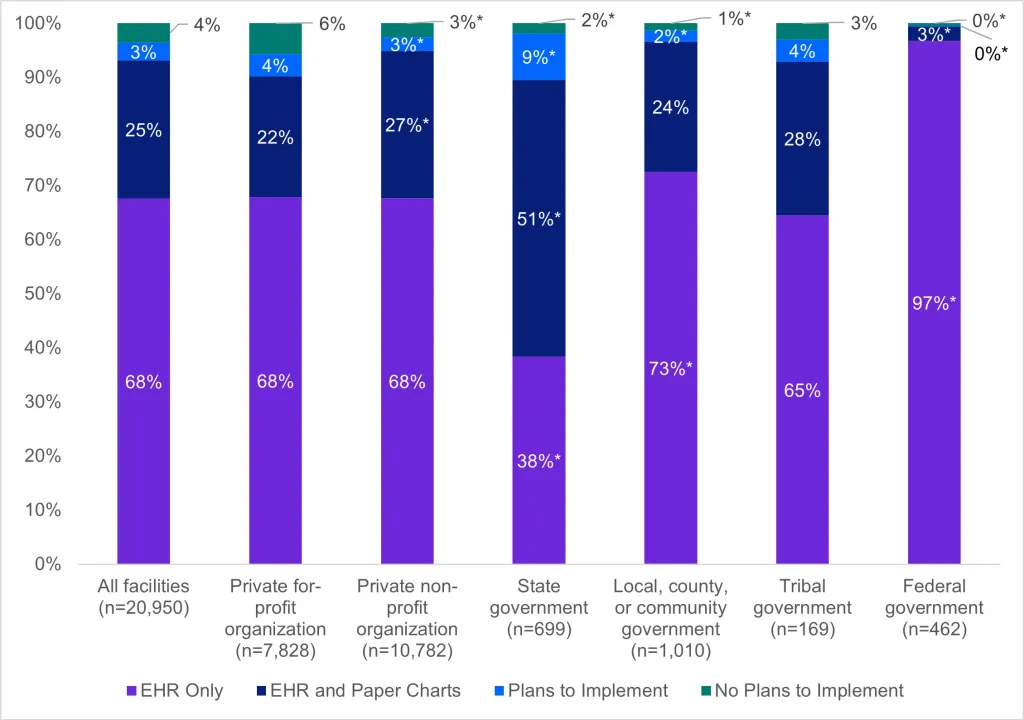
- The Baseline Adoption: According to a new ONC Brief using 2024 N-SUMHSS survey data, more than two-thirds (68%) of substance use and mental health treatment facilities use an electronic health record (EHR) exclusively. Another 25% use a combination of an EHR system and paper charts.
- The Ownership Disparity: EHR adoption varies wildly depending on facility ownership. Federal government facilities have a 97% adoption rate. Private for-profit organizations sit at 68%. Alarmingly, state government facilities trail significantly, with only a 38% exclusive EHR adoption rate.
- The Core vs. Advanced Divide: Almost all facilities use their EHRs for core administrative tasks like recording diagnoses and clinical notes (99–100%). However, utilization drops significantly for advanced capabilities like sending prescriptions, ordering lab tests, and integrating outside health information.
- The Interoperability Wall: Only 19% of behavioral health facilities reported participating in a Health Information Exchange (HIE). The majority (67%) stated they were not familiar with an HIE or did not know about HIE availability in their area.
EHR Adoption by Ownership
While overall adoption is high, the “paperless” status of a facility often depends on its ownership structure:
- Federal Government: Highest adoption rate at 97%.
- Local/County Government: 73% adoption.
- Private For-Profit: 68% adoption.
- State Government: Lowest adoption at 38%, with 51% of these facilities still relying on a combination of EHRs and paper charts.
Core Tasks vs. Advanced Capabilities
Behavioral health facilities use EHRs most effectively for internal documentation but lag in external connectivity.
Documentation (Near Universal)
Nearly all facilities (92%–100%) use their EHR to record diagnoses, clinical notes, treatment plans, and patient history.
Coordination & Engagement (The Gaps)
The frequency of EHR use drops significantly for tasks involving external data or patient interaction:
- Prescriptions: 82% of “EHR only” facilities send prescriptions electronically, compared to only 62% of those using both EHR and paper.
- Lab Orders: Only 71% (EHR only) and 50% (EHR/paper mix) use systems to order lab tests.
- Patient Portals: Fewer than half of all facilities use EHRs to allow patients to view medical records online (44% for EHR only; 33% for mix).
Health Information Exchange (HIE) Participation
A critical factor in interoperability is participation in a Health Information Exchange (HIE).
- Only 19% of facilities currently participate in an HIE.
- 67% of facilities reported they were not familiar with an HIE or did not know if one was available in their area.
- Impact: HIE participants are nearly twice as likely to search for patient health information daily (44%) compared to non-participants (25%).
Market Landscape: Top EHR Developers
The behavioral health EHR market is highly fragmented, with “Other” developers accounting for over half of the market share.
- Qualifacts / Credible: 11.7% market share
- Netsmart: 10.5% market share
- Epic: 6.7% market share
- Methasoft: 3.5% market share
- NextGen: 3.1% market share
For more information on the ONC brief, visit Electronic Health Record Adoption and Exchange Capabilities Among Substance Use and Mental Health Treatment Facilities, 2024
