
What You Should Know:
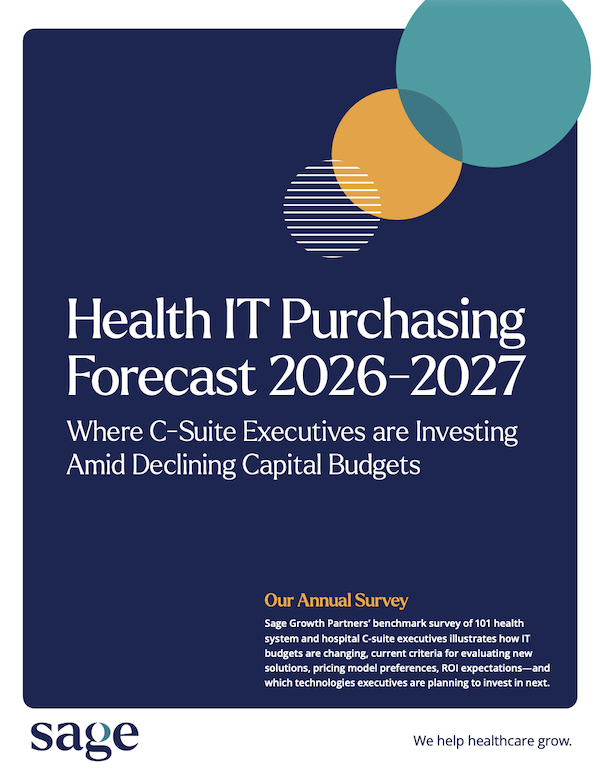
- The Data Source: Sage Growth Partners released its “Health IT Purchasing Forecast 2026-2027: Where C-Suites are Investing Amid Declining Capital Budgets” report, based on a benchmark survey of 101 hospital and health system C-suite executives.
- The Budget Squeeze: A significant 41% of C-suite leaders anticipate their capital investments will be reduced over the next two years. Only 5% expect an increase of 20% or more, representing a notable decline from prior years.
- The Growth Pivot: Despite shrinking budgets, executives are prioritizing revenue-generating technology. 46% of respondents say funding for new markets or revenue streams is a high priority (up from 34% in 2023), and 40% are explicitly prioritizing patient acquisition.
- The AI Explosion: Artificial intelligence has officially overtaken EMR optimization as a top priority. 57% of C-suites rank AI-based clinical solutions as their top technology initiative for the next two years—a massive jump from 19% in 2023. Additionally, 29% rank AI administrative solutions in their top five, up from just 6% in 2023.
- The ROI Mandate: Vendors must take note: 77% of executives rate anticipated ROI as the most critical factor in their health IT purchasing decisions, up from 50% in 2023. Even more aggressively, 39% now explicitly demand a 2x-3x return on their investments.
The C-Suite Squeeze: Why Hospital IT Budgets Are Shrinking While AI Spending Soars
According to the newly released Health IT Purchasing Forecast 2026-2027 from Sage Growth Partners, 41% of surveyed C-suite leaders anticipate their capital investments will be reduced over the next two years. Yet, paradoxically, these same executives are aggressively funding top-line growth initiatives and radically accelerating their adoption of artificial intelligence.
For years, the undisputed king of the IT budget was Electronic Medical Record (EMR) optimization. Not anymore. The survey reveals that a staggering 57% of C-suites now rank AI-based clinical solutions as their top technology initiative, skyrocketing from just 19% in 2023. Furthermore, 29% rank AI-based administrative solutions in their top five initiatives, up from 6% in 2023.
How are hospitals affording this massive AI pivot while simultaneously bracing for a 41% reduction in capital investment? By relentlessly scrutinizing ROI and shifting dollars away from traditional overhead.
“As health systems and hospitals grapple with declining capital investments, C-suite leaders are likely to apply greater degrees of scrutiny to health IT purchasing decisions,” noted Dan D’Orazio, CEO of Sage Growth Partners. “Overall, capital planning is shifting toward initiatives that drive growth, such as acquiring and retaining patients, expanding into new markets, and diversifying revenue streams to increase top line revenue”.
The Death of the “Nice-to-Have”
When capital is cheap, hospitals will experiment. When capital is tight, they only buy survival. According to the report, 77% of respondents now rate “anticipated ROI” as the most critical factor in their purchasing decisions—up from 50% in 2023. Even more aggressively, 39% of executives demand a 2x-3x financial return on their investments.
“Ultimately, C-suites are looking to health IT companies to demonstrate cost-savings to CFOs focused on driving ROI, and to help CIOs align digital strategies with organizational performance and financial goals,” said Stephanie Kovalick, Chief Strategy Officer at Sage Growth Partners.
If an AI vendor cannot definitively prove how their software captures a new patient, unlocks a new revenue stream, or automates a costly administrative bottleneck, their sales cycle will stall indefinitely. In 2026, technology is no longer an operational luxury; it is the ultimate lever for top-line survival.
Click here to download a copy of the Health IT Purchasing Forecast 2026-2027 report.
