
What You Should Know
– Kaufman Hall has released its year-end analysis for 2025, reporting a total of 46 hospital and health system transactions. While total transacted revenue hit a historical low of $18.5 billion due to a slow start in the first half of the year, momentum surged in Q4 with 17 transactions, including four “mega mergers” where the smaller party’s annual revenue exceeded $1 billion.
– Crucially, financial distress drove a record 43.5% of all transactions, a trend expected to intensify throughout 2026.
The Q4 Resurgence: Mega Mergers and Market Uncertainty
The early months of 2025 were defined by a “wait-and-see” approach as leaders navigated policy volatility and high operational expenses. However, the final quarter accounted for more than half of the year’s total transacted revenue, reaching $9.8 billion.
- Strategic Recalibration: Organizations are moving away from reactive crisis management toward structural investments.
- Mega Mergers: The emergence of four billion-dollar deals in Q4 suggests that large systems are consolidating to build the “scale and agility” required to survive in 2026.
- Diversification: Beyond traditional hospital deals, Organizations are increasingly acquiring ambulatory care, lab services, and behavioral health providers to broaden their reach and reduce reliance on high-cost acute settings.
“2025 hospital and health system M&A activity started slow given the policy and market uncertainty, but momentum returned by the end of the year,” said Anu Singh, Managing Director at Kaufman Hall. “Some of the most interesting activity in 2025 occurred outside of hospital and health system transactions, with organizations making significant deals in acquiring ambulatory care, lab services, and behavioral health providers. We anticipate this trend to continue in 2026.”
Financial Distress: A Growing M&A Catalyst
The most significant finding for CFOs is the steady climb of “distressed” deals. The percentage of transactions involving a financially struggling party hit 43.5% in 2025, the highest since Kaufman Hall began tracking the metric.
The report findings aligns with the FinThrive 2026 Transformative Trends Report, which highlights that 36% of leaders are now prioritizing cost reduction as a core strategy, but many are finding that aggressive cost-cutting has reached a point of diminishing returns. Acquisition by a larger, more stable system is often the only pathway left for survival.
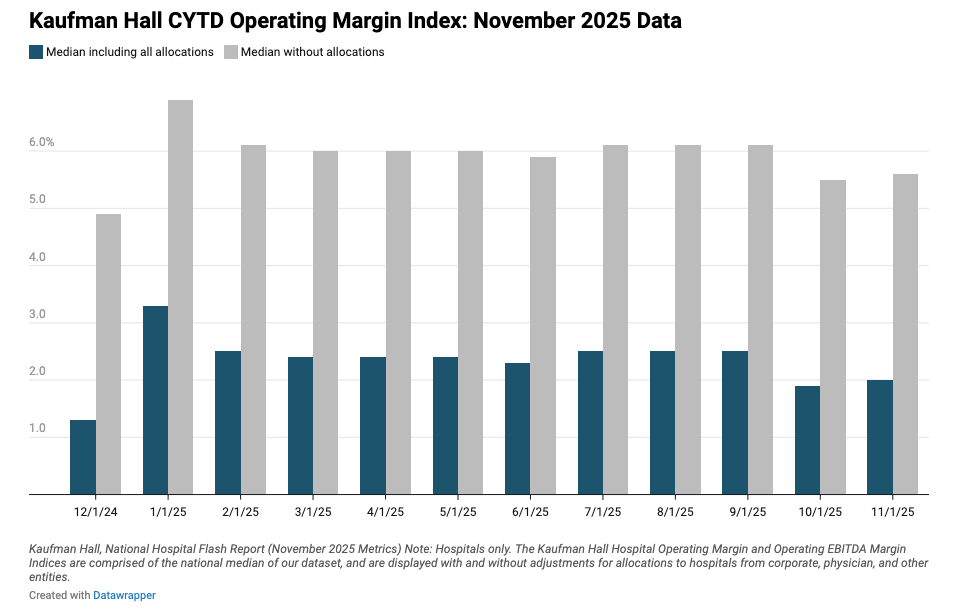
As we head into 2026, hospital performance remains a “fluctuating challenge,” with November volumes declining across all services. The winners will be those who use M&A not just to grow, but to unite patient loyalty, efficiency, and automation into a single, adaptive framework.
