
• Skip to main content
  • Skip to secondary menu
  • Skip to primary sidebar
  • Skip to secondary sidebar
  • Skip to footer

  • Opinion
  • Health IT
    • Behavioral Health
    • Care Coordination
    • EMR/EHR
    • Interoperability
    • Patient Engagement
    • Population Health Management
    • Revenue Cycle Management
    • Social Determinants of Health
  • Digital Health
    • AI
    • Blockchain
    • Precision Medicine
    • Telehealth
    • Wearables
  • Life Sciences
  • Investments
  • M&A
  • Value-based Care
    • Accountable Care (ACOs)
    • Medicare Advantage

EHR Interoperability 2025: KLAS Reports Usability Gaps Hinder Data Sharing Succes

by Fred Pennic 12/01/2025 Leave a Comment

  • LinkedIn
  • Twitter
  • Facebook
  • Email
  • Print
EHR Interoperability 2025: KLAS Reports Usability Gaps Hinder Data Sharing Succes

What You Should Know: 

– EHR interoperability holds immense potential to improve patient care decisions, enable innovation, and reduce administrative churn. However, a new report from KLAS Healthcare IT Insights reveals that despite advancements in data-sharing technology, interoperability is still far from achieving its desired state.

– The report emphasizes that true interoperability is a team effort requiring healthcare organizations, payer organizations, and vendors to work together to fully realize desired outcomes. KLAS provides an overview of three key EHR interoperability use cases and the challenges hindering data sharing.

Provider-to-Provider Patient Record Sharing

EHR vendors have made substantial progress in their capabilities for sharing patient records, primarily through individual connections, workflow improvements, and large national networks like CommonWell and Carequality. This has made patient data more available than ever.

The Usability Gap

Despite the increase in data availability, KLAS data from the Arch Collaborative shows that clinician satisfaction with external integration has not significantly improved over time. The core issue is the poor usability of shared records.

  • Obstacles to Actionable Data: Issues like duplicative data, varying data formats, and poor data mapping prevent clinicians from making the “deluge of data” actionable within the EHR.
  • Stagnant Satisfaction: In 2024, only 49% of end-user clinicians agreed that their EHR provides expected integration with outside organizations, a figure that has hovered near 45% since 2018.

Third-Party Application Data Sharing

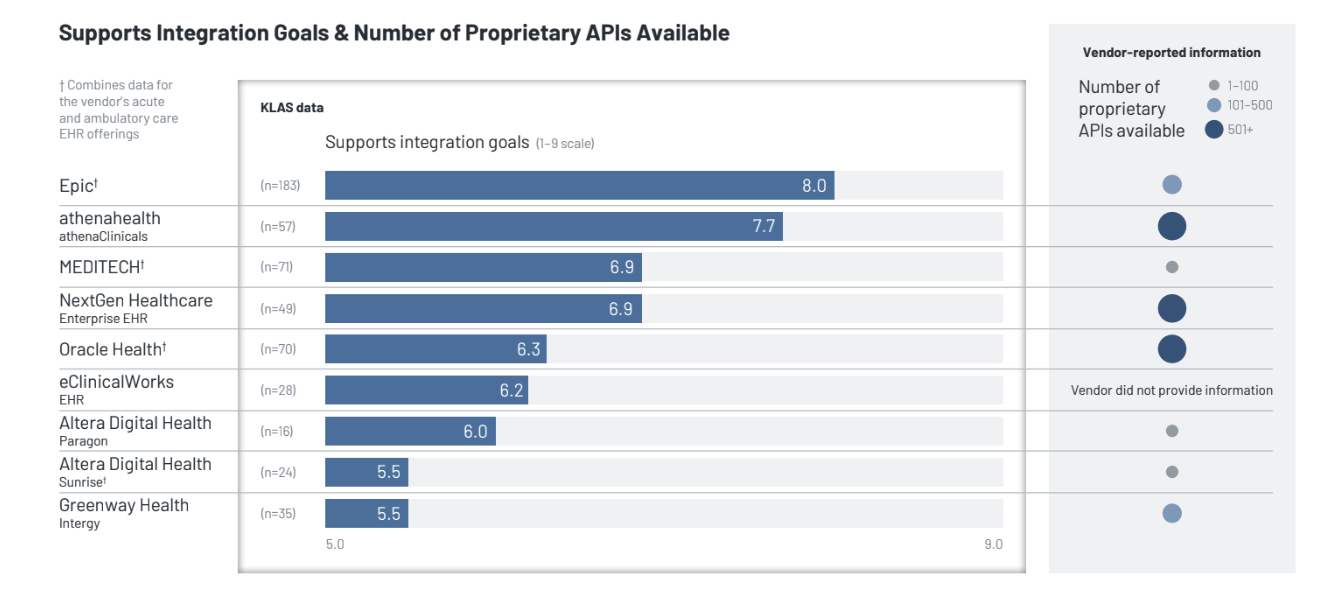
Vendors frequently use the number of proprietary APIs (Application Programming Interfaces) they have available as a measure of their interoperability capabilities. While increased API availability seems appealing, KLAS performance data shows a disconnect:

  • API Count vs. Satisfaction: Increased availability of APIs does not correlate with high customer satisfaction regarding a vendor’s ability to support integration goals.
  • The Problem of Value: “Having more APIs doesn’t equal receiving more data and value”. Vendors may build different kinds of APIs (single multifaceted vs. several specialized) to achieve the same goal.
  • FHIR Limitations: While many vendors report supporting FHIR R4 and USCDI data classes, they still have work to do to ensure FHIR APIs provide the breadth of data that healthcare organizations actually require.

In KLAS performance data, Epic leads the acute and ambulatory EHR offerings with an average score of 8.0 for supporting integration goals, followed by athenahealth at 7.7.


Payer-to-Provider Patient Record Sharing

Data sharing between payer and healthcare organizations remains a long-standing challenge, primarily due to a lack of trust.

  • The Trust Deficit: Payers fear fraudulent claims, while healthcare organizations fear giving up too much patient data. This lack of trust contributes to unnecessary administrative churn and costs.
  • Regulatory Drivers: Recent federal regulations and CMS mandates (e.g., CMS-0057-F) are spurring organizations to improve data-sharing via bulk FHIR APIs.
  • Collaboration is Key: KLAS’s analysis of “Points of Light” case studies found that nearly all mentioned the importance of building trust and partnering (96% of case studies). In contrast, only about half mentioned the need for strong technology (48% of case studies).

The report concludes that while technology is necessary, strong technology alone will not guarantee success; stakeholders must foster transparent collaboration and align goals to achieve a scalable impact on data sharing.

  • LinkedIn
  • Twitter
  • Facebook
  • Email
  • Print

Tagged With: Health IT Interoperability, KLAS Report

Tap Native

Get in-depth healthcare technology analysis and commentary delivered straight to your email weekly

Reader Interactions

Primary Sidebar

Subscribe to HIT Consultant

Latest insightful articles delivered straight to your inbox weekly.

Submit a Tip or Pitch

2026 Predictions & Trends

Healthcare 2026 Forecast: Executives on AI Survival, Financial Reckoning, and the End of Point Solutions

2026 Healthcare Executive Predictions: Why the AI “Pilot Era” Is Officially Over

Featured Research Report

Digital Health Funding Hits $14.2B in 2025: A Year of AI Exuberance and Market Bifurcation

Most-Read

Trump Unveils 'The Great Healthcare Plan': A Global Price-Matching Pivot to Settle the Affordability Crisis

Price Reset 2026: How Trump’s ‘Great Healthcare Plan’ Slashes Drug Costs at Trumprx.gov

Anthropic Debuts ‘Claude for Healthcare’ and Opus 4.5 to Engineer the Future of Life Sciences

Anthropic Debuts ‘Claude for Healthcare’ and Opus 4.5 to Engineer the Future of Life Sciences

OpenAI Debuts ChatGPT Health: A ‘Digital Front Door’ That Connects Medical Records to Agentic AI

OpenAI Debuts ChatGPT Health: A ‘Digital Front Door’ That Connects Medical Records to Agentic AI

From Genes to Hackers: The Hidden Cybersecurity Risks in Life Sciences

From Genes to Hackers: The Hidden Cybersecurity Risks in Life Sciences

Utah Becomes First State to Approve AI System for Prescription Renewals

Utah Becomes First State to Approve AI System for Prescription Renewals

NYC Health + Hospitals to Acquire Maimonides in $2.2B Safety Net Overhaul

NYC Health + Hospitals to Acquire Maimonides in $2.2B Safety Net Overhaul

KLAS Report: Why Hospitals Are Choosing Efficiency Over 'Agentic' AI Hype in 2025

KLAS Report: Why Hospitals Are Choosing Efficiency Over ‘Agentic’ AI Hype in 2025

Advanced Primary Care 2026: Top 6 Investments for Health Systems According to Harvard Medical School

Advanced Primary Care 2026: Top 6 Investments for Health Systems According to Harvard Medical School

AI Nutrition Labels: The Key to Provider Adoption and Patient Trust?

AI Nutrition Labels: The Key to Provider Adoption and Patient Trust?

Kristen Hartsell, VP of Clinical Services, RedSail Technologies

The Pharmacy Closures Crisis: How Independent Pharmacies Are Fixing Pharmacy Deserts

Secondary Sidebar

Footer

Company

  • About Us
  • 2026 Editorial Calendar
  • Advertise with Us
  • Reprints and Permissions
  • Op-Ed Submission Guidelines
  • Contact
  • Subscribe

Editorial Coverage

  • Opinion
  • Health IT
    • Care Coordination
    • EMR/EHR
    • Interoperability
    • Population Health Management
    • Revenue Cycle Management
  • Digital Health
    • Artificial Intelligence
    • Blockchain Tech
    • Precision Medicine
    • Telehealth
    • Wearables
  • Startups
  • Value-Based Care
    • Accountable Care
    • Medicare Advantage

Connect

Subscribe to HIT Consultant Media

Latest insightful articles delivered straight to your inbox weekly

Copyright © 2026. HIT Consultant Media. All Rights Reserved. Privacy Policy |