

• Skip to main content
  • Skip to secondary menu
  • Skip to primary sidebar
  • Skip to secondary sidebar
  • Skip to footer

  • Opinion
  • Health IT
    • Behavioral Health
    • Care Coordination
    • EMR/EHR
    • Interoperability
    • Patient Engagement
    • Population Health Management
    • Revenue Cycle Management
    • Social Determinants of Health
  • Digital Health
    • AI
    • Blockchain
    • Precision Medicine
    • Telehealth
    • Wearables
  • Life Sciences
  • Investments
  • M&A
  • Value-based Care
    • Accountable Care (ACOs)
    • Medicare Advantage

Denials Management Named Most Time-Consuming Task in RCM

by Fred Pennic 05/24/2023 Leave a Comment

  • LinkedIn
  • Twitter
  • Facebook
  • Email
  • Print

What You Should Know:

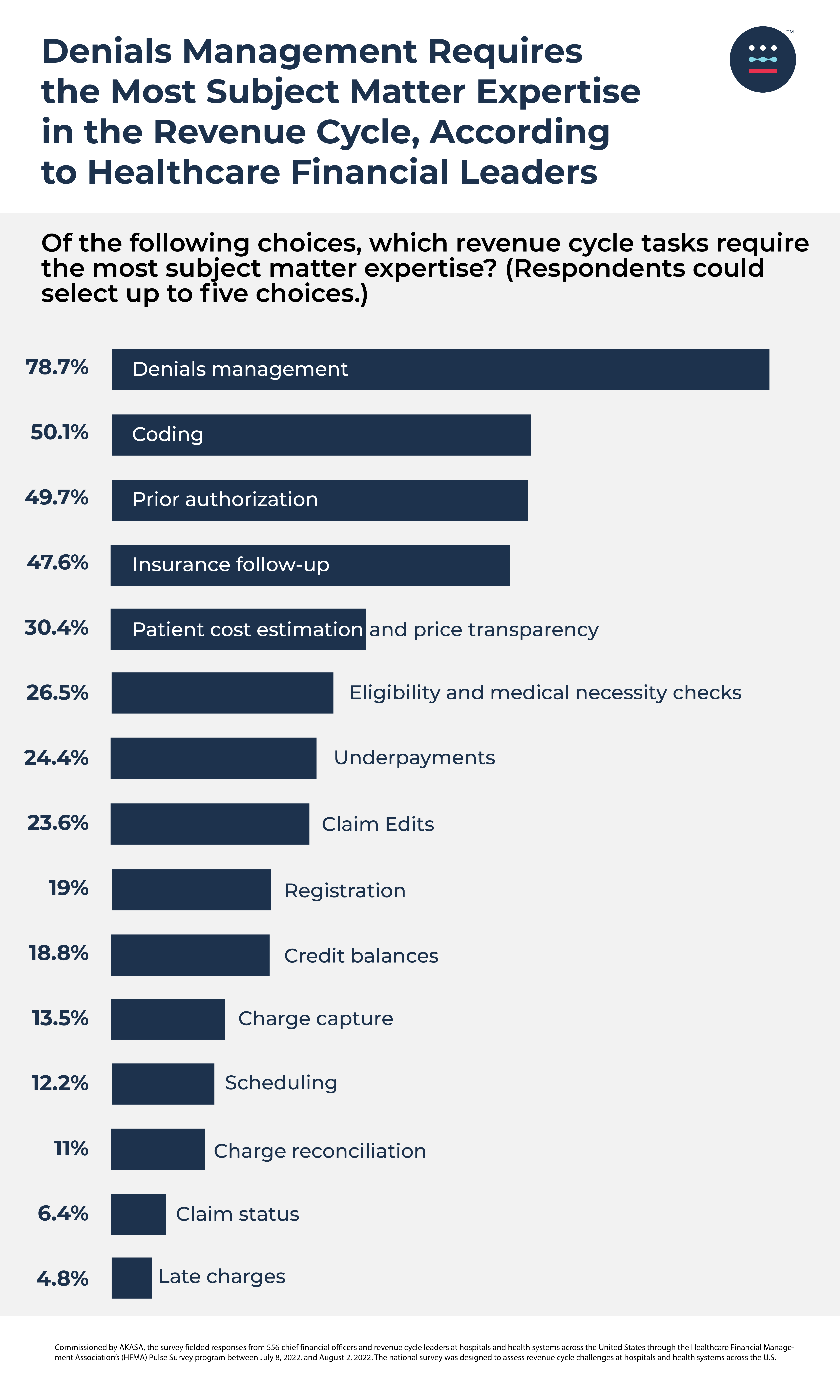
  • A new HFMA survey commissioned by AKASA highlights the revenue cycle tasks requiring the most subject matter expertise, according to responses from over 550 CFOs and revenue cycle leaders at hospitals and health systems across the U.S.
  • Denials management not only requires the most subject matter expertise, but it’s also the most time-consuming task within revenue cycle management (RCM) — followed by prior authorization and insurance follow-up. 

AI-Driven Automation to Streamline RCM Tasks

As health systems and hospitals continue to experience major staffing gaps, advanced automation driven by artificial intelligence (AI) and machine learning (ML) can help streamline these complex tasks and save providers valuable time and revenue. To make the biggest impact, health systems and hospitals should consider automating repetitive work (such as claim status checks) so teams can focus their time and attention where it’s needed most: tasks that require human judgement and revenue cycle expertise. The ideal automation tool can handle both the mundane and the more nuanced, complex tasks to provide the support RCM teams need — while ensuring processes are more streamlined and efficient.

“Experienced revenue cycle staff is hard to find. Deploying automation for more repetitive work can be a key retention strategy for training up junior staff, giving them an opportunity to build their areas of expertise, while allowing experienced staff to focus on the more challenging claims that return more value to the organization,” said Raymond. “This creates an environment where individuals feel the organization is invested in their career development and success while also improving the bottom line.”   

Survey Background/Methodology

Commissioned by AKASA, the survey fielded responses from 556 chief financial officers and revenue cycle leaders at hospitals and health systems across the United States through the Healthcare Financial Management Association’s (HFMA) Pulse Survey program between July 8, 2022, and August 2, 2022. The national survey was designed to assess revenue cycle challenges at hospitals and health systems across the U.S. 

  • LinkedIn
  • Twitter
  • Facebook
  • Email
  • Print

Tagged With: Denials Management, Revenue Cycle Management

Tap Native

Get in-depth healthcare technology analysis and commentary delivered straight to your email weekly

Reader Interactions

Primary Sidebar

Subscribe to HIT Consultant

Latest insightful articles delivered straight to your inbox weekly.

Submit a Tip or Pitch

2026 Predictions & Trends

Healthcare 2026 Forecast: Executives on AI Survival, Financial Reckoning, and the End of Point Solutions

2026 Healthcare Executive Predictions: Why the AI “Pilot Era” Is Officially Over

Most-Read

HHS Launches 'OneHHS' AI Strategy to Integrate AI Across CDC, CMS, and FDA for Efficiency and Public Trust

HHS Launches ‘OneHHS’ AI Strategy to Integrate AI Across CDC, CMS, and FDA for Efficiency and Public Trust

Kristen Hartsell, VP of Clinical Services, RedSail Technologies

The Pharmacy Closures Crisis: How Independent Pharmacies Are Fixing Pharmacy Deserts

From Overwhelmed to Optimized: How AI Agents Address Staffing Challenges and Burnout in Healthcare

From Overwhelmed to Optimized: How AI Agents Address Staffing Challenges and Burnout in Healthcare

The VBC Paradox: Why Hospitals Are Doubling Down on Value-Based Care While Revenue at Risk Lags

The VBC Paradox: Why Hospitals Are Doubling Down on Value-Based Care While Revenue at Risk Lags

Tebra Secures $250M to Challenge Legacy EHRs with AI-Powered Automation

Tebra Secures $250M to Challenge Legacy EHRs with AI-Powered Automation

AstraZeneca Selects Salesforce Agentforce Life Sciences to Deploy AI-Powered Global Customer Engagement

AstraZeneca Selects Salesforce Agentforce Life Sciences to Deploy AI-Powered Global Customer Engagement

Aidoc Partners with NVIDIA MONAI to Scale Open-Source Clinical AI

Aidoc Partners with NVIDIA MONAI to Scale Open-Source Clinical AI

RapidAI Secures FDA Clearance for Five New Deep Clinical AI Modules, Expanding Enterprise Imaging Platform

RapidAI and AWS Deepen Partnership to Scale Clinical AI in Healthcare

Greece and Sword Health to Build AI-Powered Healthcare Front Door

Greece and Sword Health to Build AI-Powered Healthcare Front Door

GE HealthCare Acquires Intelerad for $2.3B to Create Cloud-First, AI-Enabled Imaging Ecosystem

GE HealthCare Acquires Intelerad for $2.3B to Create Cloud-First, AI-Enabled Imaging Ecosystem

Secondary Sidebar

Footer

Company

  • About Us
  • Advertise with Us
  • Reprints and Permissions
  • Op-Ed Submission Guidelines
  • Contact
  • Subscribe

Editorial Coverage

  • Opinion
  • Health IT
    • Care Coordination
    • EMR/EHR
    • Interoperability
    • Population Health Management
    • Revenue Cycle Management
  • Digital Health
    • Artificial Intelligence
    • Blockchain Tech
    • Precision Medicine
    • Telehealth
    • Wearables
  • Startups
  • Value-Based Care
    • Accountable Care
    • Medicare Advantage

Connect

Subscribe to HIT Consultant Media

Latest insightful articles delivered straight to your inbox weekly

Copyright © 2025. HIT Consultant Media. All Rights Reserved. Privacy Policy |