

2018 was a record year for the world ultrasound equipment market, with revenues increasing by 6.8%, tipping the market over the $7 billion mark for the first time. Despite the backdrop of global economic uncertainty, the ultrasound market is forecast to continue to grow relatively strongly in the coming years, with the following trends driving growth.
1. New Users of Ultrasound
Over the years, the use of ultrasound has gradually expanded beyond radiology, cardiology and OB/GYN to a wide range of clinical specialties, including surgery, musculoskeletal and gastroenterology, to name a few, expanding the customer base and driving additional revenue growth. This trend started out in developed countries, but more recently it has spread to developing markets, particularly India and China, where specialty departments at larger hospitals now often have their own budgets to buy ultrasound.
Additionally, ultrasound is gaining acceptance in acute and primary care settings, both as a screening and diagnostic tool, as well as for procedure guidance. With the use of handheld ultrasound gaining pace (see Trend 4 below), this trend will accelerate in the coming years.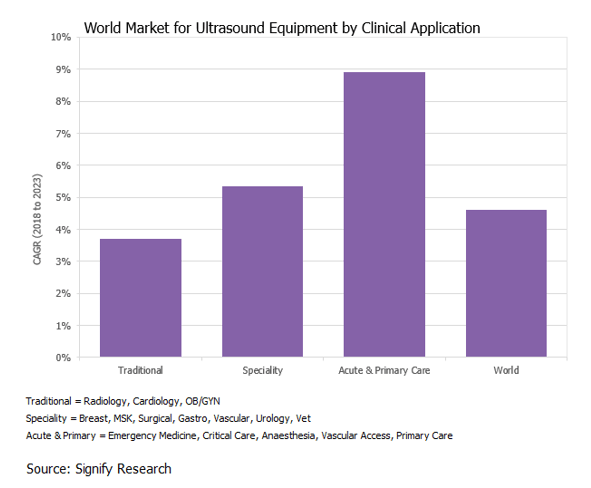
2. New Uses of Ultrasound
As well as the growing customer base, the use of ultrasound with existing customers is expanding, typically as a lower-cost and/or radiation-free alternative to other imaging modalities, such as MRI and CT. The global shift to value-based care as a replacement to the traditional fee-for-service approach will support this trend.
For example, ultrasound is playing an increasingly important role as a screening tool for women with dense breast tissue. In acute care, ultrasound is increasingly being used for lung imaging to diagnose conditions such as pleural effusion, pulmonary oedema, and pneumothorax. In another example, the use of shear wave elastography is expanding beyond hepatology (e.g. liver fibrosis) to other body areas, including breast, prostate, thyroid, and spleen. Musculoskeletal is another relatively untapped market for ultrasound, including orthopedics, rheumatology and sport’s medicine.
3. Emerging Markets
The ultrasound market in developed regions, such as Western Europe, North America, and Japan, is largely saturated and the outlook is for low to mid-single-digit growth. While these markets will continue to account for the lion’s share of the world market, developing markets continue to represent a growth opportunity. In 2019, fastest growth is forecast for Southeast Asia, Brazil, China, and India. That said, ultrasound market growth is slowing in many of the emerging markets, particularly China, largely due to slowing global economic growth.
4. Handheld Ultrasound
As we discussed in a previous insight (Handheld Ultrasound Market Poised for Next Wave of Growth), the handheld ultrasound market is growing rapidly, as the latest generation of ultra-portable devices gains acceptance among a diverse range of customer groups, from emergency medicine physicians and intensivists to internists and office-based specialists, and looking forward, primary care physicians. The expanding customer base, coupled with the increased availability of affordable handheld scanners, is forecast to boost global sales of handheld ultrasound by over 50% in 2019. By 2023, the global market for handheld ultrasound is forecast to exceed $400 million.

5. Artificial Intelligence
Artificial intelligence (AI) will have a transformative impact on the market as it addresses some of the key limitations associated with ultrasound; namely, the shortage of trained sonographers and the relatively steep learning curve, high operator dependency both during image acquisition and interpretation, poor image quality for certain exam types and the relatively lengthy exam time compared with other modalities.
The first wave of ultrasound AI applications are entering the market and are mainly for image optimization (noise reduction) and automation of time-consuming and repetitive tasks, such as anomaly detection, image labeling, feature quantification, and classification. However, the greatest impact of AI will be guided ultrasound (ultrasound navigation), which will provide real-time support during image acquisition (i.e. probe placement and anatomy detection). The first AI-enabled guided ultrasound systems are expected to be released in the second half of the year. These systems are expected to expand the user base by making ultrasound more accessible to novice users, particularly in acute and primary care.
Simon Harris is the Managing Director at Signify Research, a UK-based market research firm focusing on health IT, digital health, and medical imaging. Simon has 23 years of experience in technology market intelligence, having served as Executive Vice President at IMS Research and Senior Research Director for IHS Inc.’s Technology division.
