

• Skip to main content
  • Skip to secondary menu
  • Skip to primary sidebar
  • Skip to secondary sidebar
  • Skip to footer

  • Opinion
  • Health IT
    • Behavioral Health
    • Care Coordination
    • EMR/EHR
    • Interoperability
    • Patient Engagement
    • Population Health Management
    • Revenue Cycle Management
    • Social Determinants of Health
  • Digital Health
    • AI
    • Blockchain
    • Precision Medicine
    • Telehealth
    • Wearables
  • Life Sciences
  • Investments
  • M&A
  • Value-based Care
    • Accountable Care (ACOs)
    • Medicare Advantage

Average Frequency of Digital Health Consumer Activities

by Jasmine Pennic 08/11/2014 Leave a Comment

  • LinkedIn
  • Twitter
  • Facebook
  • Email
  • Print

Parks Associates responds to criticism with more context on the average frequency of digital health consumer activities

Last week, Parks Associates released an infographic illustrating the top digital health consumer activities of U.S. broadband consumers over the past 12 months. Based on the key findings from a survey fielded to heads-of-broadband-households in the U.S. in Q4 2013, the survey found:

– 38 percent of consumers looking up health information online

– 22 percent of consumers are using a device to track their health patterns

After Matthew Holt at Health 2.0 expressed concerns that their figures stated above were too low in comparison to Pew Research’s Health Online 2013 report finding of 72 percent of consumers looking up health information online, Parks Associates decided to drill down a little further to provide more context behind their survey methodology. 
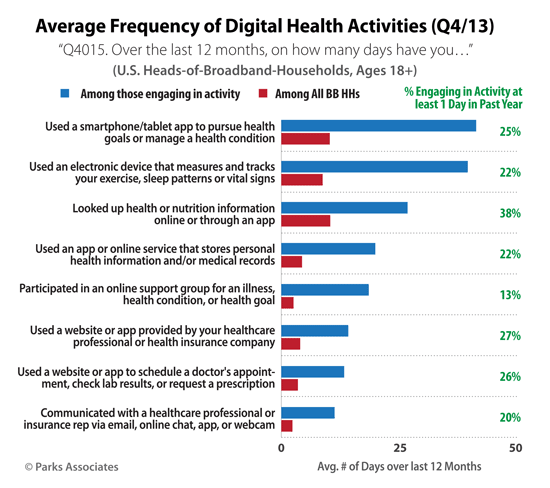
Average Frequency of Digital Health Consumer Activities

Pew Research vs Park Associates Findings

In their response, Jennifer Kent stated: “our survey found that, of the digital health activities tested, consumers most frequently use their health apps, use their tracking devices, and look up health information online or through apps. Activities that involved care providers and health insurers are far less frequent, which makes sense given these interactions are more episodic in nature.”

Park Associates provided the following two reasons why their figure is much lower than Pew Research’s report:

– The question breaks out into different “activities” some of the information areas that the Pew study incorporates into one figure – for instance, Parks Associates separates the action of visiting a care provider or health insurer’s website into its own option.


– Parks Associates asks respondents to specify the number of days on which an activity was performed in the past year. This question form requires a bit more commitment from respondents than a basic yes/no question in that it requires respondents to not only think about whether they did an activity, but how often.


Parks Associates did conclude that the actual percentage of U.S. consumers who look up a broad range of health information online to be likely higher than 38% based on these considerations. 

 

  • LinkedIn
  • Twitter
  • Facebook
  • Email
  • Print

Tap Native

Get in-depth healthcare technology analysis and commentary delivered straight to your email weekly

Reader Interactions

Primary Sidebar

Subscribe to HIT Consultant

Latest insightful articles delivered straight to your inbox weekly.

Submit a Tip or Pitch

2026 Predictions & Trends

Healthcare 2026 Forecast: Executives on AI Survival, Financial Reckoning, and the End of Point Solutions

2026 Healthcare Executive Predictions: Why the AI “Pilot Era” Is Officially Over

Most-Read

NYC Health + Hospitals to Acquire Maimonides in $2.2B Safety Net Overhaul

NYC Health + Hospitals to Acquire Maimonides in $2.2B Safety Net Overhaul

KLAS Report: Why Hospitals Are Choosing Efficiency Over 'Agentic' AI Hype in 2025

KLAS Report: Why Hospitals Are Choosing Efficiency Over ‘Agentic’ AI Hype in 2025

Advanced Primary Care 2026: Top 6 Investments for Health Systems According to Harvard Medical School

Advanced Primary Care 2026: Top 6 Investments for Health Systems According to Harvard Medical School

AI Nutrition Labels: The Key to Provider Adoption and Patient Trust?

AI Nutrition Labels: The Key to Provider Adoption and Patient Trust?

Kristen Hartsell, VP of Clinical Services, RedSail Technologies

The Pharmacy Closures Crisis: How Independent Pharmacies Are Fixing Pharmacy Deserts

HHS Launches 'OneHHS' AI Strategy to Integrate AI Across CDC, CMS, and FDA for Efficiency and Public Trust

HHS Launches ‘OneHHS’ AI Strategy to Integrate AI Across CDC, CMS, and FDA for Efficiency and Public Trust

From Overwhelmed to Optimized: How AI Agents Address Staffing Challenges and Burnout in Healthcare

From Overwhelmed to Optimized: How AI Agents Address Staffing Challenges and Burnout in Healthcare

The VBC Paradox: Why Hospitals Are Doubling Down on Value-Based Care While Revenue at Risk Lags

The VBC Paradox: Why Hospitals Are Doubling Down on Value-Based Care While Revenue at Risk Lags

Tebra Secures $250M to Challenge Legacy EHRs with AI-Powered Automation

Tebra Secures $250M to Challenge Legacy EHRs with AI-Powered Automation

AstraZeneca Selects Salesforce Agentforce Life Sciences to Deploy AI-Powered Global Customer Engagement

AstraZeneca Selects Salesforce Agentforce Life Sciences to Deploy AI-Powered Global Customer Engagement

Secondary Sidebar

Footer

Company

  • About Us
  • Advertise with Us
  • Reprints and Permissions
  • Op-Ed Submission Guidelines
  • Contact
  • Subscribe

Editorial Coverage

  • Opinion
  • Health IT
    • Care Coordination
    • EMR/EHR
    • Interoperability
    • Population Health Management
    • Revenue Cycle Management
  • Digital Health
    • Artificial Intelligence
    • Blockchain Tech
    • Precision Medicine
    • Telehealth
    • Wearables
  • Startups
  • Value-Based Care
    • Accountable Care
    • Medicare Advantage

Connect

Subscribe to HIT Consultant Media

Latest insightful articles delivered straight to your inbox weekly

Copyright © 2026. HIT Consultant Media. All Rights Reserved. Privacy Policy |