

What You Should Know
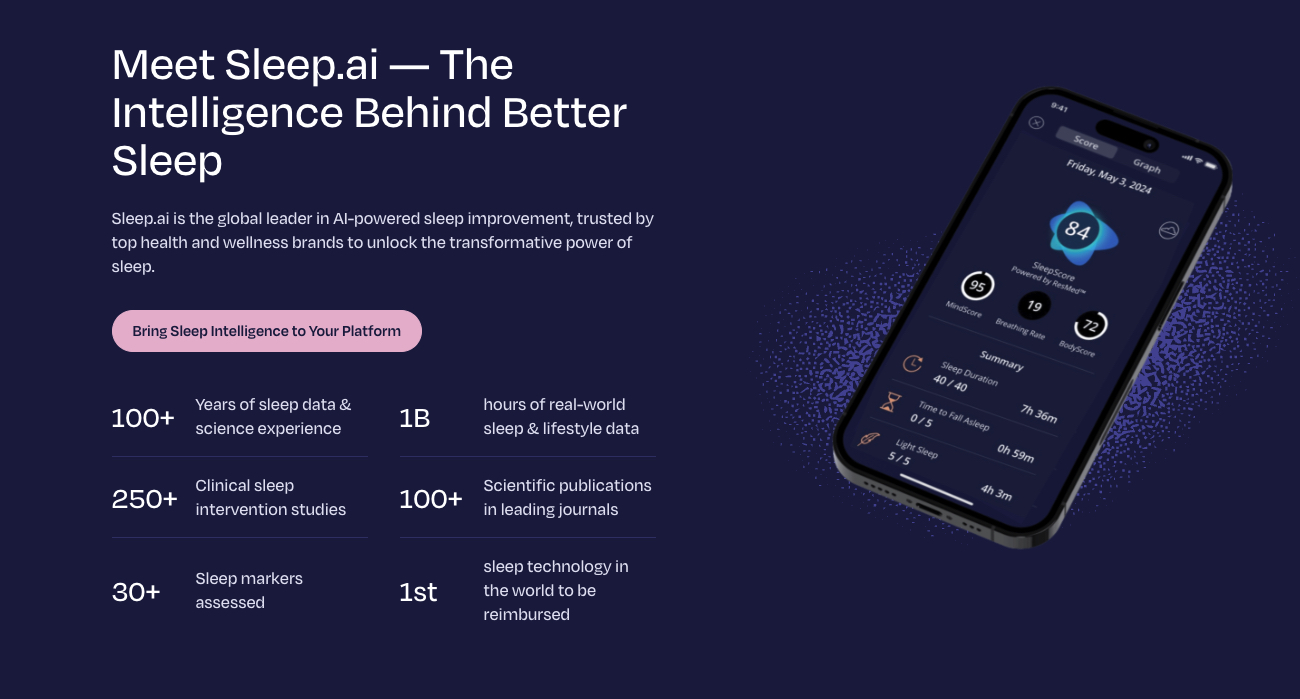
- Sleep intelligence and digital health platform Sleep.ai announced a $5.3M investment round, led by Treasure Coast Ventures with participation from the Harvard Business School Alumni Angels of Greater NY and other strategic investors.
- The company’s longitudinal real-world data repository has surpassed 1.1 billion hours of measured sleep data, analyzing over 200 billion data points captured night-after-night from home environments.
- Sleep.ai’s data exposes a foundational clinical and enterprise hurdle in consumer health tech: severe inter-device measurement variability, where different commercial wearable brands measuring the exact same sleep session exhibit typical discrepancies of 57 to 89 minutes.
- The company operates a device-agnostic normalization engine that harmonizes biometric feeds across approximately 800 consumer wearables, alongside proprietary contactless smartphone sonar tracking (which records zero audio) to generate reliable sleep metrics for users without wearable hardware.
The Normalization Engine: Contactless Sonar Meets 800 Hardware Endpoints
Formerly operating within the consumer-facing SleepScore Labs ecosystem, Sleep.ai has consolidated its intellectual property into an enterprise, business-to-business software-as-a-service intelligence engine designed to eliminate hardware lock-in. The core platform ingests and normalizes raw telemetry across approximately 800 distinct consumer wearables, applying algorithmic calibration to standardize sleep latency, wake after sleep onset, sleep staging, and duration metrics into a single consistent data schema.
For individuals who do not own a wearable tracker, Sleep.ai’s proprietary Sleep Sense software repurposes everyday smartphone microphones and speakers into non-recording, privacy-preserving sonar sensors. The system monitors nocturnal micro-respiratory patterns and physical movement without capturing raw acoustic audio, ensuring continuous tracking across low-income or non-wearable-owning populations. Partners embed this capability directly through application programming interfaces and software development kits, allowing their users to receive continuous clinical guidance regardless of whether they own dedicated biosensor hardware.
Clinical Validation and Obstructive Sleep Apnea Screening
Beyond basic sleep duration tracking, the platform cross-references longitudinal sleep patterns against validated predictive models to screen for serious chronic conditions, including obstructive sleep apnea. Validating this diagnostic capability, Sleep.ai recently published its 104th peer-reviewed scientific paper at the European Sleep Research Society’s Sleep Europe 2026 congress.
The study examined the integration of limited questionnaire data with real-world sensor streams to screen for obstructive sleep apnea risk, establishing an evidence-based foundation that allows digital health applications to identify undiagnosed respiratory disorders before patients present with acute cardiovascular complications.
National Reimbursement in Action: The German “Dein Schlaf” Prevention Model
While American digital health companies frequently struggle to secure broad-scale commercial payer coverage for preventive sleep tools, Sleep.ai has established a sustainable reimbursement pathway through the German statutory health insurance system. Branded as Dein Schlaf (“Your Sleep”), the program is formally certified by the Central Prevention Center under Section 20 of Book V of the Social Code. This certification allows all 74 million German statutory insurance beneficiaries to access the software fully covered by their insurer without requiring a physician’s prescription.
Leading statutory sickness funds—including BARMER, one of Germany’s largest health insurers, alongside AOK Niedersachsen, IKK Brandenburg und Berlin, and BERGISCHE Krankenkasse—offer the program directly to policyholders. Year-to-date, the initiative has enrolled 25,000 active participants.
Clinical data from users tracking sleep for 36 nights demonstrated measurable behavioral and physiological improvements. Two in three participants improved across at least two objective sleep parameters, gaining an average of 30 minutes of additional sleep per night alongside higher sleep quality metrics. More than half of enrolled users demonstrated measurable clinical progress by day 14, rising to nine in ten participants by day 28.
Colin Lawlor, Founder and CEO of Sleep.ai, outlined the clinical thesis: “Sleep is where better health starts. When people sleep better, it shows up in their heart health, their weight, their mood and how well they manage chronic conditions. We leverage data and science, empowering organizations to integrate better sleep with the devices and apps those consumers already use, and we measure the difference. This funding helps us bring that to more partners and all the people they serve.”