

What You Should Know
- Autonomous AI medical chart review platform Charta Health announced a $55M Series B financing round led by Insight Partners.
- The financing syndicate includes returning venture investors Madrona, Bain Capital Ventures, and South Park Commons, alongside participation from QuantumLight.
- The capital injection accelerates research and development while formally launching two specialized business units operating on a shared core AI engine: Charta for Providers and Charta for Payers.
- Charta Health’s operating philosophy establishes a shared standard of coding accuracy applied pre-submission, resolving discrepancies before claims are transmitted rather than adjudicating disputes retrospectively.
Engineering Meets Medical Coding: The Architectural Core
Charta Health was founded by Chief Executive Officer Justin Liu and Chief Technology Officer Scott Morris, two former engineering leaders from real-time database and analytics company Rockset, which was acquired by OpenAI. Rather than deploying off-the-shelf generative language models that lack regulatory precision, the founders spent a year obtaining Certified Professional Coder credentials and conducting in-depth technical audits with more than 100 health system and payer executives. Today, that discipline is embedded across the company’s operating culture: Charta mandates that all members of its engineering and go-to-market teams achieve formal medical coding certification.
Operating directly on clinical documentation, Charta’s AI engine analyzes medical charts with the precision of senior medical coders and compliance auditors. The underlying model parses complex, unstructured physician progress notes, operative reports, lab values, and discharge summaries immediately after a note is finalized. The platform automatically flags missing codes supported by the clinical narrative, validates Evaluation and Management service levels to prevent undercoding, and removes billed codes lacking sufficient documentation to withstand post-payment audit.
Charta for Payers: Aligning Risk Adjustment and Regulatory Audits
Coinciding with the funding, Charta officially launched Charta for Payers, a comprehensive software suite developed in collaboration with one of the largest health plans in the United States. The platform equips health insurance organizations participating in Medicare Advantage and Affordable Care Act Individual Marketplace exchanges to improve diagnostic accuracy and clinical quality capture across several core operational areas.
The payer suite incorporates retrospective Hierarchical Condition Category coding to identify valid, uncaptured diagnoses from historical records, alongside an automated second-pass review engine that validates processed claims against underlying clinical narratives. For audit teams, Charta provides a smart coding workspace that surfaces highlighted, source-linked documentation evidence for clinical review.
Prospective risk adjustment intelligence analyzes longitudinal patient records to prompt care teams regarding chronic disease gaps ahead of scheduled appointments. Additionally, the software features dedicated HCC validation workflows designed to remove unsupported diagnosis codes before submission, protecting health plans against regulatory audits and risk adjustment data validation clawbacks, while embedded quality engines systematically identify HEDIS care gaps from clinical text.
Charta for Providers: Pre-Bill Scrubbing Inside the Clinical Workflow
On the delivery side, Series B capital enables Charta to expand its provider footprint into additional medical specialties following enterprise deployments across urgent care, behavioral health, and multi-state pediatric networks, including American Family Care, Grow Therapy, and the Pediatric Associates Family of Companies.
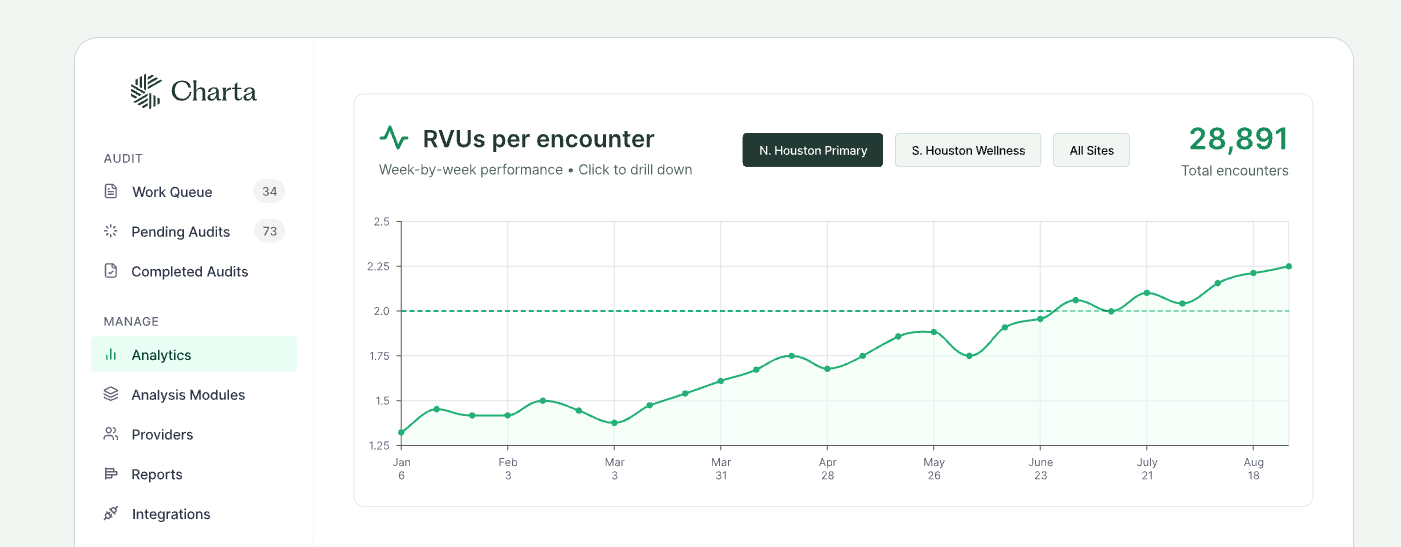
Charta for Providers integrates directly with host electronic health records, executing pre-billing chart audits the moment a clinician closes an outpatient encounter. The software checks the documentation against official ICD-10-CM and CPT coding guidelines, commercial payer medical policies, and local institutional protocols. When discrepancies are discovered, the platform surfaces suggested corrections directly within existing work queues for human coder verification, enabling healthcare organizations to submit clean, compliant claims that reduce initial denials and prevent costly post-payment payer clawbacks.
Justin Liu, CEO and Co-Founder of Charta Health, framed the operational shift: “We came to healthcare as engineers and saw a system where the most important data was locked in documents no one had time to read. Charta unlocks that data. When every chart gets reviewed, accuracy stops being a guess. Payers and providers should agree on the chart before a claim goes out, not fight about it after. That’s how we end the costly cycle of denials and appeals, and put billions of dollars back into patient care.”
