
What You Should Know
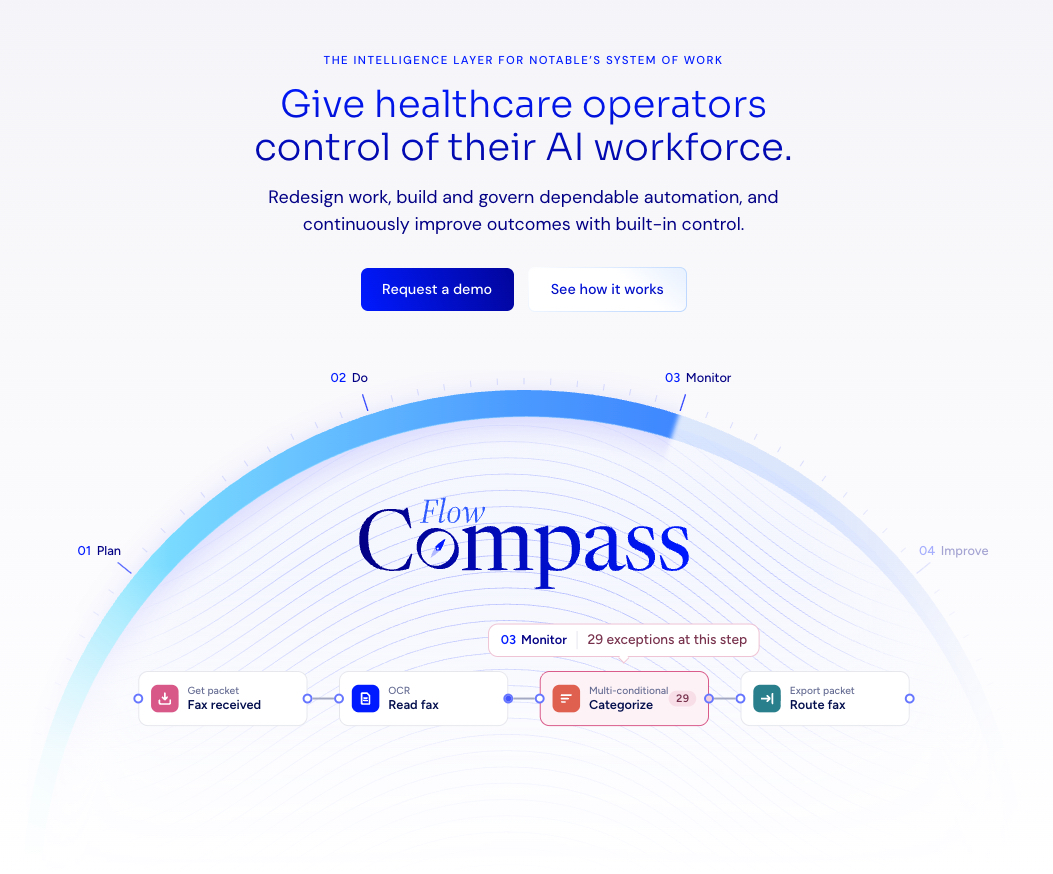
- Healthcare automation pioneer Notable announced the launch of Flow Compass, a new conversational intelligence layer embedded directly within Flow Studio on the Notable Platform.
- Addresses the emerging “AI Agent Sprawl” crisis: while building basic AI agents has become accessible, health systems deploying dozens or hundreds of autonomous agents face severe operational risks around configuration drift, silent failures, unmapped dependencies, and opaque financial returns.
- Positions Notable as an enterprise System of Work: while systems of record (like EHRs) capture what already happened, Notable’s System of Work coordinates human staff and autonomous multimodal agents (spanning voice, language, document intelligence, and computer vision) across existing software to execute tasks end-to-end.
Moving Beyond Systems of Record: The Enterprise “System of Work”
Integrated directly into Notable’s Flow Studio environment, the tool introduces conversational query capabilities into live hospital automation pipelines. Rather than sifting through log files or guessing why a patient outreach campaign stalled, healthcare operators can interrogate their operational systems in natural language—asking questions such as “What is causing my appointment outreach workflows to fail?” or “How can I reduce turnaround time on my referrals?”—and receive contextual diagnostics grounded in live run histories, electronic health record connector logs, and step-by-step remediation plans.
The release marks a core technical milestone in Notable’s positioning of its platform as an enterprise System of Work. Historically, enterprise health tech investments prioritized systems of record—primarily the electronic health record (EHR) and enterprise resource planning (ERP) platforms—which serve as passive repositories documenting what occurred during a clinical encounter or financial transaction.
Notable’s thesis argues that systems of record do not actually execute work. Instead, human staff members spend thousands of hours manually copying data between the EHR, payer clearinghouses, scheduling queues, and phone lines. By deploying multimodal agents across voice, vision, and desktop automation to execute tasks end-to-end, Notable has established a substantial footprint, having interacted with over 380 million patients, returning more than 3.2 million hours annually to clinical teams, and generating over $130M in annual partner revenue and cost savings.
Flow Compass acts as the administrative control tower for this synthetic workforce. The intelligence layer provides four integrated capabilities:
- Conversational Root-Cause Diagnostics: Traces failed runs across complex, multi-branching subflows back to their originating defect—such as an unmapped EHR field, an updated clinic template, or an unexpected insurer documentation prompt.
- Pre-Flight Testing & Readiness Verification: Generates synthetic patient test suites, runs pre-launch simulations, and maps every adjacent downstream workflow that could be disrupted before a hospital team publishes an agent into live production.
- Continuous Economic & Utilization Observability: Quantifies the tangible financial yield of each deployed bot, surfacing dashboards on revenue captured, hard labor costs averted, and net workflow turnaround times.
- Human-in-the-Loop Governance: Restricts workflow changes strictly to authorized hospital personnel through granular role-based access controls (RBAC), generates immutable audit trails that cite underlying data sources, and prevents agents from autonomously deploying code alterations without manual sign-off.
Catching Charting Defects Upstream
The governance layer is already actively mitigating operational failures across regional health systems navigating rapid automation rollouts:
- Preventing Chart Write-Back Failure at NKC Health: North Kansas City Hospital (NKC Health) was preparing to deploy an automated outreach agent designed to deliver pre-visit headache intake questionnaires to roughly 250 patients weekly. During pre-launch review, Flow Compass detected an unaligned configuration parameter that would have collected patient responses but prevented the data from writing back into the EHR chart. Catching the error pre-launch averted hundreds of hours of manual chart transcription. Dr. Todd Beardman, Chief Medical Information Officer at NKC Health, emphasized that rigorous visibility gives clinical informatics leaders the confidence to expand agentic automation safely without risking chart fragmentation.
- Structured Operational Scoping at Beacon Health System: At Indiana-based Beacon Health System, digital transformation teams use Flow Compass to convert vague operational bottlenecks into structured automation projects. Jen Hopper, Digital Transformation Strategist, noted that teams can directly interrogate the platform to evaluate system capabilities, outline workflow dependencies, and draft phased rollout plans, eliminating ad hoc software tinkering.
“Healthcare doesn’t have a shortage of technology. It has a shortage of capacity to get the work done,” said Pranay Kapadia, Co-founder and CEO of Notable. “We’ve already demonstrated what is possible, returning more than 3.2 million hours annually to healthcare teams and generating over $130 million in annual revenue and cost savings for our partners. The next challenge isn’t deploying another AI agent. It’s giving operators the ability to run an entire workforce of them, across every department, with the visibility, accountability and continuous improvement they expect from their people. Flow Compass makes this possible.”
