
What You Should Know
- Healthcare market intelligence and analytics firm Trilliant Health announced the commercial launch of the premium version of Oria, an enterprise AI Strategist engineered to deliver market-specific strategic planning on demand.
- The release directly challenges traditional management consulting economics, citing a peer-reviewed JAMA study revealing that U.S. nonprofit hospitals spent at least $7.8 billion on management consultants over roughly a decade with zero measurable improvements in operating finances, hospital throughput, or clinical care quality.
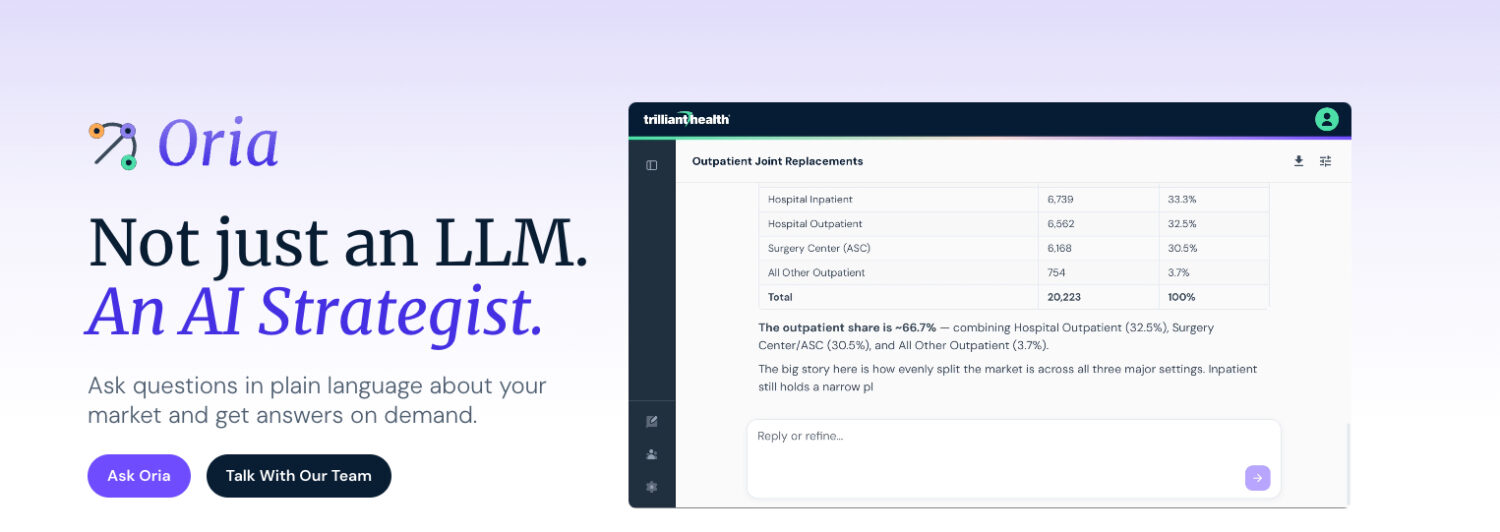
- Enables hospital C-suites, strategy officers, and service-line leaders to query complex strategic vectors in plain natural language, instantly resolving local patient utilization trends, ambulatory competitive dynamics, downstream specialist referral leakage, and optimal geographic site-selection coordinates for capital asset deployment.
Three-Pillar Architecture: Moving Beyond Generic LLMs
Unlike public foundation models that lack access to proprietary claims data and localized hospital volumes, Oria combines large language models with Trilliant’s proprietary data and governance engine:
- Proprietary National Data Layer: Direct access to Trilliant Health’s national all-payer claims database—encompassing longitudinal encounter records covering more than 300 million de-identified individuals—alongside its national provider registry, clinical service-line taxonomies, and predictive demand forecast models.
- Context Library: Encapsulates the methodologies, clinical business logic, and analytical frameworks refined across tens of thousands of bespoke strategic engagements executed by Trilliant’s strategy teams for health system and life sciences clients.
- The Proprietary “Harness”: An orchestration and guardrail layer that plans analytical multi-step pipelines, queries the underlying database via structured endpoints, applies analytical frameworks from the Context Library, and audits output accuracy to mitigate hallucination before surfacing findings.
Core Strategic and Operational Use Cases
Users query the platform in conversational natural language, receiving quantitative market evaluations across several strategic domains:
- Local Utilization & Demand Trajectories: Analyzing localized inpatient vs. outpatient procedure migration patterns, ambulatory shift velocities, and age-adjusted service-line demand across specific MSAs and ZIP codes.
- Competitive Market Share Shifts: Tracking health system and independent medical group market share trends over time across diagnostic and surgical service lines.
- Referral Leakage & Network Alignment: Mapping exact downstream physician referral pathways to pinpoint split-share tendencies and identify out-of-network patient leakage across specialty care.
- Ambulatory Network & Capital Planning: Evaluating geographic submarkets to identify optimal locations for micro-hospitals, ambulatory surgery centers (ASCs), urgent care hubs, or imaging centers to capture unmet local demand.
