
What You Should Know
- Digital health and direct-to-consumer healthcare leader Hims & Hers Health, Inc. announced the rollout of its AI-native care platform to Hims weight loss members, expanding foundational capabilities previously launched across Labs AI and the Hers ecosystem.
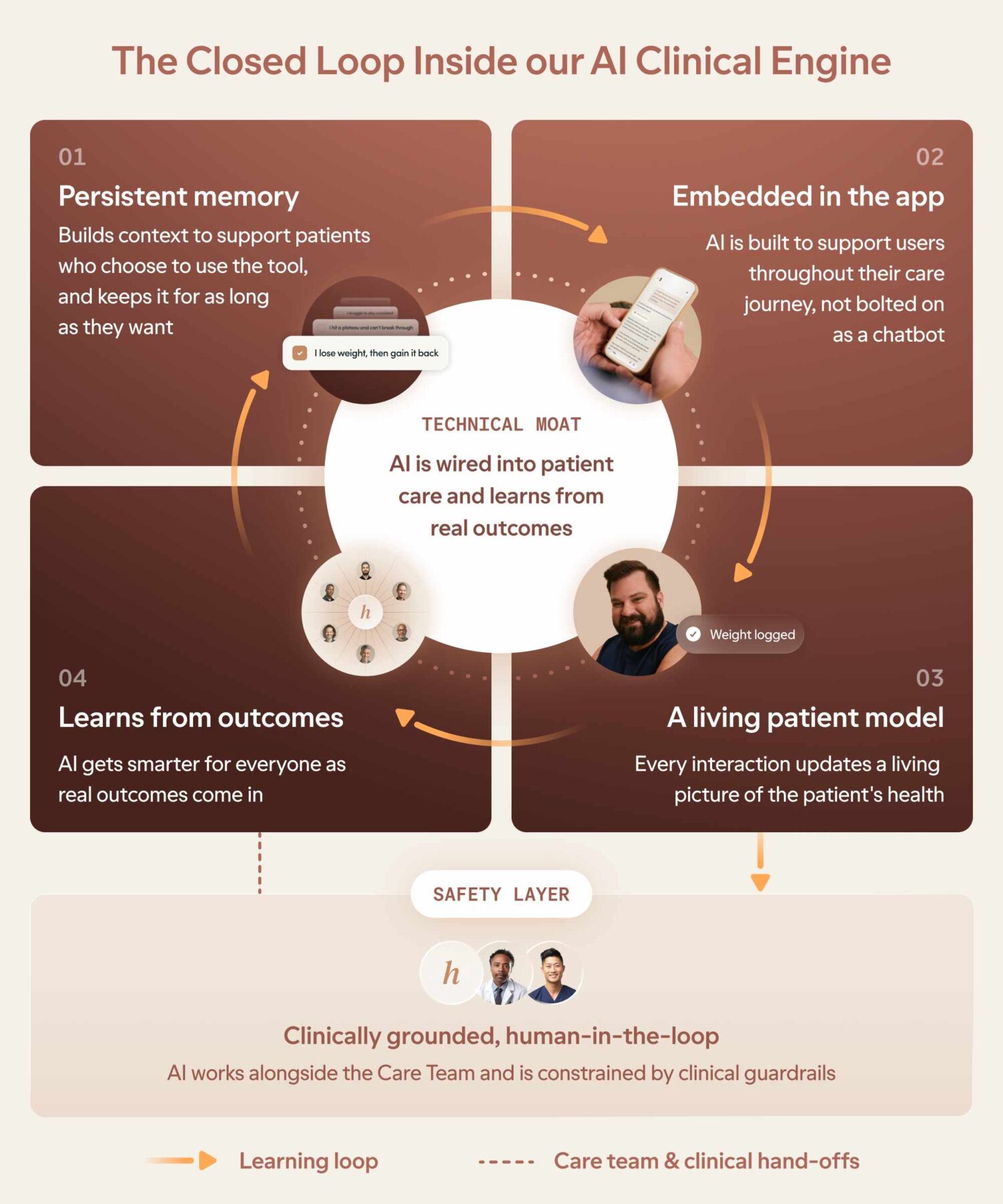
- Replaces legacy, asynchronous telehealth messaging models with a closed-loop clinical operating system designed to maintain longitudinal context, learn from patient outcomes, and eliminate repetitive patient intake re-explanations.
- Establishes a competitive enterprise moat by separating action-oriented clinical AI from generic, advisory-only large language models (LLMs), linking automated decision logic directly to clinical care delivery, medication titration schedules, and provider escalations.
The Closed-Loop Architecture: Real-Time Context vs. Static LLMs
Hims positions its engine as a shift away from advisory chatbots toward actionable clinical execution:
- Persistent Four-Tier Memory: Rather than treating each interaction as a cold prompt, the engine maintains an active, consented patient context model combining:
- Static attributes: Intake history, geography, stated goals, motivation, and prior weight-loss attempts.
- Passive programmatic streams: Current pharmaceutical regimens, exact dosage titration steps, days since last injection/dose, automated weigh-in trends, and past Care Team messages.
- Longitudinal conversational memory: Evolving lifestyle context, specific roadblocks mentioned across prior sessions, and patient definitions of success.
- Live context: Multi-turn dialogue history within the current active session.
- Proactive Symptom Triage & Longitudinal Feedback: When a patient logs an adverse event (e.g., nausea), the engine cross-references their treatment timeline (e.g., a dose increase three days prior) and historical symptom profile. It provides non-clinical guidance for mild issues or immediately routes the encounter—pre-packaged with relevant context—to a human clinician, subsequent resolution data is then fed back into the engine to refine future triage models.
Safety, Governance, and the “Accountable by Design” Framework
To safely operate in clinical weight management, Hims wraps its clinical engine in a multi-layered evaluation and runtime guardrail system:
- The 4G Safety Protocol:
- Gated: Inbound prompts are categorized by intent; any query requiring diagnostic or clinical decision-making is blocked from autonomous resolution and routed directly to licensed clinicians.
- Guardrailed: Strict conversational fences prevent the engine from straying outside its scope (such as deflecting financial or unrelated medical questions).
- Grounded (“Guidelines as Code”): Clinician-authored medical protocols are converted into programmatic rules; all system outputs must trace directly to approved clinical guidelines.
- Graded: Responses undergo automated dual-scoring via an independent AI evaluator alongside ongoing human-in-the-loop clinical audit sampling.
- Five-Layer Pre-Deployment Validation: Prior to production release, model checkpoints are subjected to offline red-teaming, full multi-turn conversational simulation (evaluated on pass/fail clinical benchmarks rather than purely technical perplexity metrics), production drift monitors, and runtime protection classifiers.
Clinician-in-the-Loop Workflow Integration
The engine is architected to offload repetitive, non-clinical logistics from healthcare providers rather than replace clinical oversight:
- Elevating High-Value Provider Encounters: By answering non-clinical administrative, lifestyle, and scheduling questions autonomously, the platform deflects low-acuity inbox volume.
- Context-Enriched Clinical Handoffs: When clinical judgment is required (such as dose adjustments, persistent side effects, or medication switches), the clinician receives a structured, context-rich summary, eliminating the need for patients to repeat their history.
The Proprietary Data Moat in DTC Telehealth
As general-purpose foundation models become commoditized, standalone virtual care companies risk losing margin if they function merely as wrappers around public APIs. The closed-loop data engine improves with every patient check-in, dose titration, and reported side effect, building an adaptive delivery platform that generic consumer LLMs and traditional fee-for-service telehealth networks cannot easily replicate.
