
What You Should Know
- Wellness Project launched a direct, verified integration with the new Google Health API, providing Fitbit and Pixel Watch users with an open pathway to sync wearable metrics into a unified, AI-ready longitudinal health record.
- The integration comes ahead of Google’s planned September 2026 retirement of the legacy Fitbit Web API, which requires developers to migrate to Google Health, adopt new OAuth infrastructure, and pass restricted-scope verification.
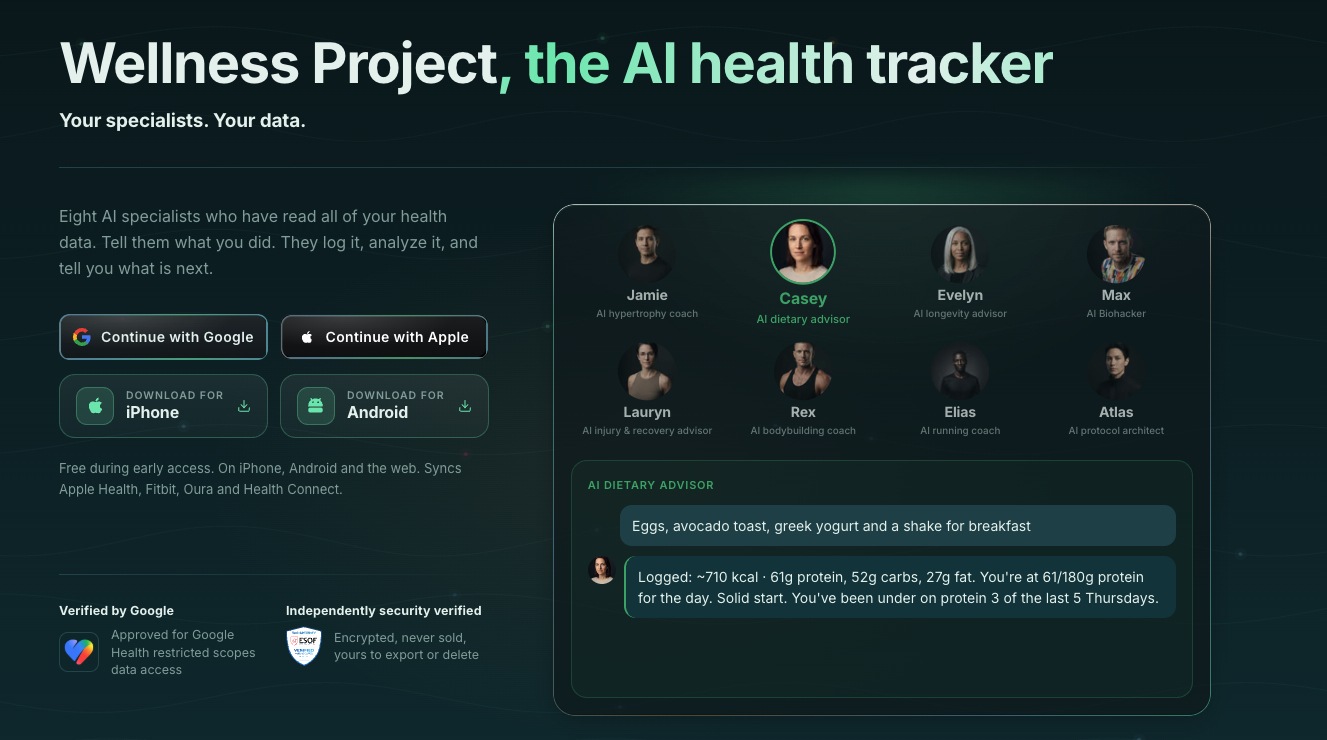
- In addition to in-app AI coaching across eight domain specialists, Wellness Project features a Model Context Protocol (MCP) integration, allowing users to securely query their longitudinal health data directly from frontier AI assistants such as ChatGPT and Claude.
- The platform unifies multi-modal metrics across sleep stages, recovery, workouts, nutrition, heart health, and body composition into a format-agnostic intelligence layer.
Mitigating API Migration Friction
As major technology platforms consolidate developer endpoints, third-party fitness and coaching applications face migration deadlines requiring new OAuth infrastructure, updated data scopes, and restricted-scope security audits. Applications that fail to complete this process risk stranding historical user data.
Wellness Project addresses this transition by establishing a verified, format-agnostic pipeline:
- Google Health API Verification: Secures verified status for Google’s restricted-scope requirements, enabling Fitbit and Pixel Watch users to import sleep stages, heart rate variability (HRV), workouts, recovery, and body composition without service disruption.
- Model Context Protocol (MCP) Integration: Uses MCP pipelines to allow users to securely connect their longitudinal wellness profiles directly to frontier AI models—including Anthropic’s Claude and OpenAI’s ChatGPT—enabling contextual natural-language inquiries with revocable user permissions.
- Multi-Modal Data Synthesis: Unifies biometrics across sleep, workouts, recovery, nutrition, and body metrics into a single timeline, allowing its AI engine to reason across interrelated physiological signals.
- Multi-Wearable Aggregation: Operates natively alongside data streams from sources such as Oura, Apple Health, and Google Health Connect, preventing duplicate session logs and maintaining long-term continuity regardless of device switches.
“People spend years building a health history, but that history is often trapped across different devices and apps. Google is taking Fitbit into a new era. We think users should be able to take their data with them too, combine it with the rest of their health story, and decide how they want to use it.” > — Bryan Barash, Founder, Wellness Project
