
What You Should Know
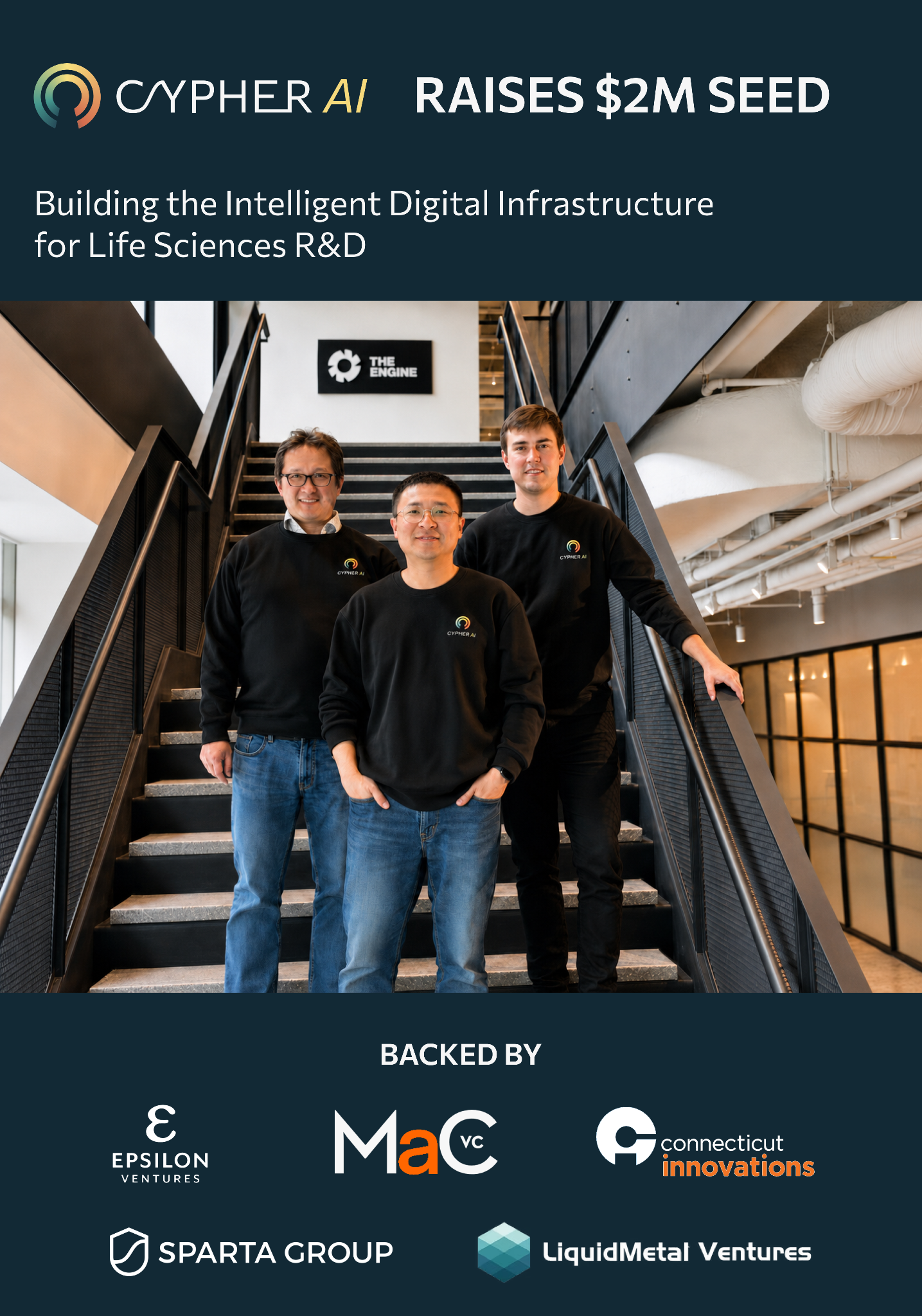
- Life science infrastructure startup Cypher AI has emerged from stealth, announcing a $2M seed funding round led by MaC Venture Capital.
- The financing includes strategic participation from Epsilon Ventures, Connecticut Innovations, Sparta Group, and LiquidMetal Ventures.
- Founded in 2025 by former scientist and engineer Yaoyu Yang, PhD, the platform replaces fragmented spreadsheets, disconnected Electronic Lab Notebooks (ELNs), and legacy Laboratory Information Management Systems (LIMS).
- To date, the company has seen rapid early adoption across growth-stage biotechs, with more than 800 scientists running over 100,000 lab and computational workflows on the platform.
- Early enterprise customers actively utilizing the unified, adaptive workflow layer include DropGenie, Flock Bio, WayBio, and Bioqore.
Beyond the Spreadsheets: Why Cypher AI Raised $2M to Re-Engineer the Biotech R&D Stack
The global biotechnology sector is experiencing an unprecedented wave of technological divergence. Over the past several years, the overwhelming majority of venture capital and market attention has centered entirely on artificial intelligence built for upfront drug discovery—training massive foundation models to predict protein folding, design novel small molecules, and identify hidden disease targets. Yet, beneath these sophisticated algorithmic breakthroughs lies a less-discussed operational bottleneck. Once a drug candidate leaves the initial design phase, the actual execution of life science research and development (R&D) remains tethered to a highly fragmented, manual patchwork of legacy operational systems.
Modern scientific workflows are incredibly dynamic, yet frontline research teams still rely heavily on static Excel spreadsheets, disconnected Electronic Lab Notebooks (ELNs), siloed Laboratory Information Management Systems (LIMS), and manual vendor coordination to run day-to-day wet-lab experiments. This structural disconnect forces highly trained scientists to function as administrative data coordinators, manually copying protocols and tracking logistics across applications that were never designed to communicate with one another. In an era where timelines are compressed and biological data sets are growing exponentially, this operational fragmentation chokes reproducibility, increases error rates, and caps the scalability of emerging biotechs.
To dismantle this patchwork tech stack and establish a single, adaptive operating layer for modern research, life science infrastructure pioneer Cypher AI has officially launched out of stealth with a $2 million seed financing round. Led by MaC Venture Capital, with prominent participation from Epsilon Ventures, Connecticut Innovations, Sparta Group, and LiquidMetal Ventures, the capital injection will be deployed to expand the core engineering team and accelerate platform scale across biotech, pharma, and global research organizations.
Unifying Experiment Design, Execution, and Analysis
Founded in 2025 by former scientist and engineer Yaoyu Yang, PhD, Cypher AI introduces an entirely new category: AI-native infrastructure built explicitly to alter how physical research gets executed. Rather than forcing scientists to toggle between separate administrative tools, Cypher AI consolidates experiment design, workflow orchestration, laboratory execution, data management, and automated vendor coordination into a single, cohesive digital ecosystem.
“Life science R&D today still relies heavily on outdated tools that were never designed for modern scientific workflows,” stated Dr. Yang. “We are replacing that legacy patchwork with an AI-native platform built for dynamic scientific environments, enabling researchers to seamlessly move from initial hypothesis to validated insight within a unified, intelligent workflow layer.”
By combining highly structured data with adaptive intelligent workflows, the platform creates an agile environment that actively evolves alongside the scientific work itself. This systemic approach eliminates duplicate data entry, improves laboratory reproducibility, and allows teams to scale up complex research pipelines without absorbing massive, compounding operational overhead.
The market response to this unified infrastructure has been immediate. Since its incubation in 2025, Cypher AI has captured rapid early adoption across both early-stage and growth-stage biotechnology companies actively modernizing their operational blueprints. To date, more than 800 active research scientists have successfully executed over 100,000 distinct laboratory and computational workflows natively on the platform. Early enterprise customers validating the system include DropGenie, Flock Bio, WayBio, and Bioqore.
Redefining Nonlinear Scale in Modern Biotechnology
The primary technical benefit for enterprise biotech teams deploying Cypher AI is the ability to unlock nonlinear growth. In traditional R&D settings, expanding research parameters or onboarding new operational vendors required a complete, manual rebuild of internal laboratory documentation and data pipelines.
Josh Hinckley, PhD, CEO and co-founder of Bioqore, highlighted this exact infrastructure moat, noting that the next generation of biotech simply cannot scale linearly due to highly compressed timelines and extreme biological complexity. Hinckley emphasized that Cypher AI delivers an AI-native software foundation that enables life sciences companies to expand in a fundamentally different way, ensuring that integrating a completely new organism or onboarding a new client no longer requires a disruptive teardown of the existing software stack.
