
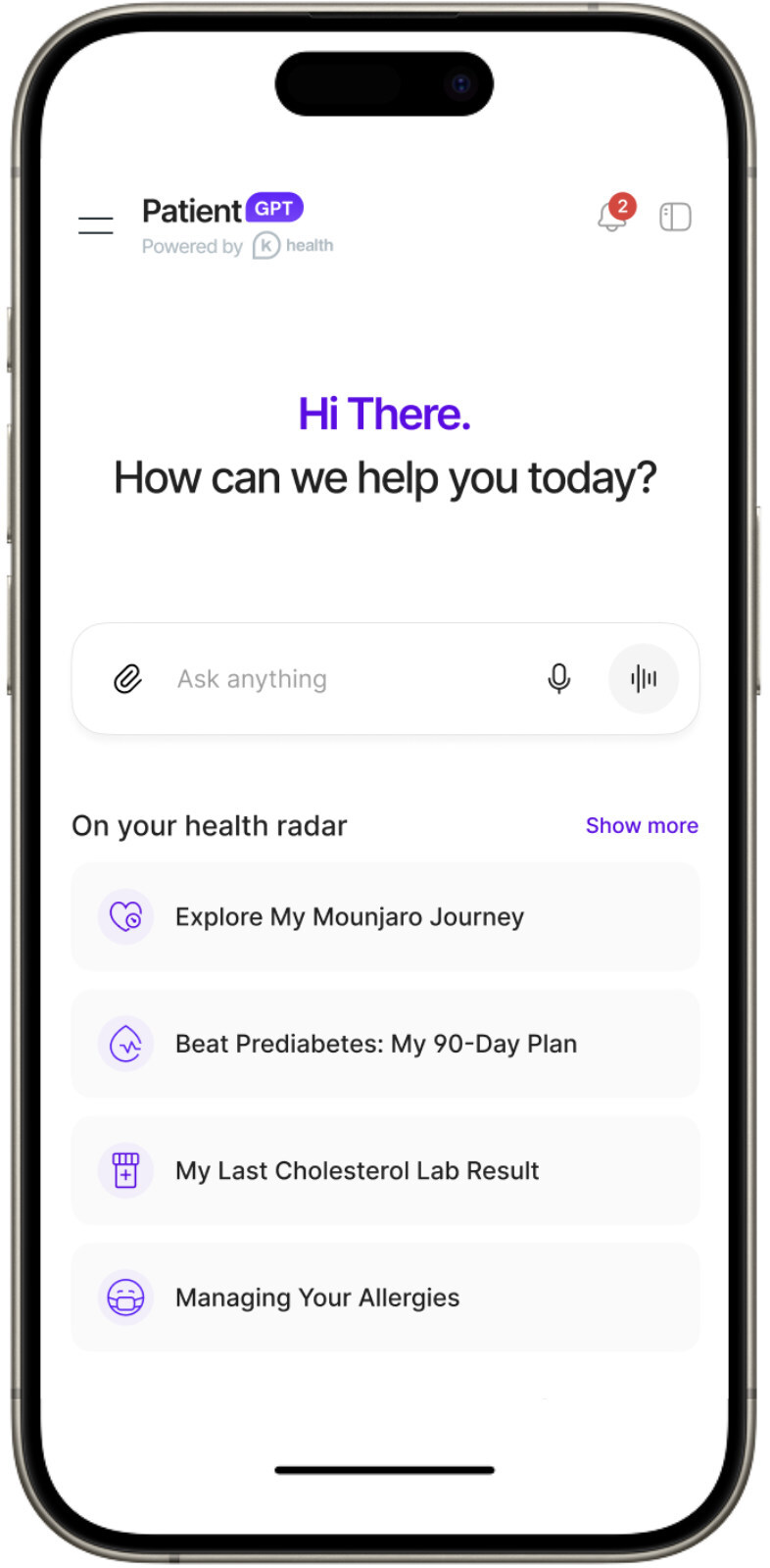
What You Should Know
- The Launch: Hartford HealthCare (HHC) and clinical AI company K Health have launched PatientGPT, a new AI tool embedded directly within the HHC patient portal and app. It is currently rolling out in a limited beta phase.
- Fixing the “Dead End”: The platform is designed to seamlessly connect patients to actual care. If the AI interaction indicates a need for a provider, patients can instantly connect to HHC 24/7 virtual care or schedule an in-person visit, bridging the gap between digital triage and human treatment.
Why Hartford HealthCare Just Launched PatientGPT
The problem with asking a public LLM about a lingering cough or a confusing lab result is twofold. First, the AI lacks the critical context of your personal medical history. Second, even if the AI gives you perfect educational advice, it leaves you at a “dead end.” It cannot order a test, and it cannot connect you to a doctor.
PatientGPT operates with full access to the patient’s secure medical record by embedding the AI directly into the Hartford HealthCare patient portal. This transforms the AI from a generic encyclopedia into a personalized health assistant. A patient can ask the AI to translate complex lab results into plain English, identify potential interactions within their specific medication list, and generate a concise summary of their concerns to paste into an in-basket message to their primary care doctor.
Crucially, PatientGPT eliminates the dead end. If a patient’s questions escalate, the system provides a seamless pathway to book an in-person appointment or instantly connect with a human clinician via HHC’s 24/7 virtual care network.
Governance Over Autonomy
“The question isn’t whether AI will shape healthcare, it’s about how we do it in a safe, transparent way, inside a health system that connects to your medical records and your care team,” said Allon Bloch, CEO and Co-Founder of K Health.
From an enterprise risk perspective, the liability of deploying a diagnostic AI directly to patients is currently too high for most health systems. To mitigate this, PatientGPT is strictly fenced in: it does not diagnose, and it does not prescribe.
Furthermore, the architecture utilizes an auditable, multi-agent system. Before the AI responds to the patient, independent review agents assess the output against established clinical guidelines to prevent the model from hallucinating or drifting off-topic. Most importantly, HHC has guaranteed that patient data will not be siphoned off to train external AI models.
