
What You Should Know
- The Launch: Clarius Mobile Health, a major player in handheld point-of-care ultrasound (POCUS), has released T-Mode™ Heart and T-Mode™ Knee as part of its Clarius App 12.2.6 update.
- The Core Problem: Handheld ultrasound devices have become cheap and portable enough to sit in a primary care physician’s pocket. However, interpreting the grainy, grayscale images of complex anatomy (like the heart) requires significant, specialized training that most PCPs lack.
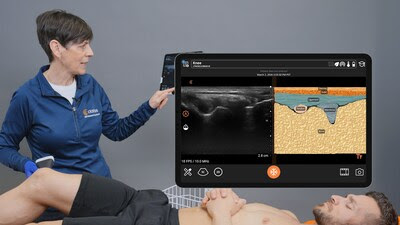
- The “T-Mode” Solution: T-Mode acts as a real-time, AI-powered translation layer. With a single tap during a live exam, the app splits the screen: on one side is the standard grayscale ultrasound, and on the other is an AI-generated, color-coded, labeled “textbook-style” image of the exact same anatomy.
- The Cardiac Use Case: By instantly translating the image, T-Mode Heart allows novice users to confidently identify heart chambers and valves. This is critical for PCPs trying to screen for heart failure in patients presenting with vague symptoms like fatigue or chest discomfort.
- The MSK Use Case: Clarius also launched T-Mode Knee to address one of the most frequent complaints in primary care (knee pain). The AI helps clinicians identify anatomical markers across all planes (anterior, posterior, lateral, medial) to make faster, more accurate referrals to physical therapy or orthopedics.
Decoding the Grayscale
The clinical value of T-Mode lies in its immediacy. When a novice user is scanning a patient’s chest and struggling to differentiate the left ventricle from the right atrium, they simply tap the T-Mode button on the Clarius app.
The screen instantly splits. On one side, the live, standard grayscale ultrasound continues to run. On the other side, an AI algorithm generates a synchronized, color-coded, and fully labeled replica of the anatomy being scanned.
“When teaching, I often point to the left ventricle… and learners sort of nod their heads, but I can see they are not sure if they are truly seeing what I want them to see,” said Dr. Brian Johnson, an emergency physician and ultrasound educator. “With the T-Mode they can learn in real time.”
The Strategic Value to Primary Care
A recent study in the Journal of Primary Care demonstrated that when PCPs are properly trained in cardiac POCUS, they can accurately diagnose serious heart conditions like heart failure—a massive global burden—much earlier in the disease progression. If a patient presents with vague chest discomfort, a PCP with T-Mode can confidently screen the heart rather than blindly referring them to a cardiologist who might have a three-month waitlist.
Similarly, knee pain is one of the most common musculoskeletal (MSK) complaints in a general practice. T-Mode Knee allows a family physician to scan the joint, confidently identify the anatomy, and determine whether the patient needs conservative physical therapy or an immediate orthopedic surgical consult.
